


Related Resources
Data Center Growth in the U.S.: Where Developers Are Building and What It Means for Insurance
Key Takeaways for Enterprise Risk Managers
- Explosive U.S. Growth: The United States had 565 operating data centers and 571 planned projects as of December 2025, with construction spending surging from $1.8 billion in 2014 to $28.3 billion in 2024
- Texas Is the New Frontier: Texas data center power demand reached 9.7 GW in 2025, making it the second-largest state market behind Virginia — and the Stargate, Vantage Frontier, and Tract megasite projects are adding billions in new construction across Abilene, Shackelford County, and Caldwell County
- Regional Concentration Creates Risk: Northern Virginia hosts approximately 4,000 MW of data center capacity, consuming 24% of total regional power — this geographic concentration creates catastrophic aggregation risk that insurers are only beginning to price
- Rural Markets Unprepared: Data center construction is flooding rural Texas and Midwest counties with multi-billion-dollar projects that overwhelm local insurance markets, contractors, and infrastructure capacity
- Insurance Availability Tightening: Carriers are restricting capacity in high-concentration markets and tornado-exposed corridors, making early engagement with specialty brokers critical for developers breaking ground in 2026-2027
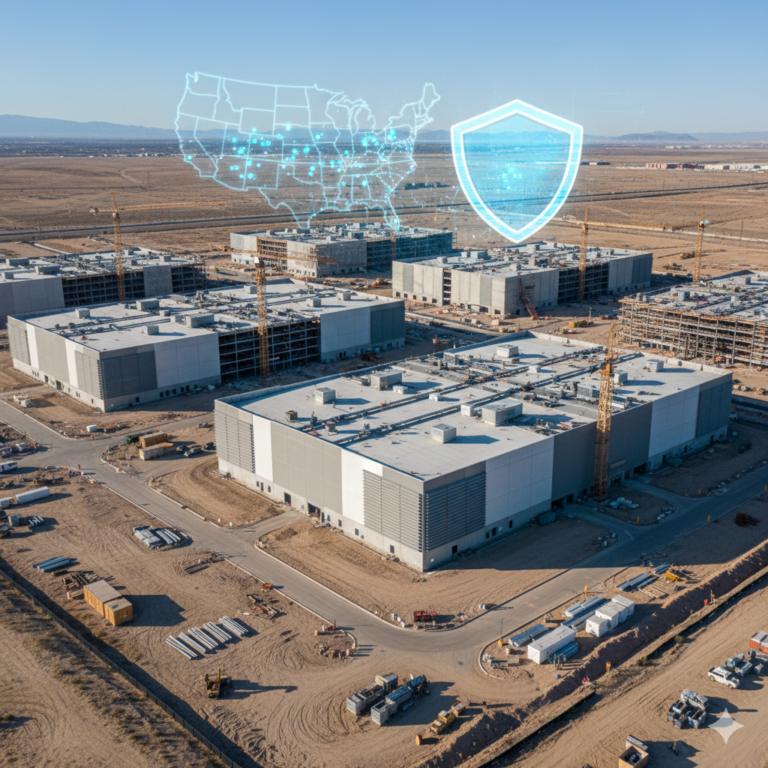
The map of American data center construction looks nothing like it did five years ago. Virginia’s dominance hasn’t faded — Northern Virginia still accounts for more data center capacity than most countries — but the growth vectors have shifted dramatically toward Texas, the Midwest, and the Southeast. Developers are chasing cheap power, available land, and favorable permitting environments. The insurance market is scrambling to keep up.
As of December 2025, Insurance Business Magazine reports that the U.S. has 565 operating data centers and 571 planned projects — meaning the country’s data center footprint is set to nearly double. This isn’t incremental expansion. It’s a complete restructuring of where America’s digital infrastructure lives, and every new site creates a unique bundle of construction, property, liability, and environmental insurance demands.
- Virginia and Texas are the two largest state-level data center markets, with Virginia at 12.1 GW and Texas at 9.7 GW of grid power demand in 2025 according to S&P Global
- Texas data center growth is concentrated across three emerging corridors: Abilene (Stargate flagship), Shackelford County (Vantage Frontier $25B campus), and Caldwell County (Tract 2GW megasite)
- Midwestern states including Ohio, Iowa, and Indiana are attracting hyperscale campuses with abundant power and lower land costs — but these locations sit squarely in tornado-prone regions
- The Southeast corridor spanning Georgia, the Carolinas, and Tennessee is emerging as a growth market, accelerated by the federal government soliciting bids for data centers on DOE land in South Carolina, Tennessee, and Kentucky
- Our licensed advisors track data center development across all major U.S. markets and help contractors, developers, and landowners navigate the insurance requirements specific to each region
Where the Biggest Projects Are Breaking Ground
Texas: Three Corridors, Three Different Risk Profiles
Texas has become the primary expansion market for hyperscale data center developers, and it’s not hard to see why. The state offers abundant land, business-friendly permitting, no state income tax, and proximity to major energy infrastructure. But each Texas corridor presents distinct insurance challenges based on geography, weather exposure, and construction complexity. We cover these in depth in our Texas Data Center Boom Insurance Guide.
For enterprises evaluating exposure in this space, the starting point is understanding what data center operations actually require from an insurance standpoint. Our guide covering what a data center is and why it needs specialized insurance walks through the full coverage architecture — from equipment breakdown to cyber liability — that these facilities demand.
For a broader look at how these coverage considerations fit into a complete risk program, our guide on data center insurance requirements covers the full picture for organizations at this scale.
The speed of construction in Texas is redefining insurance timelines. Crusoe built the first two Stargate buildings in Abilene from ground-up to operational in roughly 12 months — compressing typical builders risk policy periods and creating underwriting challenges that most carriers hadn’t anticipated for data center construction.
- The Stargate flagship campus in Abilene covers 1,100 acres with eight buildings, 4 million square feet, and 1.2GW of power capacity — Phase 1 went live in September 2025, Phase 2 targeted for mid-2026 with a $7.1 billion construction loan from JPMorgan
- Vantage Data Centers’ Frontier campus in Shackelford County represents a $25 billion investment across 1,200 acres with 1.4GW capacity — construction mobilizing 5,000+ workers
- Tract’s Caldwell County megasite near Lockhart encompasses 1,515 acres supporting 2GW+ capacity, with initial power from Bluebonnet Electric Cooperative expected in 2028
- West Texas and Central Texas corridors face hailstorm, tornado, and extreme heat exposures that increase builders risk rates and complicate workers compensation programs during summer construction
- We’re actively helping Houston-area contractors prepare insurance programs that meet the contract specifications flowing from Crusoe, Vantage, and Tract for these unprecedented Texas projects
Northern Virginia: Capacity Constraints Creating Insurance Pressure
Northern Virginia — “Data Center Alley” — remains the world’s largest data center market by total capacity. But the sheer concentration of facilities is creating insurance challenges that newer markets haven’t yet confronted. When 24% of a region’s total power consumption goes to data centers, any grid disruption creates correlated losses across dozens of facilities simultaneously. Insurers call this aggregation risk, and they’re starting to price it.
CleanArc Data Centers announced plans in late 2025 to expand its Northern Virginia hyperscale campus to nearly 1 GW capacity. These announcements barely make headlines anymore in a market that’s been building for two decades. But the insurance implications compound with every new facility added to an already-saturated grid.
- Loudoun County data centers consumed 24% of total regional power in 2023, surpassing residential consumption at 18% — creating grid stability concerns that affect every facility in the market
- Insurance carriers are beginning to limit aggregate exposure in Northern Virginia, declining to add new data center policies to portfolios already concentrated in the region
- Power purchase agreements and behind-the-meter generation solutions are changing the insurance landscape as facilities move away from grid dependency
- Property and business interruption rates in Northern Virginia data center corridors have increased 15-25% over the past two years as carriers reprice aggregation risk
- For developers considering Northern Virginia expansion, early engagement with specialty brokers who can access surplus lines capacity is essential — waiting until construction permits are in hand means competing for limited insurance availability
Related Resources: nonprofit directors officers insurance • does zenni take insurance
Multi-Market Data Center Insurance Strategy
Whether you’re developing in Texas, expanding in Virginia, or evaluating Midwest sites, your insurance program needs to account for regional risk factors including natural catastrophe exposure, grid reliability, and local market capacity. Our licensed advisors serve data center clients across all major U.S. markets from our Houston, Miami, and NYC offices.
Request Multi-Market Insurance ReviewServing developers and operators with $1M+ annual insurance premiums.
The Midwest Gamble: Cheap Power, Tornado Risk
Data center developers have discovered the Midwest’s combination of inexpensive electricity, available transmission capacity, and vast tracts of affordable land. What they haven’t fully reckoned with is the insurance cost of building multi-billion-dollar facilities in Tornado Alley. The industry hasn’t had a major tornado strike a data center yet — but as Bisnow reported, insurance experts say it’s a matter of when, not if.
HUB Executive Vice President Kirk Chamberlain has publicly warned that insurance models were “never really designed for a $20B data center because you don’t typically see $20B of anything sitting in the way of a tornado in the Midwest.” Spring 2026 will be a critical test as a substantial number of megacampuses in the Midwest open or enter active construction during tornado season.
- Ohio, Iowa, Indiana, and Oklahoma are all attracting hyperscale development — each state sitting within established tornado risk corridors that drive catastrophic loss modeling
- ValorC3 claims to have built a tornado-proof data center in Oklahoma with steel blast doors and two layers of concrete, but this approach adds significant construction costs that affect project economics and insurance valuations
- Insurance carriers are applying catastrophe deductibles of 2-5% of total insured value for data centers in tornado-exposed regions — on a $2 billion facility, that’s a $40-100 million deductible before coverage responds
- Wind-resistant construction upgrades reduce premium costs over the facility lifecycle but require upfront investment that developers must factor into project financing
- Our advisors help Midwest data center developers model total cost of risk including construction premiums, catastrophe deductibles, and operational coverage costs specific to tornado-prone locations
Case Study: How Pinnacle Development Group Saved $4.7 Million by Choosing the Right Location
Pinnacle Development Group (name changed for confidentiality) was evaluating three sites for a 200MW colocation campus: a location in central Oklahoma, a site in East Texas, and a property in central Georgia. The CEO had narrowed the choice to Oklahoma based on electricity costs alone — $0.052/kWh versus $0.068/kWh in Georgia and $0.071/kWh in East Texas. On a facility consuming 200MW continuously, that price advantage looked like $28 million in annual savings.
Then we ran the insurance analysis.
- The Oklahoma site’s location in an Enhanced Fujita EF-3+ tornado risk zone added $3.2 million in annual property and builders risk premiums compared to the Georgia location
- Catastrophe deductibles in Oklahoma were set at 3% of total insured value ($54 million retained risk) versus 1% in Georgia ($18 million) — a $36 million difference in first-dollar exposure
- Workers compensation rates for construction trades in Oklahoma exceeded Georgia rates by 22%, adding $1.5 million to the two-year construction-phase insurance program
- The Georgia site’s proximity to multiple fiber routes and redundant grid feeds reduced business interruption premiums by $480,000 annually compared to the more isolated Oklahoma location
- After modeling total cost of risk over a 15-year facility lifecycle, the Georgia site’s insurance savings exceeded the Oklahoma site’s electricity savings by $4.7 million — Pinnacle broke ground in Georgia six months later, and we structured the complete insurance program
How Geographic Choices Affect Every Line of Coverage
Natural Catastrophe Exposure by Region
Every data center location decision is simultaneously an insurance decision. The specific natural catastrophe exposures — hurricane, tornado, earthquake, flood, wildfire — vary dramatically by region and directly determine builders risk rates, property insurance costs, catastrophe deductible structures, and business interruption coverage availability. Developers who evaluate locations purely on power costs and land prices are ignoring the third leg of the financial stool.
Carriers are increasingly sophisticated in modeling data center catastrophe exposure. Unlike traditional commercial real estate, where building replacement cost is the primary concern, data center losses include irreplaceable equipment, extended lead times for specialized components, and business interruption values that can dwarf property damage. A Nvidia GPU rack destroyed by a tornado takes months to replace — and the revenue loss during that replacement period is where the real financial damage occurs.
- Gulf Coast and Southeast locations face hurricane exposure with wind and flood deductibles that can reach 5% of total insured value for coastal facilities
- California sites carry earthquake risk requiring separate policies from specialty carriers, with deductibles typically ranging from 10-15% of insured value
- Mountain West locations face wildfire exposure increasingly difficult to insure as carriers withdraw from fire-prone regions
- Northeast locations offer the lowest natural catastrophe exposure but face higher construction costs, limited land availability, and aging grid infrastructure
- Our team provides total-cost-of-risk modeling for data center developers evaluating multiple locations, incorporating construction-phase insurance, operational coverage, and catastrophe retention analysis across all candidate sites
Grid Reliability and Power Insurance
Grid reliability directly impacts data center insurance in ways most developers underestimate. In ERCOT territory (Texas), the February 2021 Winter Storm Uri exposed the vulnerability of grid-dependent facilities. Now insurers scrutinize backup power capacity, fuel storage, and behind-the-meter generation for every Texas data center submission. Facilities with on-site power generation — natural gas, nuclear, solar, or battery storage — receive materially better insurance terms than those relying solely on grid power.
The trend toward “behind-the-meter” data centers pairing dedicated power sources with computing facilities is creating a new category of insurance risk. These facilities combine the exposures of a power plant with the exposures of a data center — requiring coverage expertise across both energy and technology infrastructure. For Houston-area energy companies considering this model, our Houston energy insurance expertise translates directly to these hybrid facilities.
- ERCOT grid instability premiums add 10-20% to property and business interruption costs for Texas data centers without adequate on-site backup
- Behind-the-meter generation reduces grid dependency premiums but introduces power plant liability, environmental, and equipment breakdown exposures
- Battery energy storage systems (BESS) installed for data center backup create thermal runaway fire risks that require specialized coverage endorsements
- Power purchase agreements (PPAs) with dedicated renewable or nuclear generation can improve insurance terms by demonstrating power supply diversification
- We help data center developers and operators evaluate the insurance implications of their power strategy alongside energy consultants, ensuring coverage programs reflect actual operational risk rather than carrier assumptions about grid reliability
Data Center Site Selection Insurance Analysis
The right location decision can save millions in insurance costs over a facility’s lifecycle. Our licensed advisors provide total-cost-of-risk modeling across candidate sites, helping developers make location decisions informed by catastrophe exposure, grid reliability, and market capacity — not just power costs and land prices.
Request Site Risk AnalysisServing developers with $1M+ annual insurance premiums across all U.S. markets.
What This Means for Contractors and Supply Chain Businesses
The geographic expansion of data center construction creates opportunity for contractors, suppliers, and service businesses in markets that have never seen technology infrastructure projects. But the contract insurance requirements flowing from hyperscale developers are unlike anything most regional contractors have encountered. We explore these requirements in detail in our guide to builders risk coverage for data center construction.
A Houston-based electrical contractor bidding on Stargate subcontracts faces insurance specifications written by corporate legal teams at OpenAI and Oracle. A concrete supplier in Caldwell County needs product liability coverage meeting requirements designed for billion-dollar infrastructure. These aren’t optional — they’re bid qualifiers that determine who gets the work.
- General liability limits on data center construction contracts typically start at $2M per occurrence / $5M aggregate with umbrella requirements of $10M-$25M
- Professional liability is increasingly required for contractors providing design-build services or specialized installations
- Workers compensation must cover all trade classifications present on the jobsite, with experience modification rates (EMR) directly affecting bid competitiveness
- Product liability coverage is essential for equipment manufacturers, material suppliers, and technology vendors providing components to data center projects
- We help contractors across Texas and the Southeast build insurance programs that meet the specific requirements of data center construction contracts — qualification starts with having the right coverage in place before the RFP drops
Frequently Asked Questions
Where are data centers being built in the United States right now? +
The largest concentrations of new data center construction are in Northern Virginia (the established leader), Texas (Abilene, Shackelford County, and Caldwell County corridors), and the Midwest (Ohio, Iowa, Indiana). Emerging markets include Georgia, the Carolinas, and Tennessee, where the federal government is soliciting bids for data centers on DOE land.
Texas has become the fastest-growing state for new data center development, driven by the Stargate AI infrastructure project in Abilene ($500B pipeline), Vantage Data Centers’ Frontier campus ($25B), and Tract’s Caldwell County megasite (2GW+). These projects are reshaping the insurance market for construction and technology infrastructure across the state.
How does data center location affect insurance costs? +
Location dramatically impacts insurance costs through natural catastrophe exposure (hurricane, tornado, earthquake, flood, wildfire), grid reliability, local contractor markets, and insurer aggregation concerns. A data center in tornado-prone Oklahoma may carry catastrophe deductibles of 3-5% of total insured value, while the same facility in Georgia might face only 1% deductibles.
Over a 15-year facility lifecycle, the difference in insurance costs between high-risk and moderate-risk locations can reach tens of millions of dollars. Smart developers model total cost of risk alongside power costs and land prices when making site selection decisions.
Why are insurers concerned about data center aggregation risk? +
Aggregation risk occurs when an insurer has too much exposure concentrated in a single geographic area. In Northern Virginia, where data centers consume 24% of regional power, a single catastrophic event — a major storm, grid failure, or infrastructure disruption — could trigger claims across dozens of insured facilities simultaneously.
Carriers are responding by limiting new capacity in high-concentration markets, increasing catastrophe deductibles, and requiring more detailed risk engineering before binding coverage. This is pushing developers toward newer, less saturated markets — which is partly why Texas and the Midwest are seeing explosive growth.
What insurance do Texas contractors need for data center projects? +
Texas contractors bidding on data center work need commercial general liability ($2M+ per occurrence), workers compensation, commercial auto, umbrella/excess liability ($10M-$25M), and often professional liability and pollution liability. These requirements are set by the prime contract and flow down through subcontract agreements from developers like Crusoe, Vantage, and Tract.
The insurance specifications in data center contracts are written by corporate legal teams at companies like OpenAI, Oracle, and SoftBank. Meeting these requirements before bidding is essential — your insurance program is a bid qualifier, not an afterthought. Our Houston office specializes in helping Texas contractors build compliant insurance programs.
How fast is data center construction growing in the U.S.? +
U.S. data center construction spending surged from $1.8 billion in 2014 to $28.3 billion in 2024 — a fifteen-fold increase in a decade. As of December 2025, the U.S. has 565 operating data centers and 571 planned projects, meaning the national footprint is set to roughly double. McKinsey projects up to $7 trillion in global data center construction spending by 2030.
This growth is generating massive demand for construction insurance products including builders risk, workers compensation, general liability, and wrap-up programs (OCIPs and CCIPs). The insurance industry is building capacity as fast as the data centers themselves, with specialty products like Aon’s $2.5 billion Lifecycle Insurance Program emerging to serve this market.
The concentration of power demand in large campus developments creates underwriting exposure that standard property programs were not designed to address. Our analysis of power infrastructure insurance exposure covers how insurers assess and price this risk.
New supply entering the market requires understanding data center construction insurance costs and requirements — from groundbreaking through commissioning, the coverage needs differ materially from standard commercial construction.
Related Data Center Insurance Resources
See also: our guide on childcare center insurance.
Work With Licensed Enterprise Insurance Advisors
Hotaling Insurance Services specializes in comprehensive insurance programs for data center developers, contractors, and operators across every major U.S. market. Our licensed advisors bring decades of experience structuring coverage for complex construction and technology infrastructure projects.
Credentials & Expertise:
- ✓ Nationally licensed in 50 states
- ✓ $368M in managed premium volume
- ✓ 99.7% client retention rate
- ✓ Partnerships with top-tier carriers (Hartford, Travelers, AIG, Chubb, etc.)
- ✓ Specialized expertise in construction, builders risk, and technology infrastructure insurance
Serving Houston, Miami, and NYC markets. Minimum $1M annual premium.