


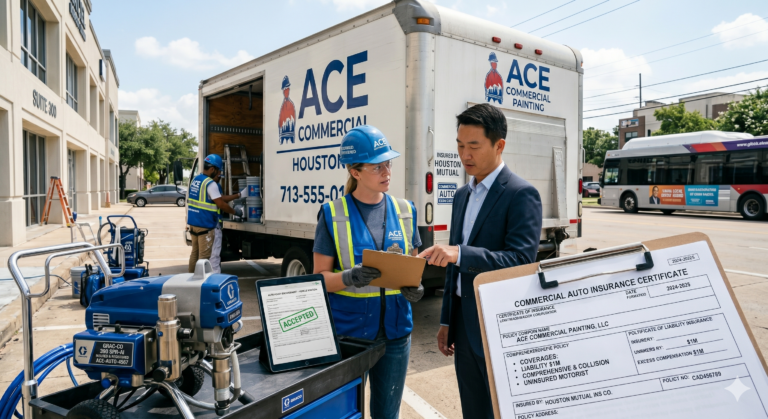
Commercial Auto Insurance for Painting Contractors
A large painting or coatings contractor running a fleet of vans, box trucks, and rigs across multiple states needs a commercial auto program coordinated with its excess tower — not the single-vehicle policy a solo painter buys. For additional guidance, explore our resource on personal umbrella insurance. At fleet scale, auto liability feeds directly into the umbrella that institutional contracts require. For a detailed breakdown of costs and coverage options, see our guide on umbrella insurance costs. We cover this topic in depth in our vendor liability insurance
Key Takeaways
- Fleet liability underlies the umbrella — auto limits set the attachment point.
- Required for business-titled vehicles in nearly every state.
- HNOA covers crews driving personal vehicles between jobs.
- Driver controls (MVR screening, telematics) move fleet premium materially.
- Equipment in transit is inland marine, not auto.
Commercial
- Liability for bodily injury and property damage caused by fleet vehicles.
- Physical damage across owned vans, trucks, trailers, and rigs.
- Hired and non-owned auto for crews using personal or rented vehicles.
- Auto liability limits that serve as the attachment point for the excess tower.
- Driver-safety and telematics programs that carriers credit at fleet scale.
Why Fleet Auto Feeds Your Excess Tower
For a large contractor, commercial auto is not a standalone line — it is one of the underlying policies the umbrella sits above, so its limits and loss history shape the whole program.
- Institutional contracts requiring $5M+ combined limits rely on auto as an underlying layer.
- Poor fleet loss history raises both auto and excess pricing.
- MVR screening and telematics reduce frequency and improve excess terms.
- Consistent limits across auto, GL, and employer’s liability simplify the umbrella placement.
- Personal-auto use by crews creates uncovered gaps that HNOA closes.
Coordinate Fleet and Excess Together
For $1M+ premium contractors, fleet auto and the umbrella have to be structured as one. We align limits, driver controls, and excess attachment.
Premium benchmarks vary by region — our analysis of homeowners insurance for a $400K home provides state-level rate ranges. Learn more about homeowners insurance fundamentals. For more details, see our guide on dock coverage under homeowners insurance.
Tenants often underestimate what they stand to lose — our guide to the benefits of renters insurance covers what the policy protects. For more details, see our guide on whether renters insurance covers car theft.
Liability extends beyond business operations — our guide to personal liability insurance explains individual coverage options. For context on what employees pay out of pocket, see our guides on MRI costs without insurance and chiropractor costs without insurance.
Request a Fleet ReviewSingle-vehicle operators are typically served well by State Farm, GEICO, or Progressive.
How Much Does Commercial Auto Insurance Cost for Painting Contractors?
Commercial auto premiums for painting contractors range from $1,800 to $6,000 per vehicle per year, depending on vehicle type, driver records, coverage limits, and whether you carry hired and non-owned auto (HNOA) coverage for employee-driven personal vehicles. Cargo vans and box trucks carrying spray equipment cost more to insure than pickup trucks because the replacement value is higher and the cargo (compressors, sprayers, solvents) adds liability exposure.
| Vehicle Type | Annual Premium | Key Cost Driver |
|---|---|---|
| Pickup truck (F-150/Silverado) | $1,800–$3,000 | Driver age/record, deductible choice |
| Cargo van (Transit/Sprinter) | $2,500–$4,500 | Higher replacement value, cargo exposure |
| Box truck (14–26 ft) | $3,500–$6,000 | GVW classification, CDL requirement |
| Trailer (equipment hauler) | $300–$800 add-on | Scheduled on the towing vehicle’s policy |
The biggest controllable cost factor is driver records. A single at-fault accident on any driver’s MVR adds 15–30% to the fleet premium at renewal. Two or more and some carriers will non-renew entirely. For painting contractors running 5–15 vehicles, a formal driver qualification program — annual MVR pulls, written safety policy, quarterly ride-alongs — keeps the fleet insurable and earns 5–15% credits from carriers who offer them.
Hired and non-owned auto (HNOA) coverage is the most frequently overlooked piece. If any employee drives their personal vehicle for company business — picking up supplies, running to a job site, meeting a client — and causes an accident, your GL policy does not cover it. HNOA fills that gap and typically costs $200–$500 per year for the entire company. Skipping it to save $400 creates an uninsured exposure on every employee’s commute to a job site.
Frequently Asked Questions
Do large painting contractors need commercial auto? +
Yes. Nearly every state requires it for business-titled vehicles, and for a fleet operation auto liability also serves as an underlying layer for the excess/umbrella tower that contracts require.
How does fleet auto affect umbrella cost? +
The umbrella sits above auto liability, so fleet loss history and limits directly influence excess pricing and attachment. Strong driver controls improve terms on both layers.
What is hired and non-owned auto? +
HNOA covers liability when employees drive personal or rented vehicles for business. For operations with crews dispatching from multiple locations, it closes a gap that owned-vehicle policies miss.
Can telematics lower fleet premium? +
Yes. MVR screening and telematics programs reduce accident frequency, which carriers credit at fleet scale and which improves terms on the excess tower above auto.
I have one work van — is this for me? +
A single-vehicle operation is typically served efficiently by standard carriers such as State Farm, GEICO, or Progressive. This guidance addresses fleet operations within a $1M+ premium program.
Disclaimer: This article is for informational purposes only and does not constitute insurance advice. Consult our licensed advisors for guidance tailored to your operations.
This is part of our complete guide to commercial painting contractor insurance.
Service contractors running fleet vehicles face tools-in-transit gaps that commercial auto policies alone do not cover — see our guide to HVAC contractor insurance costs
Painting contractors working on construction projects need to understand how their coverage fits within the broader insurance requirements — see our guide to construction insurance requirements for contractors for the full landscape.
Painting contractors on construction projects should confirm builders risk coverage protects their installed work — see our breakdown of builders risk insurance pricing for how premiums are calculated.