


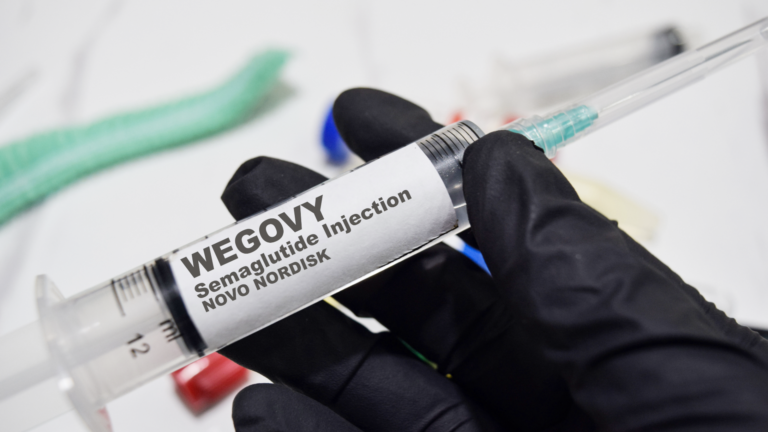
Wegovy is covered by some commercial insurance plans, usually with prior authorization, but many employer plans still exclude weight-loss drugs. In KFF’s 2025 survey, 19% of large employers covered GLP-1s like Wegovy for weight loss, rising to 43% of employers with 5,000 or more workers. With coverage and the Wegovy Savings Card, you can pay as little as $25 a month; without it, the list price is about $1,349 a month, NovoCare’s self-pay price is $349 for the pen and $149 to $299 for the pill, and eligible Medicare Part D members pay $50 through the Medicare GLP-1 Bridge.
Key Takeaways on Wegovy Insurance Coverage
- FDA-approved for weight management: Wegovy (semaglutide 2.4mg) is approved for chronic weight management in adults with BMI ≥30, or BMI ≥27 with at least one weight-related comorbidity
- Commercial coverage depends on employer size: 19% of large employers covered GLP-1s for weight loss in 2025, including 43% of employers with 5,000+ workers, up from 28% in 2024 (KFF)
- Medicare coverage changed in July 2026: Standard Part D plans still exclude drugs prescribed solely for weight loss, but eligible beneficiaries can now get Wegovy for weight management at $50 a month through the Medicare GLP-1 Bridge program
- List price without insurance: Approximately $1,349/month ($16,188/year) at retail pharmacy
- Savings programs available: Novo Nordisk offers a savings card reducing cost to as low as $0-$25/month for eligible commercially insured patients
Wegovy is a once-weekly injectable prescription medication containing semaglutide at the 2.4mg dose, manufactured by Novo Nordisk. The FDA approved it in June 2021 specifically for chronic weight management — making it one of the first GLP-1 receptor agonists with an explicit obesity indication rather than just a diabetes label.
The coverage question is more complicated than it should be. Whether your insurance covers Wegovy depends on three things: the type of insurance you have (commercial vs government), whether your plan’s formulary includes GLP-1 medications for weight loss, and whether you meet the prior authorization criteria your insurer sets. Each of those layers can block access even when the drug is medically appropriate.
Sometimes. Wegovy is covered by insurance when your plan includes weight-loss drugs on its formulary and you meet prior authorization criteria, usually a BMI of 30 or higher, or 27 with a weight-related condition. Many employer plans still exclude anti-obesity drugs. Medicare covers Wegovy under Part D for cardiovascular risk reduction, and since July 1, 2026 eligible beneficiaries can get it for weight management at $50 a month through the Medicare GLP-1 Bridge program.
Is Wegovy Covered by Insurance?
If your commercial plan covers it, the Wegovy Savings Card can bring the cost down to as little as $25 a month. If it doesn’t, NovoCare Pharmacy sells the Wegovy pen to self-pay patients for $349 a month at maintenance doses and $399 for Wegovy HD, and the Wegovy pill starts at $149. The list price is about $1,349 a month.
Prior authorization is where most people get stuck. Expect the plan to ask for your BMI, your weight-related diagnoses and proof of a prior weight-loss attempt, then to re-check your progress after about six months.
| Your coverage | Is Wegovy covered? | What you typically pay per month |
|---|---|---|
| Commercial plan that covers anti-obesity drugs | Yes, with prior authorization | As little as $25 with the Wegovy Savings Card |
| Commercial plan that excludes weight-loss drugs | No | $349 to $399 self-pay for the pen through NovoCare; pill from $149 |
| Medicare Part D, cardiovascular risk reduction | Yes | Plan cost-sharing, capped by the $2,100 Part D out-of-pocket maximum in 2026 |
| Medicare, weight management | Yes, through the GLP-1 Bridge (July 1, 2026 to Dec. 31, 2027) | $50 |
| Medicaid | Varies by state | Depends on the state program |
| No insurance | No | $349 to $399 pen or $149+ pill self-pay; list price about $1,349 |
Sources: NovoCare, Wegovy coverage and Medicare GLP-1 Bridge; Drugs.com (August 2026). Prices change often; confirm before filling.
Is the Wegovy Pill Covered by Insurance?
The Wegovy pill (oral semaglutide), approved by the FDA in December 2025 and launched in January 2026, is covered the same way as the injection: only if your plan covers anti-obesity drugs, and usually with prior authorization. If your plan covers it, the Wegovy Savings Card applies to the pill too.
| How you pay | Wegovy pill (monthly) | Wegovy pen (monthly) |
|---|---|---|
| List price | About $1,349 | About $1,349 |
| Commercial plan that covers it + Savings Card | As little as $25 | As little as $25 |
| NovoCare Pharmacy self-pay | $149 (1.5 mg), $199 (4 mg), $299 (9 mg and 25 mg) | $349 at maintenance doses; $399 for Wegovy HD; new-patient intro pricing may apply |
| Medicare GLP-1 Bridge (eligible Part D) | $50 | $50 |
Self-pay prices are Novo Nordisk’s published NovoCare Pharmacy prices as of September 2026 and change often; confirm at NovoCare before ordering. The Medicare GLP-1 Bridge runs July 1, 2026 through December 31, 2027 for Part D enrollees who meet CMS criteria. The Savings Card is not available with Medicare, Medicaid or other government coverage.
Because the pill is new, some plans haven’t added it to their formulary even when they cover the injection. If your plan covers the pen but not the pill, your doctor can request a formulary exception or prescribe the covered form.
Which Insurance Plans Cover Wegovy?
Commercial (Employer-Sponsored) Insurance
Coverage is expanding but far from universal, and it depends heavily on employer size. In KFF’s 2025 Employer Health Benefits Survey, 16% of firms with 200 to 999 workers, 30% of firms with 1,000 to 4,999 workers and 43% of firms with 5,000 or more workers covered GLP-1s used primarily for weight loss. The trend is clearly upward — driven by employer interest in reducing downstream healthcare costs from obesity-related conditions like diabetes, cardiovascular disease, and joint problems. Self-funded employers pay that cost directly through claims, so many are moving to managed access instead of open coverage, an approach we break down in GLP-1 coverage for self-funded employers in 2027.
When covered, Wegovy typically sits on Tier 3 or Tier 4 (specialty tier) of the formulary. That means higher copays than generic drugs, which vary widely by plan, and almost always a prior authorization requirement. The Wegovy Savings Card can offset much of that copay for eligible commercially insured patients. Your doctor will need to document your BMI, prior weight-loss attempts, and comorbidities before the plan approves the prescription.
Plans that don’t cover Wegovy often have a blanket exclusion for “weight loss medications” or “anti-obesity drugs” in the benefit summary. Check your Summary Plan Description (SPD) or call the number on your insurance card and ask specifically about GLP-1 coverage for obesity.
ACA Marketplace Plans
Coverage varies by state and by plan. ACA plans are not required to cover weight loss medications under the essential health benefits mandate. Some state-based marketplace plans do include GLP-1 coverage; many don’t. Check your specific plan’s formulary before assuming coverage.
Medicare Part D
Standard Medicare Part D plans do not cover Wegovy when prescribed for weight loss, but since July 1, 2026 eligible beneficiaries can get it for weight management at $50 a month through the Medicare GLP-1 Bridge program. Section 1862(a)(1)(A) of the Social Security Act excludes drugs used for “anorexia, weight loss, or weight gain” from Part D coverage. This applies to all Medicare Part D plans, including Medicare Advantage plans with integrated Part D.
There is one exception: if Wegovy is prescribed for a covered indication other than weight loss (the drug has a separate FDA approval for cardiovascular risk reduction in adults with established cardiovascular disease and BMI ≥27), some Medicare plans may cover it under that indication. Your doctor would need to prescribe it specifically for cardiovascular risk reduction, not weight management.
Dental expenses illustrate the out-of-pocket gap — our breakdown of dental cleaning costs without insurance shows what patients actually pay when preventive coverage is missing, and the same gap applies to chiropractor visits and MRI scans.
When Wegovy coverage is denied, patients often pivot to tirzepatide — Mounjaro costs without insurance including deductibles details the full out-of-pocket cost structure for Mounjaro without any plan assistance.
Congressional legislation to allow Medicare coverage of weight loss drugs has been introduced repeatedly but has not passed as of May 2026.
Medicaid
Coverage varies by state. Most state Medicaid programs do not cover weight loss medications, though a growing number are adding GLP-1 coverage as the cost-effectiveness data improves. Check your state’s Medicaid formulary.
How Much Does Wegovy Cost Without Insurance?
Very few people pay the full list price. Here’s what each route costs per month and per year, based on Novo Nordisk’s published pricing as of September 2026.
| Scenario | Monthly Cost | Annual Cost |
|---|---|---|
| Retail price (no insurance) | ~$1,349 | ~$16,188 |
| Commercial plan covers it + Wegovy Savings Card | As little as $25 | As little as $300 |
| NovoCare self-pay, pen (maintenance doses) | $349 | $4,188 |
| NovoCare self-pay, pill | $149–$299 | $1,788–$3,588 |
| Medicare GLP-1 Bridge (eligible Part D) | $50 | $600 |
How Do You Know If Your Insurance Covers Wegovy?
The fastest answer comes from your pharmacy benefit, not your medical plan. Four checks settle it in a day or two.
- Use the coverage checker: Novo Nordisk’s coverage checker on wegovy.com looks up your plan from your insurance card.
- Call the pharmacy benefits number: Ask whether semaglutide (Wegovy pen and pill) is covered for chronic weight management, what tier it sits on, and whether prior authorization or step therapy applies.
- Read the plan documents: Look for “anti-obesity medications” or “weight-loss drugs” in the exclusions section of your Summary Plan Description.
- Ask HR: Employer plans decide whether to cover weight-loss drugs, so your benefits team can confirm the rule and any lifestyle-program requirement.
- Check the indication: Some plans that exclude weight loss still cover Wegovy to reduce cardiovascular risk in adults with established heart disease and obesity or overweight.
What Can You Do If Insurance Won’t Cover Wegovy?
A denial isn’t always final. Ask for the reason in writing, have your doctor appeal or request a peer-to-peer review, and ask whether a formulary exception is possible. If the plan excludes weight-loss drugs entirely, compare NovoCare self-pay, the Medicare GLP-1 Bridge if you’re eligible, and alternatives your doctor considers appropriate.
How To Get Wegovy Covered by Insurance
If your plan covers GLP-1 medications for weight management, here’s the process:
- Confirm formulary coverage: Call the pharmacy benefits number on your insurance card. Ask specifically: “Does my plan cover semaglutide (Wegovy) for weight management?” Get the answer in writing if possible.
- Meet prior authorization criteria: Most plans require documented BMI ≥30 (or ≥27 with comorbidities), evidence of prior weight-loss attempts (diet, exercise, sometimes previous medications), and a prescribing physician who documents medical necessity.
- Have your doctor submit the PA: The prescribing physician’s office submits the prior authorization to your insurer with supporting documentation. Turnaround is typically 3-10 business days.
- Appeal if denied: First-level denials are common and don’t always mean final “no.” A peer-to-peer review between your doctor and the insurer’s medical director overturns many initial denials. Request the specific denial reason in writing.
- Use step therapy if required: Some plans require you to try (and fail) a less expensive weight-loss medication before approving Wegovy. Completing the step therapy requirement — even if the prior medication didn’t work well — satisfies the coverage criteria.
Wegovy Savings Card and Patient Assistance
Novo Nordisk offers a manufacturer savings program that can reduce your out-of-pocket cost dramatically:
- Wegovy Savings Card: For commercially insured patients whose plan covers Wegovy. Reduces your copay to as low as $0 for the first 3 months, then $25/month thereafter. Maximum savings of $500/fill. Not available for Medicare, Medicaid, or government-insured patients.
- NovoCare Patient Assistance Program: For uninsured patients who meet income eligibility criteria (typically ≤400% of federal poverty level). May provide Wegovy at no cost for qualifying patients.
Enroll at wegovy.com or by calling NovoCare at 1-888-809-3942.
Wegovy vs Ozempic vs Mounjaro: Insurance Coverage Compared
| Medication | Manufacturer | FDA Approval | Insurance Coverage |
|---|---|---|---|
| Wegovy (semaglutide 2.4mg) | Novo Nordisk | Weight management + CV risk | Varies by employer (19% of large employers cover GLP-1s for weight loss, KFF 2025); Medicare for CV indication; weight management via GLP-1 Bridge ($50/mo) |
| Ozempic (semaglutide 1.0mg) | Novo Nordisk | Type 2 diabetes only | Widely covered for diabetes; NOT approved for weight loss (off-label use often denied) |
| Mounjaro (tirzepatide) | Eli Lilly | Type 2 diabetes | Widely covered for diabetes; weight-loss coverage expanding via Zepbound brand |
| Zepbound (tirzepatide) | Eli Lilly | Weight management | Newer entry; coverage expanding but less established than Wegovy |
Employee Benefits and GLP-1 Coverage Strategy
For employers evaluating whether to add GLP-1 medications to their benefits plan — or employees navigating coverage denials — Hotaling Insurance Services advises on employee benefits design, pharmacy benefit optimization, and appeals strategy.
Mid-market employers managing complex insurance programs benefit from working with a dedicated employee benefits broker for mid-market companies who can coordinate benefits alongside commercial coverage.
Discuss Benefits OptionsFrequently Asked Questions
Is the Wegovy pill covered by insurance?+
The Wegovy pill is covered only when your plan covers anti-obesity drugs, usually with prior authorization, the same as the injection. Some plans have not yet added the pill to their formulary. With coverage and the Wegovy Savings Card you may pay as little as $25 a month; without coverage, NovoCare self-pay is $149 to $299 a month depending on dose, and eligible Medicare Part D members pay $50 through the Medicare GLP-1 Bridge.
How do I know if my insurance covers Wegovy?+
Use the coverage checker on wegovy.com or call the pharmacy benefits number on your insurance card and ask whether semaglutide is covered for chronic weight management, what tier it is on, and whether prior authorization or step therapy is required. Your employer’s HR team can also confirm whether the plan excludes weight-loss drugs.
Does insurance cover Wegovy for weight loss?+
Some commercial (employer-sponsored) plans cover Wegovy for weight management, typically with prior authorization. In 2025, 19% of large employers covered GLP-1s for weight loss, including 43% of the largest (KFF). Medicare Part D does not cover Wegovy for weight loss, but the Medicare GLP-1 Bridge does, at $50 a month for eligible beneficiaries. Medicaid coverage varies by state. Check your specific plan’s formulary by calling the pharmacy benefits number on your insurance card.
How much does Wegovy cost per month without insurance?+
Wegovy’s list price is approximately $1,349 per month ($16,188 per year). GoodRx and SingleCare coupons typically reduce this to $1,200-$1,350. The Novo Nordisk savings card can reduce the cost to $0-$25/month for commercially insured patients whose plan covers the medication.
Does Medicare cover Wegovy?+
Standard Medicare Part D plans do not cover Wegovy prescribed for weight loss, but since July 1, 2026 eligible beneficiaries can get it for weight management at $50 a month through the Medicare GLP-1 Bridge program. Federal law excludes weight loss drugs from Part D coverage. The only potential exception is if Wegovy is prescribed for cardiovascular risk reduction (its second FDA-approved indication) in patients with established cardiovascular disease and BMI ≥27. Congressional legislation to change this exclusion has been proposed but not enacted as of May 2026.
What is the difference between Wegovy and Ozempic?+
Both contain semaglutide but at different doses and for different indications. Ozempic is approved for type 2 diabetes at doses up to 2.0mg. Wegovy is approved for weight management at 2.4mg — a higher dose. Insurance coverage differs significantly: Ozempic is widely covered for diabetes but often denied for off-label weight loss use. Wegovy has an explicit weight loss indication, which makes it easier to get covered by plans that include anti-obesity medications.
Patients exploring GLP-1 coverage should also review how to get Ozempic covered by insurance for step-by-step guidance on navigating prior authorization and formulary tiers for Ozempic specifically.
How do I appeal a Wegovy insurance denial?+
Request the denial reason in writing from your insurer. Have your prescribing physician submit a letter of medical necessity documenting your BMI, comorbidities, prior weight-loss attempts, and why Wegovy is medically appropriate. Request a peer-to-peer review between your doctor and the insurer’s medical director. If the internal appeal fails, you can file an external appeal with your state’s insurance department. Many initial denials are overturned through this process. Physician groups evaluating coverage options should review our medical malpractice cost breakdown for current specialty-by-specialty pricing.
Disclaimer: This article is for informational purposes only and does not constitute medical, pharmaceutical, or insurance advice. Wegovy is a prescription medication with potential side effects. Consult your healthcare provider before starting any medication. Insurance coverage terms change frequently — verify current coverage with your specific plan. Hotaling Insurance Services is not affiliated with Novo Nordisk.
Employee Benefits and Prescription Drug Strategy
Hotaling Insurance Services advises employers on employee benefits design including pharmacy benefit management, GLP-1 medication coverage strategy, and group health plan optimization. For employees navigating coverage questions, our licensed advisors can help you understand your options.
Contact Us$30.2M in employee benefits premium under management.