


About the cost figures and examples in this article: Any premium ranges, cost figures, or pricing factors discussed here are general market estimates drawn from publicly available industry data and are provided for educational context only. They are not quotes, offers, or guarantees of cost, and they do not reflect the price Hotaling Insurance Services will or can offer for any specific policy. Actual premiums are determined solely by the insurance carrier based on your individual risk profile, coverage selections, claims history, location, and other underwriting factors, and they vary widely from the general ranges described above. Any client scenarios are anonymized, illustrative composites created for educational purposes; they do not depict actual named clients and should not be relied upon as a prediction of results. Nothing in this article constitutes financial, legal, tax, or insurance advice. For pricing and coverage specific to your organization, please request a consultation with our licensed advisors.
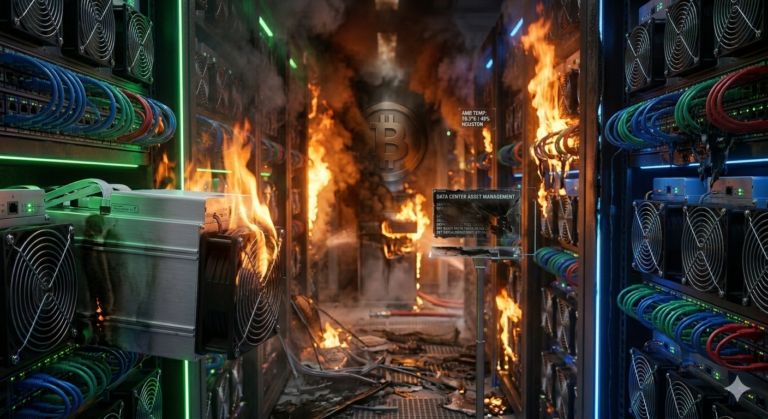
Fire is the single most devastating insured peril in bitcoin mining — and it’s not theoretical. The December 2025 fire at NFN8 Group’s 78,377-square-foot Crystal City, Texas facility cut operational capacity by 50% and contributed directly to Chapter 11 six weeks later. Insurance existed. But payment timing was uncertain enough that the company needed $2.75 million in debtor-in-possession financing just to stay operational while the claim resolved. The fire didn’t bankrupt NFN8. The gap between when they needed the money and when insurance paid it did.
Most operators assume their property policy handles fire. It does — but the coverage mechanics, exclusions, and claims outcomes are more complex than anyone expects until they’re in the middle of one. This guide covers what actually happens: which coverage pays, what prevention reduces your premium, and the specific scenarios that drive the gap between your coverage limit and your actual recovery.
Key Takeaways: Mining Fire Insurance
- Primary Fire Cause: Chafed or overloaded electrical cables at 480V+ — not ASIC hardware failure. The fire starts in infrastructure, not equipment.
- Soot Damage Exceeds Burn Damage: Soot contamination of adjacent equipment can render 3–5× more equipment unusable than direct flame exposure.
- Decontamination vs. Replacement: Professional ASIC restoration costs 40–60% of replacement and completes in weeks — not the 5+ months new ASIC orders require. Your policy must explicitly allow it.
- Container Operations Are Highest Risk: No fire separation, no suppression, 20–45 minute rural Texas response times.
- Prevention ROI: Automatic suppression reduces property premiums 20–30% and estimated total-loss probability by 70–80%.
Why Bitcoin Mining Creates Exceptional Fire Risk
The fire risk profile of a mining facility shares almost nothing with standard commercial property underwriting assumptions. Gen Re’s analysis identifies four primary drivers that create conditions where fires start more easily, spread faster, and cause more secondary damage than equivalent-value operations.
Electrical density runs 3–5× higher per square foot than a data center — every ASIC draws 2,000–5,000 watts continuously with no cyclic relief, driving failure rates on cables and distribution equipment far above rated specs. Most fires start in cable management: CLM Magazine documents 480V feeder cables chafing against metal container walls during Texas thermal expansion, abrading insulation until a hot spot ignites surrounding materials. Rural Texas volunteer fire departments average 20–45 minute response times — long enough for an unsuppressed fire to consume an entire container before anyone arrives.
The NFN8 Group Fire: Coverage Exists. Payment Speed Doesn’t.
The December 2025 NFN8 fire is instructive because it’s well-documented through bankruptcy proceedings. Large property and BI claims in specialty markets take 6–12 months to settle — the insurer investigates cause of loss, verifies equipment values, assesses coverage defenses, and negotiates contested items. NFN8’s BI losses accrued daily at 50% capacity while $0 had been paid. That gap drove the DIP financing and ultimately Chapter 11.
The fix is negotiated at inception. Advance payment provisions (30–50% of estimated loss within 30–60 days) must be in the policy before a fire. Pre-documenting your ASIC inventory, SOV, and BI calculation methodology lets adjustment start immediately. The August 2024 bankruptcy of Rhodium’s Temple, TX operation adds a second data point — treat payment-speed provisions as non-negotiable.
What Fire Coverage Actually Pays — and What It Doesn’t
The Soot and Smoke Problem
Standard “all risk” property insurance covers direct physical loss from fire — but “direct,” “physical,” and “loss” each create complexity for mining claims. For additional guidance, explore our resource on homeowners insurance fundamentals. For additional guidance, explore our resource on homeowners coverage costs. When fire hits one section of a facility, the high-velocity airflow cooling the ASICs distributes soot throughout the entire building. In the CLM Magazine container fire, soot contamination exceeded direct burn damage by 3–4×. For more details, see our guide on homeowners dock protection. Homeowners considering a switch should follow our step-by-step guide to changing homeowners insurance providers to avoid coverage gaps.
Whether contaminated equipment constitutes “direct physical loss” depends on your policy wording — “direct physical loss or damage” covers soot; “physical loss or damage caused by fire” may not. Most purpose-built mining policies use the broader language, but verify before a loss, not after. Specialists like AREPA restore soot-contaminated ASICs via ultrasonic cleaning at 40–60% of replacement cost in 4–8 weeks vs. 5–7 months for new hardware. Your policy must explicitly allow decontamination as an alternative to replacement — “replacement with new equivalent equipment” language can be used to reject restoration claims. Cleaning and janitorial companies have unique exposure — our commercial cleaning insurance guide covers GL, bonding, and employee dishonesty.
Common Exclusions and Sublimits Operators Miss
- Debris removal: Standard sublimits of $25,000–$50,000 are common; clearing a large facility runs $100,000+
- Fire investigation costs: Forensic origin-and-cause investigation costs $15,000–$50,000 and some policies exclude it entirely or count it against the property limit
- Pollutant cleanup: Immersion cooling fluid released by fire is an environmental liability claim, not property — two separate policies, two separate adjustment processes
- Generator fuel fires: Undocumented generator maintenance creates coverage disputes when backup generation is the ignition source
- Intentional acts in multi-owner operations: One owner’s arson can void coverage for all insureds — verify the innocent insured provision if your operation has multiple ownership interests
Review Your Mining Fire Coverage
Our Houston advisors verify soot contamination language, negotiate advance payment provisions, and structure restoration-first coverage for Houston commercial insurance operations.
Request a Coverage ReviewHouston: 713.324.7680 | Specialty mining market access
Fire Prevention: What Underwriters Require
The COPE Assessment
Underwriters score mining fire risk using the COPE framework — Construction, Occupancy, Protection, Exposure. The highest-ROI move is automatic fire suppression: a 20–30% property premium reduction on a $500,000 premium saves $100,000–$150,000 annually. Systems cost $50,000–$200,000 installed with 1–2 year payback. Above $5M TIV, most specialty markets now treat suppression as a minimum requirement — without it, expect declination or E&S placement with higher rates and broader exclusions. Noncombustible construction gets the best rates; combustible structures face 30–50% surcharges. Texas remote locations carry low adjacent exposure — a partial offset to the long fire response time penalty.
Electrical Maintenance: The Most Actionable Prevention Measure
Because most mining fires originate in electrical infrastructure rather than ASIC hardware, electrical maintenance is the most direct prevention measure available. OSHA compliance is the floor — effective operations go well beyond it.
- Annual infrared thermography of all electrical distribution identifies overloaded breakers, loose connections, and degraded cables as anomalous heat signatures before they become fires — cost is $2,000–$8,000/facility, typically recovered in year-one premium savings
- Quarterly cable management audits verify high-voltage cables are secured away from metal edges with no abrasion — the exact failure mode in the CLM Magazine fire
- Load monitoring below 80% of rated capacity on all circuits — continuous 100% loading accelerates insulation degradation faster than visual inspection detects
- Tracked SPD replacement schedules — expired surge protection devices provide zero protection
- Generator maintenance logs with fuel quality testing — deferred maintenance is a recurring cause of generator-origin fires
Business Interruption: The Recovery Timeline
Revenue loss runs from the moment of the fire until full capacity is restored. The most consequential decision happens at days 14–60: decontaminate and restore (4–8 weeks) or procure new hardware (5–7 months). That 90–120 day gap drives the difference between a manageable BI claim and an existential one. Large claims take 6–12 months to reach final settlement — make the restoration call with your adjuster present and your policy language verified before committing.
Frequently Asked Questions
Does my property policy cover all fire damage to my mining equipment? +
Fire is a named covered peril in nearly all property policies, but coverage for mining fire losses often depends on sub-provisions that aren’t obvious: whether soot-contaminated equipment is treated as “physically damaged” under your policy language, whether your policy allows decontamination/restoration as an alternative to replacement, the adequacy of your debris removal sublimit for facility-scale cleanup, and whether your fire investigation costs are covered or come out of your property limit.
The more important question is whether your policy covers fire losses adequately — not just whether fire is a named peril. Verify that your total insured value is current, your deductible doesn’t eliminate recovery on smaller fires, and your BI coverage runs long enough to cover realistic ASIC replacement lead times.
Can soot-damaged ASICs be restored, or do they need to be replaced? +
In most cases, soot-contaminated ASICs can be professionally restored to OEM operational specifications through ultrasonic cleaning, component-level inspection, and targeted replacement of degraded parts. Professional restoration companies can typically restore units at 40–60% of replacement cost. At $3,500 per new unit, a $1,400–$2,100 restoration cost is meaningfully cheaper — and 4–8 week completion vs. 5–7 months for new hardware dramatically reduces business interruption losses.
Not all soot-contaminated units are restorable. Units with direct flame exposure, melted components, or degraded PCB traces should be declared total losses. A qualified vendor can triage your inventory within 48–72 hours. Your adjuster should be involved in this assessment — the decision affects both your property claim and your BI duration. Many drivers with comprehensive policies still wonder whether they need additional protection — our guide on gap insurance with full coverage breaks down when it still applies. For a foundational overview, our complete guide to gap insurance covers what it is, how it works, and who needs it.
Do I need fire suppression systems to get mining insurance? +
For permanent facilities above $5M TIV, most specialty mining markets now treat automatic fire suppression as a minimum requirement, not a premium credit. Operations without suppression face either declination or coverage under limited E&S markets with significantly higher rates and broader exclusions. For container-based operations, suppression requirements vary by market.
Even where suppression isn’t technically required, the premium math strongly favors installation. A 20–30% property premium reduction on a $500,000 annual premium generates $100,000–$150,000 in annual savings. Industrial suppression systems cost $50,000–$200,000 installed — payback is typically 1–2 years. Treat it as a capital expenditure with documented insurance premium ROI.
What electrical standards reduce fire risk and insurance premiums? +
NEC compliance is the regulatory minimum — all mining facilities in Texas are subject to NEC requirements under the Texas Department of Insurance’s electrical safety regulations. But NEC was designed for standard commercial occupancies, not 24/7 100%-load mining operations. Underwriters look for documented practices that go beyond NEC minimums: annual thermographic inspection, cable management protocols preventing abrasion, load monitoring below 80% of rated capacity, and documented SPD replacement schedules.
Documented electrical maintenance reduces equipment breakdown premiums 5–15%. Thermographic inspection costs ($2,000–$8,000 per facility per year) are typically recovered in premium savings within year one — and the prevention benefit of identifying fire precursors far exceeds the insurance savings.
How long does a mining fire insurance claim take to settle? +
For large mining property and BI claims in specialty markets, 6–12 months from loss notification to final settlement is realistic. The process involves fire cause investigation, equipment inventory verification, appraisal of damaged equipment, BI loss calculation (including ERCOT curtailment revenue offsets for Texas operators), and negotiation on contested items. The NFN8 Group case illustrates that confirmed coverage doesn’t prevent payment timing from forcing DIP financing.
Operators accelerate resolution by maintaining current off-site-backed equipment inventories and SOVs, engaging a mining-specialist public adjuster, negotiating advance payment provisions at inception, and pre-agreeing BI calculation methodology with their insurer. Pre-loss preparation is the only reliable way to compress adjustment timelines.
Disclaimer: This article is for informational purposes only and does not constitute insurance, legal, or financial advice. Bitcoin mining fire insurance coverage, claims outcomes, and prevention requirements vary significantly by policy, carrier, and facility characteristics. The NFN8 Group and other case references are based on publicly available information. Consult with our licensed insurance advisors for analysis specific to your facility’s fire risk profile and coverage needs.
Protect Your Mining Operation Against Fire Risk
Hotaling Insurance Services structures mining fire coverage with the provisions that matter most at claim time: restoration coverage that allows ASIC decontamination as an alternative to replacement, advance payment provisions that prevent the NFN8 scenario, and suppression-credited rates that reward your fire prevention investment. Our Houston advisors have active relationships with specialty markets that understand mining fire risk.
- ✓ Soot contamination coverage verified in your policy language
- ✓ Restoration vs. replacement coverage options negotiated upfront
- ✓ Advance payment provision negotiation for large programs
- ✓ Fire suppression premium credits documented and applied
- ✓ Houston: 24 Greenway Plaza, Suite 800 | 713.324.7680
info@hgfin.net | Serving Texas mining operations from Houston