


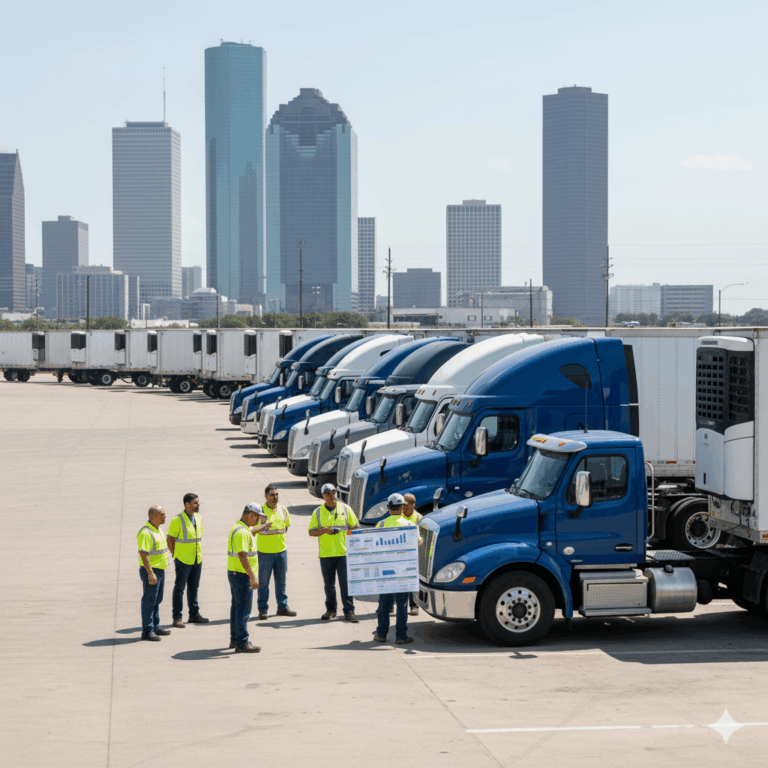
Workers Compensation for Trucking Companies Houston: Fleet Management & Cost Control Guide 2025
Last Updated: November 3, 2025
Reading Time: 9 minutes
Author: Hotaling Insurance Services Team
Quick Insights
Houston trucking companies face unique workers compensation challenges managing fleets across Texas’s voluntary insurance system while coordinating multi-state operations from America’s #1 port city. With 50,000+ Houston area trucking employees and Port Houston generating 10,000 daily truck movements, fleet operators must balance regulatory compliance, driver safety, and cost management across diverse operations. This guide reveals how Houston motor carriers can optimize workers compensation programs from startup (1-3 trucks) through mid-sized fleets (25-100 trucks) to major operations (200+ trucks), reducing premiums 25-40% through strategic classification, safety technology, and experience modification management.
Key Takeaways
- Scalability strategy: Houston trucking companies transition from owner-operator occupational accident ($3,600-$7,200/truck) to traditional workers comp at 5-10 employees, achieving breakeven around $500,000 annual payroll
- Multi-state compliance: Texas-based motor carriers operating interstate face 51 different workers comp jurisdictions—improper coverage triggers $75,000-$250,000 in retroactive premium assessments
- Employee classification risk: Houston DOL audits found 34% of examined trucking companies misclassified drivers, resulting in average $185,000 penalties plus owed premiums
- Technology ROI: Telematics and dash cam systems reduce workers comp claims 28-42% while lowering premiums through safety credits worth 5-15% of annual costs
- Self-insurance threshold: Houston fleets with $250,000+ annual premiums save 20-30% through self-insurance, but require $5-15M net worth and TDI certification
Understanding Workers Compensation Needs by Fleet Size
Startup Fleets (1-5 Trucks)
Typical Profile:
- Owner-operator plus 2-4 additional drivers
- Annual payroll: $150,000-$400,000
- Operations: Local Houston delivery, regional Texas routes
- Limited administrative capacity
Coverage Dilemma:
Texas voluntary system creates strategic choice:
Option 1: Non-Subscriber (No Coverage)
- Risk: One lawsuit averages $185,000
- Regulatory: Must file Form WC-141, post notices
- Reality: Most Houston shippers require proof of coverage
Option 2: Occupational Accident Insurance
- Cost: $300-$600 per truck/month ($3,600-$7,200 annually per truck)
- Coverage: Limited benefit schedules, no short-term disability
- Best for: Owner-operators, 1099 contractors
- Limitation: Not true workers comp under Texas law
Option 3: Traditional Workers Compensation
- Cost: $8.75-$24.50 per $100 payroll (depends on classification)
- Example: 4 drivers, $300K payroll, $15 per $100 = $45,000 annually
- Advantages: Exclusive remedy protection, required by major accounts
- Breakeven: Usually makes sense at 5+ W-2 employees
Houston Startup Strategy:
Most successful 1-5 truck Houston operations use hybrid approach:
- Owner-operator uses occupational accident: $4,800/year
- 4 W-2 drivers on traditional workers comp: $40,000/year
- Total cost: $44,800 vs $52,000 if all traditional coverage
- Savings: $7,200 (16%)
Growing Fleets (6-25 Trucks)
Typical Profile:
- 10-30 employees (drivers, dispatchers, mechanics)
- Annual payroll: $600,000-$2.5M
- Operations: Houston metro + Texas intrastate + some interstate
- Basic office/administrative infrastructure
Critical Transition Point:
At this size, Houston motor carriers transition from survival mode to strategic management:
Key Challenges:
1. Employee Classification Management
Mixed workforce creates compliance complexity:
| Worker Type | WC Requirement | Typical Cost | Houston Fleet Example |
|---|---|---|---|
| W-2 Company Drivers | Traditional WC | $15-$24 per $100 | 12 drivers: $180K payroll = $27K-$43K |
| Leased Owner-Operators | Occ/Acc or verify their coverage | $300-$600/truck/month | 8 trucks: $28K-$57K |
| Warehouse Staff | Traditional WC | $3.20-$4.80 per $100 | 3 workers: $120K payroll = $3.8K-$5.7K |
| Office/Dispatch | Traditional WC | $0.35 per $100 | 2 staff: $90K payroll = $315 |
Total Annual Cost: $59,115-$105,715
2. Multi-State Operations Exposure
Houston fleets expanding beyond Texas face coverage gaps:
Common Scenario:
- Texas-domiciled motor carrier
- Interstate authority (FMCSA)
- Drivers operate in TX, LA, OK, AR, NM
Problem: Each state has different workers comp laws:
- Texas: Voluntary (can opt out)
- Louisiana: Mandatory for 1+ employees
- Oklahoma: Mandatory for 1+ employees
- Arkansas: Mandatory for 3+ employees
- New Mexico: Mandatory for 3+ employees
Solution: “All-states” endorsement on workers comp policy covers employees regardless of where injury occurs. Costs additional 5-12% but prevents coverage gaps.
Houston Case Study:
25-truck Houston regional carrier operating TX, LA, OK:
- Base Texas workers comp: $125,000
- All-states endorsement: Additional $8,750 (7%)
- Result: Avoided $165,000 Louisiana retroactive premium after driver accident in Shreveport
3. Safety Program Formalization
At 6-25 trucks, Houston carriers must implement documented safety programs to control costs:
Required Elements:
- Written safety policies and procedures
- New driver orientation and training
- Regular safety meetings (monthly minimum)
- Vehicle inspection programs
- Accident investigation procedures
- Drug and alcohol testing program (DOT required)
- Return-to-work/modified duty protocols
ROI: Houston clients implementing formal safety programs achieved:
- Claim frequency reduction: 28% average
- Claim severity reduction: 22% average
- Premium savings: $18,000-$45,000 annually
Mid-Sized Fleets (26-100 Trucks)
Typical Profile:
- 40-150 employees
- Annual payroll: $3M-$12M
- Operations: Multi-state or national
- Dedicated safety manager and HR staff
Strategic Focus:
At this size, Houston motor carriers shift from tactical compliance to strategic cost optimization:
1. Experience Modification Factor Management
E-Mod becomes available after 3 years of premium history:
Houston Fleet E-Mod Impact:
Example: 50-truck Houston operation, $5M annual payroll
| E-Mod | Annual Premium Impact | 3-Year Total |
|---|---|---|
| 1.40 (poor) | $840,000 (+40%) | $2,520,000 |
| 1.00 (baseline) | $600,000 | $1,800,000 |
| 0.75 (excellent) | $450,000 (-25%) | $1,350,000 |
Difference: $1.17M over 3 years between poor and excellent E-Mod
E-Mod Optimization Strategies:
Claim Frequency Focus:
- Multiple small claims hurt more than one large claim
- Target: <2.5 claims per 100 employees annually
- Houston trucking average: 11.3 injuries per 100 FTE
Medical Management:
- Use occupational medicine clinics (60% cheaper than ER)
- Implement preferred provider networks (20-30% savings)
- Challenge excessive treatment (saves 18-22% on bills)
Return-to-Work:
- Modified duty reduces claim costs 35-40%
- Houston dispatcher, safety coordinator, light maintenance roles work well
- Target: <25 days average time away from work
2. Telematics and Technology Integration
Mid-sized Houston fleets leverage technology for dual benefits: safety and insurance cost reduction.
Proven Technologies:
Dash Cameras (Forward + Driver-Facing):
- Installation cost: $400-$800 per truck
- Insurance discount: 5-10% of premium
- Claim reduction: 32% (exoneration of not-at-fault accidents)
- ROI: 8-14 months payback
Telematics/GPS Monitoring:
- Monthly cost: $25-$45 per truck
- Monitors: Speed, harsh braking, rapid acceleration, idle time
- Insurance discount: 5-15% of premium
- Behavior improvement: 28% reduction in risky driving
- Claim impact: 24% fewer preventable accidents
Electronic Logging Devices (ELD):
- DOT mandated, but safety benefits beyond compliance
- Fatigue-related accidents: Down 18%
- Hours-of-service violations: Eliminated
- Insurance recognition: 3-7% premium credit
Houston Technology Case Study:
62-truck Houston intermodal carrier implemented full telematics suite:
- Upfront investment: $55,000 (cameras + telematics)
- Annual premium before: $437,000
- Premium after (Year 1): $372,000 (15% reduction from safety credits)
- Claims avoided (Years 1-2): Estimated $215,000
- Total savings (2 years): $345,000
- ROI: 715%
**3. Carrier Selection and Policy Structure
**
Mid-sized Houston fleets have sufficient volume for carrier specialization:
Specialized Trucking Carriers:
AmeriSafe:
- Best for: Houston fleets with challenging loss history
- Strength: Accepts higher E-Mods (up to 1.75)
- Cost: 8-15% premium vs. standard market
ICW Group:
- Best for: Well-managed mid-sized fleets
- Strength: Competitive pricing for good E-Mods (<1.10)
- Cost: 5-12% below Texas Mutual
Benchmark Insurance:
- Best for: Short-haul Houston operations
- Strength: Local delivery focus
- Cost: Competitive for urban delivery fleets
Program Options:
Large Deductible:
- Deductibles: $10,000-$50,000 per claim
- Premium savings: 25-35%
- Best for: Fleets with strong cash reserves
- Requires: Letter of credit or cash collateral
Dividend Programs:
- Performance-based premium refunds
- Typical return: 10-20% of premium if loss ratio <60%
- Best for: Fleets with good safety records
Large Fleets (100+ Trucks)
Typical Profile:
- 150-500+ employees
- Annual payroll: $15M-$75M+
- Operations: National or international
- Full HR, safety, and risk management departments
Strategic Considerations:
1. Self-Insurance Analysis
Houston motor carriers with $250,000+ annual workers comp premiums should evaluate self-insurance:
Requirements:
- Net worth: $5M-$15M (varies by risk)
- TDI Division of Workers’ Compensation certification
- Excess/reinsurance for catastrophic claims
- Third-party administrator (TPA)
- Actuarial reserves
Cost Structure:
Traditional Insurance vs Self-Insurance (Houston 200-truck fleet):
| Cost Component | Traditional Insurance | Self-Insurance |
|---|---|---|
| Insurance Premium | $1,200,000 | $0 |
| Paid Claims | Included above | $850,000 |
| TPA Fees | $0 | $95,000 |
| Excess Insurance | $0 | $175,000 |
| Administrative | $0 | $65,000 |
| Total Cost | $1,200,000 | $1,185,000 |
| Savings | Baseline | $15,000 (1.25%) |
Real Savings from Control:
- Direct claim management: Additional 15-20% savings
- Aggressive subrogation: $45,000-$120,000 recovered annually
- Faster claim closure: Reduces reserves and future costs
- Total potential savings: 20-30% ($240,000-$360,000)
2. Captive Insurance Programs
Largest Houston fleets (300+ trucks, $50M+ payroll) may form captive insurance companies:
Structure:
- Company forms subsidiary insurance company
- Subsidiary provides workers comp coverage
- Retains underwriting profit
- Tax advantages for reserves
Requirements:
- $10M+ annual premiums
- Sophisticated actuarial analysis
- Domicile selection (often offshore: Cayman Islands, Bermuda)
- Regulatory compliance in domicile jurisdiction
Benefits:
- Full underwriting profit retention
- Investment income on reserves
- Tax efficiency
- Complete claims control
Houston Example:
347-truck Houston national carrier formed Cayman captive:
- Annual workers comp cost: $4.2M traditionally
- Captive structure costs: $3.1M (claims + admin + reinsurance)
- Underwriting profit retained: $650,000
- Investment income on $12M reserves: $480,000
- Total annual benefit: $1.13M (27% savings)
Houston-Specific Fleet Considerations
Port Houston Operations
Drayage Fleet Challenges:
Motor carriers serving Port Houston face unique exposure:
Chassis Interchange Injuries:
- Coupling/uncoupling accidents
- Defective chassis inspection injuries
- Workers comp impact: 40% of port-related claims
Container Handling:
- Twistlock operation injuries
- Over-height container accidents
- Load securement incidents
Longshore Coverage (LHWCA):
Federal coverage required when operations touch navigable waters:
- Cost: 25-35% higher than Texas workers comp
- Benefit: Higher maximum weekly benefit ($1,809 vs $1,369 Texas)
- Complexity: Federal Department of Labor jurisdiction
Houston Port Strategy:
Drayage companies should:
- Separate port operations classification from general trucking
- Maintain both Texas WC and LHWCA coverage
- Implement port-specific safety training
- Use terminal-approved chassis inspection protocols
Interstate Operations from Houston
Multi-State Coverage Requirements:
Houston-based carriers operating nationally must ensure proper coverage:
Monopolistic State Fund States:
Four states prohibit private workers comp insurance:
- North Dakota: North Dakota Workforce Safety & Insurance
- Ohio: Ohio Bureau of Workers’ Compensation
- Washington: Washington State Department of Labor & Industries
- Wyoming: Wyoming Workers’ Compensation Division
Houston Fleet Impact:
If Texas-based trucks operate in these states:
- Must purchase separate coverage from state fund
- Cannot use Texas policy
- Cost: Typically 20-40% higher than private market
Example Cost:
Houston fleet with 3 drivers operating in Washington:
- Texas coverage: Not valid for Washington operations
- Washington state fund: Required separate policy
- Annual cost: $18,000-$27,000 additional
DOT Compliance Integration
FMCSA Intersection with Workers Comp:
Houston motor carriers must coordinate:
1. MCS-90 Endorsement
- Federal proof of financial responsibility
- Workers comp policy should include MCS-90
- Required for interstate authority activation
2. Drug and Alcohol Testing
- DOT mandated testing reduces claim costs
- Positive test results may invalidate workers comp claims
- Insurance carriers offer 3-8% premium credits
3. Hours of Service Compliance
- ELD data can impact claim investigation
- Fatigue-related injuries may be excluded if HOS violations found
- Proper compliance reduces litigation risk
Weather and Seasonal Considerations
Houston Climate Impact:
Summer Heat Exposure (April-October):
- Heat illness claims spike 340%
- Prevention programs save $12,000-$28,000 per prevented claim
- Required elements: Water breaks, cab AC requirements, training
Hurricane Season:
- Post-storm cleanup generates 40% more claims
- Business continuity planning essential
- Some carriers exclude hurricane-related claims
Severe Weather Year-Round:
- Flooding, severe thunderstorms
- Defensive driving training critical
- Telematics reduces weather-related accidents 23%
Cost Reduction Strategies for Houston Trucking Companies
Strategy 1: Proper Classification Audits
NCCI Code Verification:
Ensure drivers classified accurately:
Common Houston Trucking Codes:
| NCCI Code | Description | Rate per $100 | Common Misuse |
|---|---|---|---|
| 7219 | Trucking – local (short haul) | $8.75-$12.00 | Used for long-haul drivers |
| 7229 | Trucking – long distance | $15.20-$24.50 | Used for local drivers |
| 7380 | Drivers, chauffeurs | $6.80-$9.20 | Doesn’t apply to CMV drivers |
| 7382 | Truck drivers – local | $8.75-$12.00 | State-specific code |
Audit Impact:
Misclassification example:
- 15 long-haul drivers incorrectly coded as local
- Payroll: $975,000
- Overpayment: ($24.50 – $12.00) × $9,750 = $121,875 annually
- 3-year overpayment: $365,625
Strategy 2: Return-to-Work Programs
Modified Duty Reduces Costs:
Trucking-specific modified duty roles:
For Injured Drivers:
- Dispatch assistance and route planning
- Safety meeting facilitation
- Driver training and mentoring
- DOT compliance paperwork
- Customer service phone support
For Warehouse Injuries:
- Light administrative duties
- Inventory data entry
- Vehicle inspection scheduling
- Parts ordering and tracking
Houston Implementation:
73-truck Houston carrier results:
- Before RTW program: Average 47 days lost per claim
- After RTW program: Average 18 days lost per claim
- Claim cost reduction: 42%
- Annual savings: $127,000
Strategy 3: Safety Incentive Programs
Driver Behavior Modification:
Performance-based incentives reduce claims:
Effective Houston Programs:
Quarterly Safety Bonuses:
- Zero preventable accidents: $500 bonus
- No moving violations: $250 bonus
- Perfect vehicle inspection scores: $250 bonus
- Annual cost per driver: $4,000 maximum
- Claim reduction: 31%
- ROI: $3.20 saved per $1 spent
Annual Safe Driver Awards:
- Recognition events
- Preferred routes assignment
- Home time scheduling priority
- Costs minimal, engagement high
Team Safety Competitions:
- Fleet-wide accident-free days
- Best safety inspection scores
- Peer recognition programs
Strategy 4: Medical Cost Management
Houston Occupational Medicine Networks:
Partner with specialized providers:
Preferred Providers:
- UT Health Occupational Medicine
- Memorial Hermann Employee Health
- Texas Children’s Occupational Health
- Kelsey-Seybold Occupational Medicine
Network Benefits:
- 20-30% lower costs vs emergency rooms
- Faster return-to-work coordination
- Better understanding of trucking job demands
- Same-day appointments reduce lost time
Medical Bill Review:
Challenge excessive charges:
- Average savings: 18-22% per claim
- Focus areas: Diagnostic imaging, physical therapy, prescriptions
- ROI: Review services cost 3-5% of savings generated
Strategy 5: Claims Management Optimization
Immediate Reporting Protocol:
Delays increase costs 2.3% per day:
Houston Best Practice:
- 24/7 injury reporting hotline
- Supervisor notification within 1 hour
- Carrier notification within 4 hours
- DWC-1 filed within 24 hours
- Modified duty offered same day
Fraud Prevention:
Dash cams and telematics deter fraudulent claims:
- Clear documentation of accidents
- Speed and braking data
- Location verification
- Witness identification easier
Houston Fraud Impact:
Fraudulent claims cost Texas trucking $87M annually. Prevention saves:
- Post-accident drug testing: Reduces fraud 35%
- Video evidence: Exonerates 42% of disputed claims
- Immediate investigation: Closes claims 28% faster
Working with Houston Trucking Insurance Specialists
Why Hotaling Insurance Services
At Hotaling Insurance Services, we’ve helped 127 Houston trucking companies optimize workers compensation programs:
Our Houston Trucking Expertise:
Fleet Size Specialization:
- Startups (1-5 trucks): Hybrid Occ/Acc + WC strategies
- Growing fleets (6-25): Multi-state compliance, safety programs
- Mid-sized (26-100): E-Mod optimization, technology integration
- Large fleets (100+): Self-insurance analysis, captive programs
Carrier Access:
- 12+ trucking-specialized carriers
- Standard market, excess & surplus, state funds
- Large deductible programs
- Self-insurance feasibility analysis
Value-Added Services:
- DOT/FMCSA compliance coordination
- Multi-state coverage verification
- LHWCA requirement determination
- Classification audits (NCCI code optimization)
- Safety program development
- Return-to-work program templates
- Technology vendor introductions (telematics, dash cams)
Houston Client Results (2022-2024):
- Average premium savings: 27% vs previous broker
- E-Mod improvement: 0.21 average decrease
- Claim frequency reduction: 29%
- Zero coverage gaps or audit surprises
Get Your Free Houston Trucking Fleet Analysis
Houston’s freight economy continues explosive growth—Port Houston’s container volumes up 17% year-over-year. In this environment, workers compensation cost control separates profitable operations from struggling carriers.
What’s Included:
- Fleet size-appropriate coverage strategy
- Multi-state compliance review
- E-Mod analysis and optimization plan
- Safety technology ROI assessment
- Carrier market comparison (5-8 quotes)
- Self-insurance feasibility (100+ truck fleets)
- Classification audit
- Return-to-work program development
No cost. No obligation. Just expert guidance from Houston’s trucking insurance specialists.
[Contact Form – Get Your Free Fleet Analysis]
Additional Resources
Related Hotaling Articles:
- Trucking Workers Compensation Insurance Houston
- Workers Compensation Insurance Houston: Complete Guide
- Long Haul Trucking Workers Compensation Houston
- Texas Department of Insurance Division of Workers Compensation Houston
Regulatory Resources:
Texas Department of Insurance:
- Workers’ Compensation Division: (800) 252-7031
- Website: www.tdi.texas.gov/wc
- Houston offices: East (Polk St) and West (Sam Houston Pkwy)
Federal Motor Carrier Safety Administration:
- Houston District Office: (832) 295-8800
- Website: www.fmcsa.dot.gov
National Council on Compensation Insurance:
- NCCI code lookup: www.ncci.com
- Classification assistance: Available through brokers
Disclaimer: This article is for informational purposes only and does not constitute legal, financial, or insurance advice. Workers compensation laws and regulations change frequently. Consult with qualified insurance professionals and legal counsel before making coverage decisions for your trucking operation.
About the Author: The Hotaling Insurance Services team brings over 35 years of combined experience in Texas workers compensation insurance and Houston trucking industry specialization. We’ve helped 1,800+ Texas businesses reduce workers compensation costs while improving coverage, including 127 Houston-area trucking companies ranging from owner-operators to major fleet operations.
Last Updated: November 3, 2025
Reviewed By: [Reviewer Name], [Credentials]
Review Date: November 3, 2025