


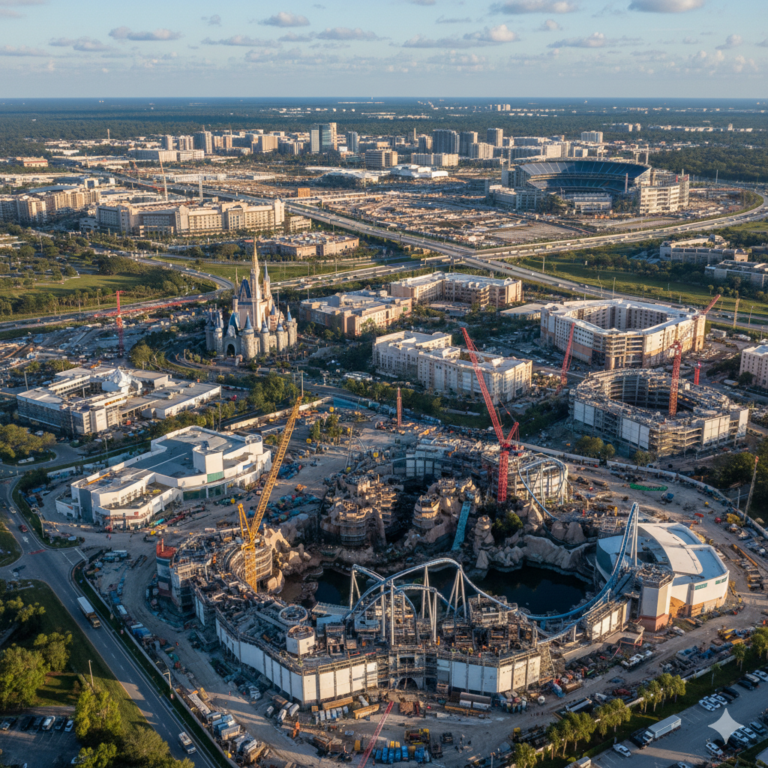
Florida Mega-Development Boom Insurance Guide: Coverage for Contractors and Developers Around Disney’s $17B Expansion, Epic Universe, and the Tropicana Field Redevelopment
Key Takeaways for Florida Contractors and Developers
- Orlando Construction Pipeline Exceeds $30 Billion: Disney’s $17B expansion across 17,000 acres and Universal’s Epic Universe (opened May 2025 with expansion already underway) are driving the largest sustained construction cycle in Central Florida history
- St. Pete’s 86-Acre Opportunity: The Tropicana Field site has attracted 9 redevelopment proposals including a $6.8B mixed-use vision, with $60M in stadium repairs already underway for the 2026 Rays season
- Hurricane Season Risk Is Real: Hurricane Milton shredded Tropicana Field’s roof in October 2024 — every contractor and developer in Florida needs catastrophe-rated builders risk and business interruption coverage
- Disney’s Buy-Local Mandate: The $17B development agreement requires at least 50% of construction goods and services from Florida businesses — creating massive opportunity for in-state contractors with qualifying insurance programs
- Theme Park Construction Is Specialized: Building attractions, show buildings, and immersive environments requires contractors with entertainment-specific insurance covering ride systems, special effects, and proprietary technology
Florida is building at a pace that makes the mid-2000s construction boom look modest. In Orlando, Disney has locked in a $17 billion development agreement covering 17,000 acres over 15 years while Universal’s Epic Universe — which opened in May 2025 — is already filing permits for Phase 2 expansion. Across the state in St. Petersburg, the 86-acre Tropicana Field site has attracted nine redevelopment proposals with visions ranging from $6.8 billion mixed-use districts to convention centers. For Florida contractors and developers, the question isn’t whether there’s work — it’s whether your insurance program can keep pace with the scale.
We work with Florida contractors scaling from regional residential and commercial work into the mega-development tier. The jump from building strip malls to bidding Disney Imagineering subcontracts or Tropicana Field infrastructure work requires an insurance program that satisfies completely different contract specifications, carrier requirements, and regulatory frameworks.
- Disney’s CFTOD development agreement commits to an initial $8 billion in capital investment over the first 10 years, with projects already underway including the Tropical Americas expansion at Animal Kingdom and Beyond Big Thunder Mountain at Magic Kingdom
- Epic Universe’s four immersive lands opened May 2025, and Universal filed a 150,000-square-foot construction permit in November 2025 — suggesting rapid Phase 2 expansion potentially including a Wizarding World of Harry Potter addition
- The Tropicana Field stadium renovation — a $60 million project led by Hennessy Construction Services and AECOM Hunt — is on track for the Rays’ April 2026 Opening Day, while the larger 86-acre site redevelopment enters the proposal evaluation stage
- Disney’s development agreement requires at least 50% of construction goods and services to come from Florida-based businesses, creating a contractual preference for in-state contractors who meet insurance qualifications
- Florida’s hurricane exposure — demonstrated by Milton’s destruction of the Tropicana Field roof in October 2024 — makes catastrophe-rated insurance coverage essential for every construction project in the state
Related Resources: does zenni take insurance
Related: Mounjaro prescription savings
Florida Mega-Development Insurance Assessment
Our Miami-licensed advisors structure insurance programs for Florida contractors and developers scaling into theme park construction, stadium renovation, and mixed-use mega-development projects. We understand Florida’s hurricane exposure, construction defect liability landscape, and the specialized requirements of entertainment and hospitality construction.
Request Florida Construction ConsultationServing Florida contractors and developers with $1M+ annual insurance premiums.
Disney’s $17 Billion Expansion: What Contractors Need to Know
Disney’s development agreement with the Central Florida Tourism Oversight District isn’t a single project — it’s a 15-year framework that authorizes construction across 17,000 acres of Disney-owned property. New theme park lands, up to 13,000 additional hotel rooms (bringing the total to 53,000), expanded retail and dining, potentially a fifth theme park, and two new water parks. The first $8 billion is committed within the first decade.
For Florida contractors, the 50% buy-local requirement is the critical detail. Disney is contractually obligated to source at least half of its design, development, and construction goods and services from Florida businesses. That’s potentially $8.5 billion in Florida contractor revenue over 15 years — but only for firms whose insurance programs meet Disney’s vendor qualification standards.
- Active Disney construction projects include Tropical Americas at Animal Kingdom (opening 2027), Cars and Villains lands at Magic Kingdom, Monsters Inc. Land at Hollywood Studios, and multiple hotel renovations spanning through 2027
- Disney’s construction vendor prequalification requires comprehensive insurance including GL ($2M+ per occurrence), workers comp, commercial auto, professional liability for design-build scopes, and umbrella coverage typically starting at $10M
- Theme park construction involves proprietary ride systems, animatronics, special effects, and immersive technology that standard construction insurance policies may exclude — endorsements or specialty policies are required
- Disney mandates specific additional insured language, waiver of subrogation, and primary/non-contributory coverage terms that must be in place before contractor mobilization
- Construction defect liability in Florida has a 10-year statute of repose — your completed operations coverage needs to extend well beyond project completion
Epic Universe and Universal’s Expansion Pipeline
Universal Orlando’s Epic Universe opened in May 2025 with four immersive lands — Super Nintendo World, How to Train Your Dragon, Wizarding World of Harry Potter – Ministry of Magic, and Universal Monsters. The park immediately became Orlando’s hottest attraction, and Universal wasted no time planning what comes next. A 150,000-square-foot construction permit filed in November 2025 and additional land acquisitions signal Phase 2 is moving fast.
Universal’s construction approach differs from Disney’s — they tend to announce projects after construction is already underway rather than generating years of pre-construction hype. For contractors, this means being prequalified and insurance-ready before opportunities are announced, because the bidding timeline will be compressed.
- Epic Universe’s expansion permits suggest a major new attraction — industry observers point to a Wizarding World expansion based on updated permit codes filed in December 2025
- Universal is also planning significant renovations at Universal Studios Florida and Islands of Adventure, creating parallel construction demand across multiple park properties
- Universal’s Catchlight Crossings affordable housing project (20 acres, 1,000 apartment homes) broke ground in late 2025 with Phase 1 opening in 2026 — a separate construction pipeline for residential contractors
- Theme park contractor insurance for Universal requires entertainment-specific coverage including ride system installation liability, show technology, and specialized equipment
- Universal’s construction velocity — building Epic Universe from ground-up in approximately 4 years — sets expectations for contractor performance and insurance capacity that must support aggressive timelines
Tropicana Field and St. Pete’s 86-Acre Redevelopment
St. Petersburg’s Tropicana Field site tells two insurance stories simultaneously. First, the $60 million stadium renovation — new PTFE roof rated for 165 mph winds, interior systems replacement, turf installation — racing to complete for the Rays’ April 2026 Opening Day. Second, the larger question of what happens with 86 acres of prime downtown St. Pete real estate that has attracted nine redevelopment proposals.
The Rays walked away from their $1.37 billion stadium deal in March 2025, and the city council formally terminated the agreement in July. New team ownership (acquired for $1.7 billion in September 2025) is exploring stadium options across Tampa Bay. Meanwhile, proposals for the Historic Gas Plant District site range from a $6.8 billion mixed-use vision backed by ARK Invest’s Cathie Wood to smaller-scale community-focused developments.
- The $60 million stadium renovation is being led by Hennessy Construction Services and AECOM Hunt, with the new German-manufactured PTFE roof installed on schedule in November 2025
- Nine redevelopment proposals for the 86-acre site were submitted by the February 2026 deadline — ranging from innovation districts to mixed-use developments with housing, hospitality, and cultural components
- The $6.8 billion proposal from Casey Ellison, Cathie Wood (ARK Invest), and Jonathan Graham envisions four phases over 17 years including 1,900+ affordable housing units, 1,543 hotel rooms, and cultural institutions
- Related Group and Kettler have also entered the competition, bringing national development expertise and significant insurance capacity requirements for their contracting partners
- Hurricane Milton’s destruction of the original Tropicana Field roof in October 2024 underscores the catastrophe risk that every Florida contractor and developer must address in their insurance programs
Hurricane and Catastrophe Insurance for Florida Construction
Milton destroyed Tropicana Field’s roof with 110 mph winds. That’s not an outlier — it’s the reality of building in Florida. Every construction project in the state faces hurricane season exposure from June through November, and builders risk policies must be structured to cover wind damage, flood, and construction delay caused by named storms.
Florida’s catastrophe insurance market has hardened dramatically since 2020, with carriers exiting the state and premiums increasing 30-60% across many construction classes. For contractors bidding multi-year mega-development projects, locking in catastrophe coverage at viable rates is a competitive advantage that directly impacts bid pricing.
- Builders risk policies in Florida must include named storm and flood coverage — standard forms often exclude or sub-limit windstorm damage in hurricane-prone zones
- Delay in completion coverage protects against lost revenue when hurricane damage pushes project milestones beyond contractual deadlines — essential for Disney and Universal projects with coordinated opening dates
- Florida’s assignment of benefits (AOB) reform and ongoing tort reform are reshaping the construction insurance market, but carriers remain cautious about Florida wind exposure
- Contractors should budget 40-80% more for Florida builders risk compared to non-hurricane states, with rates varying significantly based on project location, construction type, and proximity to coast
- Our Miami insurance advisors maintain relationships with Florida-specialized carriers and surplus lines markets that continue writing construction coverage in the state
Construction Defect Liability in Florida
Florida’s 10-year statute of repose for construction defects means your liability exposure persists for a decade after project completion. For theme park attractions, stadium structures, and mixed-use developments, construction defect claims can emerge years after you’ve moved on to other projects — and the defense costs alone can be staggering.
The interaction between Florida’s construction defect statute and general liability completed operations coverage creates planning requirements that many contractors overlook. Your GL policy needs to maintain completed operations coverage for 10 years after each project — which means your insurance program structure today affects your exposure profile for the next decade.
- Florida Statute 95.11(3)(c) establishes a 10-year statute of repose for construction defect claims, running from the date of actual possession, issuance of a certificate of occupancy, or abandonment of construction
- Completed operations coverage within your GL policy must remain active for the full 10-year period — dropping coverage leaves you exposed to claims without defense
- Project-specific completed operations policies (also called “tail coverage”) provide dedicated protection for high-value projects like theme park construction and stadium work
- Subcontractor default insurance (SDI) protects general contractors when subcontractors perform defective work and lack adequate insurance to cover resulting claims
- Statute of repose claims on theme park and entertainment venues can involve complex technical allegations about ride systems, structural integrity, and life safety systems that require specialized defense counsel
Scaling Your Insurance Program for Mega-Development Contracts
The gap between a $5 million commercial contractor and a $50 million mega-development subcontractor isn’t just about bonding capacity and equipment — it’s about insurance program sophistication. Disney, Universal, and major mixed-use developers require coverage specifications that regional contractors may not currently carry, and meeting these requirements takes planning, carrier negotiation, and sometimes structural changes to your insurance program.
We help Florida contractors make the jump from regional commercial work to mega-development tier. The process typically takes 6-12 months to restructure your program, establish carrier relationships, and demonstrate the coverage capacity that prime contractors and developers require.
- Surety bonding capacity is the first gate — mega-development subcontracts typically require performance and payment bonds that your current surety may not support at the required values
- GL and umbrella limits must typically increase to $5M-$25M total depending on contract value and scope — a significant step up from the $1M-$2M limits common in regional commercial work
- Workers compensation experience modification rates (EMR) below 1.0 are often required for prequalification — contractors with EMRs above 1.0 may be disqualified regardless of other qualifications
- Professional liability is increasingly required for contractors providing design-assist, value engineering, or technology integration services on theme park and entertainment projects
- Our licensed advisors help Florida contractors build insurance programs that qualify for Disney, Universal, and major developer prequalification within competitive premium structures
Frequently Asked Questions
How do Florida contractors qualify for Disney construction work? +
Disney’s vendor prequalification process evaluates financial stability, bonding capacity, safety record (EMR below 1.0 preferred), and insurance program comprehensiveness. Required coverage typically includes GL ($2M+ per occurrence), workers comp, commercial auto, professional liability for design-build scopes, and umbrella coverage starting at $10M.
Disney’s $17B development agreement requires at least 50% of construction goods and services from Florida businesses, creating built-in preference for in-state contractors. However, meeting the insurance and bonding requirements is the prerequisite. Our advisors help Florida contractors build programs that meet Disney prequalification standards.
What is the Tropicana Field redevelopment timeline? +
The $60 million stadium renovation is on track for the Rays’ April 6, 2026 Opening Day against the Chicago Cubs. Nine proposals for the larger 86-acre Historic Gas Plant District site were submitted by February 2026, with the city currently evaluating options ranging from a $6.8 billion phased development to smaller community-focused plans.
The Rays are contracted to play at Tropicana Field through 2028, with new ownership still exploring long-term stadium options. The first phase of any major redevelopment could begin as early as 2026-2027, with multi-phase projects spanning 10-17 years depending on which proposal is selected.
How much does builders risk insurance cost in Florida? +
Florida builders risk rates typically run $0.25 to $0.75+ per $100 of project value — 40-80% higher than non-hurricane states. For a $50 million construction project, that translates to $125,000 to $375,000+ in annual builders risk premiums. Rates vary significantly based on proximity to coast, construction type, project duration, and named storm coverage limits.
Projects in Central Florida (Orlando/theme park corridor) generally see lower windstorm rates than coastal St. Petersburg projects, but all Florida construction requires catastrophe-rated coverage. Our advisors access specialty Florida construction markets that maintain competitive pricing despite the hardening market.
What insurance do theme park contractors need beyond standard construction coverage? +
Theme park construction involves unique exposures that standard commercial construction policies don’t address. These include ride system installation liability, show technology and special effects equipment, animatronic and proprietary technology, and life safety systems integration. Contractors working on attraction interiors also face intellectual property exposure related to Disney and Universal’s copyrighted content.
Professional liability is increasingly required for contractors providing design-assist services on attraction systems. Installation floaters must cover high-value specialized equipment during transit and installation. And completed operations coverage takes on heightened importance when the systems you install will carry millions of riders over their operational life.
How does Florida’s construction defect statute affect my insurance? +
Florida’s 10-year statute of repose means you can face construction defect claims for a decade after project completion. Your GL policy’s completed operations coverage must remain active for this entire period to provide defense and indemnification for defect allegations.
For high-profile projects like theme park attractions or stadium structures, project-specific tail coverage provides dedicated protection beyond your standard GL program. This is especially important for contractors who may change carriers or restructure their programs during the 10-year exposure period. Our advisors help Florida contractors structure completed operations coverage that protects their business for the full statutory period.
Disclaimer: This article is for informational purposes only and does not constitute financial, legal, or insurance advice. Construction insurance programs require individualized analysis based on specific project scope, contract requirements, and risk exposures. Consult with our licensed insurance advisors for guidance tailored to your organization’s needs.
Work With Licensed Enterprise Insurance Advisors
Hotaling Insurance Services specializes in comprehensive insurance programs for mid-market and enterprise businesses generating $20M-$200M+ in annual revenue. Our licensed advisors bring decades of experience structuring coverage for complex construction, hospitality, and entertainment operations across multiple states and jurisdictions.
Credentials & Expertise:
- ✓ Nationally licensed in 50 states
- ✓ $368M in managed premium volume
- ✓ 99.7% client retention rate
- ✓ Partnerships with top-tier carriers (Hartford, Travelers, AIG, Chubb, etc.)
- ✓ Specialized expertise in Florida construction, hurricane coverage, and theme park infrastructure
Serving Houston, Miami, and NYC markets. Minimum $1M annual premium.
Related: nonprofit D&O insurance guide.