


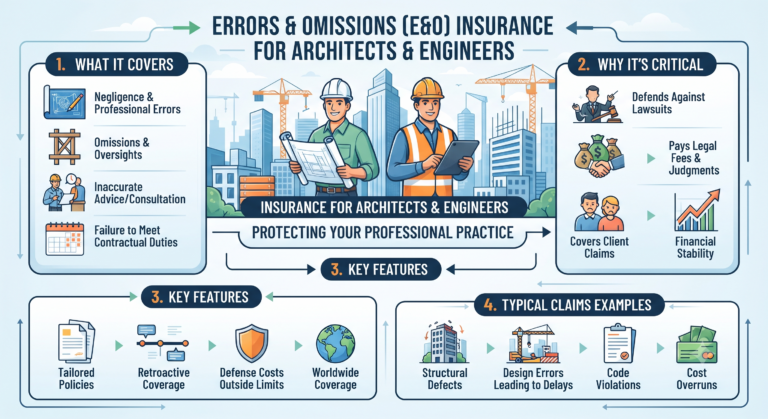
Professional liability insurance for architecture and engineering firms costs $7,000 to $50,000 per year at mid-market scale, making it one of the most expensive E&O classifications in the insurance market. The reason is straightforward: when an architect’s design fails or an engineer’s calculation is wrong, people can die, buildings can collapse, and the resulting claims routinely reach $5M–$50M+. A structural defect discovered five years after construction completion generates a claim against the policy in force when the claim is filed — not the policy in force when the design was created. That’s why A/E firms must maintain continuous claims-made coverage for years (often decades) after project completion.
AIA and EJCDC standard contract forms both require professional liability as a default provision. AIA B101–2017 Article 2.5 requires the architect to maintain professional liability insurance for the duration of the project and, in most negotiations, for a specified period after substantial completion. EJCDC E-500 includes similar requirements for engineering services. These aren’t negotiable provisions for firms pursuing institutional and commercial work — they’re table-stakes requirements that determine which projects you can bid on.
A/E E&O Cost by Firm Size
| Firm Revenue | Employees | $1M/$1M Limits | $5M/$5M Limits |
|---|---|---|---|
| $2M–$5M | 10–25 | $7,000–$15,000 | $18,000–$35,000 |
| $5M–$15M | 25–75 | $12,000–$22,000 | $28,000–$45,000 |
| $15M–$50M | 75–250 | $18,000–$35,000 | $40,000–$75,000 |
| $50M+ | 250+ | $30,000–$50,000 | $60,000–$120,000+ |
Structural engineering firms pay more than interior design firms at the same revenue level because the severity exposure is categorically different. A structural failure generates wrongful death claims that routinely exceed $10M. An interior design dispute generates property damage claims that rarely exceed $500K. Carriers price this distinction aggressively — structural, geotechnical, and environmental engineering classifications can carry premiums 40–60% higher than architectural or MEP classifications at the same revenue tier.
For Houston-based A/E firms, the construction market’s scale creates both opportunity and exposure. Houston’s commercial construction pipeline — driven by Texas Medical Center expansion, Port of Houston infrastructure, and energy facility builds — means larger project values, higher fee volumes, and correspondingly higher E&O premiums. Firms doing work in the Houston market should also consider how excess liability layers interact with their professional liability program.
Disclaimer: This article is for informational purposes only and does not constitute insurance advice. A/E professional liability requirements vary by state licensure, contract terms, and project scope. Consult with our licensed insurance advisors for guidance.
A/E Professional Liability Program Review
We structure E&O programs for architecture and engineering firms pursuing institutional, commercial, and infrastructure projects. Specialty carrier access for structural, geotechnical, and environmental engineering classifications.
Request A/E E&O Review