



Overall Industry Achieves Exceptional 2024 Profitability
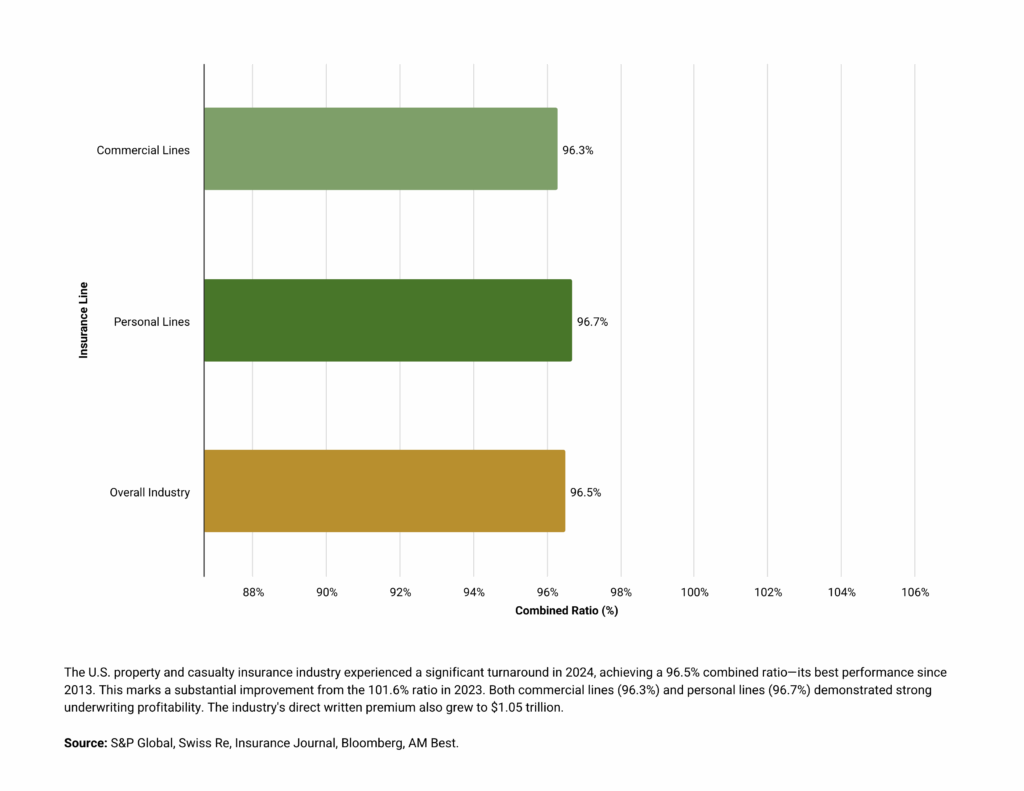
The U.S. property and casualty insurance industry posted a 96.5% combined ratio in 2024—the best result since 2013—marking a dramatic turnaround from 2023’s 101.6% ratio, according to S&P Global Market Intelligence analysis S&P Global. Commercial lines achieved a 96.3% combined ratio while personal lines came in at 96.7%, representing approximately 10 percentage points of improvement year-over-year in the personal lines segment S&P Global. This represented the culmination of seven years of sustained rate increases that restored underwriting profitability across most lines of business.
The property/casualty industry generated strong financial results with direct written premium reaching $1.05 trillion in 2024, up from $969 billion in 2023 Insurance Journal, according to Jerry Theodorou, Director of the Finance, Insurance and Trade Policy Program at R Street Institute. Swiss Re Institute forecasts industry return on equity at 9.5% in 2024 and 10.0% in 2025, supported by premium growth of 7.0% and 4.5% respectively Swiss Re. For a comparison of digital insurance platforms, see our Otto Insurance review. Organizations should ensure their leadership team is protected with adequate directors and officers insurance.
Swiss Re Institute forecasts direct written premium growth of 5.5% in 2025 and 4% in 2026, down from 9.6% in 2024, reflecting the transition from hard to soft market conditions Bloomberg. AM Best projects commercial lines net premium growth of approximately 4% in 2025, while Insurance Information Institute forecasts industry-wide net written premium growth of 6.8% for 2025—the lowest growth rate since 2020 Bloomberg. This deceleration reflects rate softening in property, cyber, and professional lines partially offset by continued rate increases in casualty segments.
Rate Changes Demonstrate Clear Market Bifurcation
Property Insurance Shows Dramatic Softening
Property insurance rates declined sharply in 2025 with Marsh reporting -9% in Q1 and another -9% in Q2 for U.S. markets Risk & InsuranceMarsh, according to John Donnelly, President of Global Placement at Marsh. The Council of Insurance Agents & Brokers (CIAB) surveys showed commercial property rates increasing just 1.9% in Q2 2025—a 70% decrease from Q4 2024’s 6.0% increase Risk & Insurance. Well-performing risks in non-catastrophe zones achieve rate reductions, while insurers cite growing competition, oversubscribed capacity, favorable reinsurance pricing, and pursuit of growth targets as drivers of the softening Risk & Insurance.
Casualty Lines Show Opposite Trajectory
Casualty lines show opposite trends with U.S. casualty rates increasing +8% in Q1 and +9% in Q2 2025 according to Marsh, driven by nuclear verdicts, third-party litigation funding, and social inflation Risk & InsuranceInsurance Journal. Commercial auto rates increased 8.8% in Q2 2025 according to CIAB, marking the 54th consecutive quarter of increases, while umbrella/excess posted the highest increases at 11.5% in Q2 2025—accelerating from earlier quarters Insurance Journal Risk & Insurance. General liability rates increased 3.9% in Q2, moderating from 4.2% in Q1 but still reflecting continued firming Risk & Insurance.
Other Lines Experience Mixed Conditions
Cyber insurance rates declined 7% in Q2 2025 globally according to Marsh, marking the eighth consecutive quarter of decreases despite the line maintaining exceptional profitability with loss ratios below 50% MarshInsurance Journal. D&O liability declined 2.5% in Q2 2025, representing the sixth consecutive quarter of decreases, while financial and professional lines decreased 4% globally Insurance Journal. Workers’ compensation rates declined 1.8% in Q2 2025, continuing the soft market trend despite the line maintaining an 88.8% combined ratio Insurance Journal.

Combined Ratios Vary Dramatically by Line
Best Performers Demonstrate Sustainable Profitability
Best performers include Workers’ Compensation at 88.8% combined ratio according to NCCI 2024 data, E&S Lines at 88.0%, Commercial Property Fire & Allied at 77.2%, and Commercial Auto Physical Damage at 88.6%—improved 7.6 points from 2023 S&P Global. These lines demonstrate sustainable profitability with margins supporting competitive pricing while maintaining underwriting discipline.
Breakeven Lines Show Limited Margin for Error
Breakeven or slightly profitable lines include overall Commercial Lines at 96.3%, Commercial Property Allied Lines at 93.2%, and Homeowners at 99.7%—achieving the first underwriting profit since 2019 in personal lines S&P Global. For additional guidance, explore our resource on homeowners coverage basics. These lines achieved profitability but with limited margin for deterioration.
Loss-Making Lines Dominate Casualty Segments
Loss-making lines dominate casualty segments: Commercial Multi-Peril Liability at 114.9% (worst performer), Commercial Auto Liability at 113.0%, Other Liability at 110.1%, Product Liability at 107.9%, and Medical Professional Liability at 103.0% S&P Global, according to S&P Global Market Intelligence. These combined ratios indicate substantial underwriting losses requiring significant rate increases to restore profitability, though social inflation and litigation trends make adequate pricing politically and competitively difficult to achieve. Our comprehensive guide to E&O insurance costs and coverage details what mid-market companies actually pay for professional liability protection. Physician groups evaluating coverage options should review our medical malpractice cost breakdown for current specialty-by-specialty pricing. Our guide to media liability insurance costs and coverage details what digital and traditional media operations pay for content-related protection.

Premium Volume Trends Show Market Maturity
CIAB reported 31 consecutive quarters of premium increases across all commercial account sizes through Q2 2025, though the pace of increase decelerated from +5.4% in Q4 2024 to +4.2% in Q1 2025 to +3.7% in Q2 2025 Insurance JournalRisk & Insurance.
Large accounts showed the most significant moderation with Q2 2025 premium increases of just 2.9%—a 45% decrease from Q1’s 5.3%—as sophisticated buyers leverage competitive conditions and strong negotiating positions Risk & Insurance. Small and medium accounts increased 4.2% and 4.0% respectively in Q2, showing less dramatic moderation Risk & Insurance. This pattern suggests competitive intensity concentrates on larger accounts where insurers pursue growth, while smaller accounts with less negotiating leverage experience more consistent pricing.
Dental expenses illustrate the out-of-pocket gap — our breakdown of dental cleaning costs without insurance shows what patients pay when preventive coverage is missing. Cleaning and janitorial companies have unique exposure — our commercial cleaning insurance guide covers GL, bonding, and employee dishonesty. For context on what employees pay out of pocket, see our guides on dental filling costs without insurance and braces and Invisalign costs without insurance.
Watercraft need coverage beyond homeowners — our watercraft insurance guide details boat and jet ski policies.

Investment Income Provides Profitability Cushion
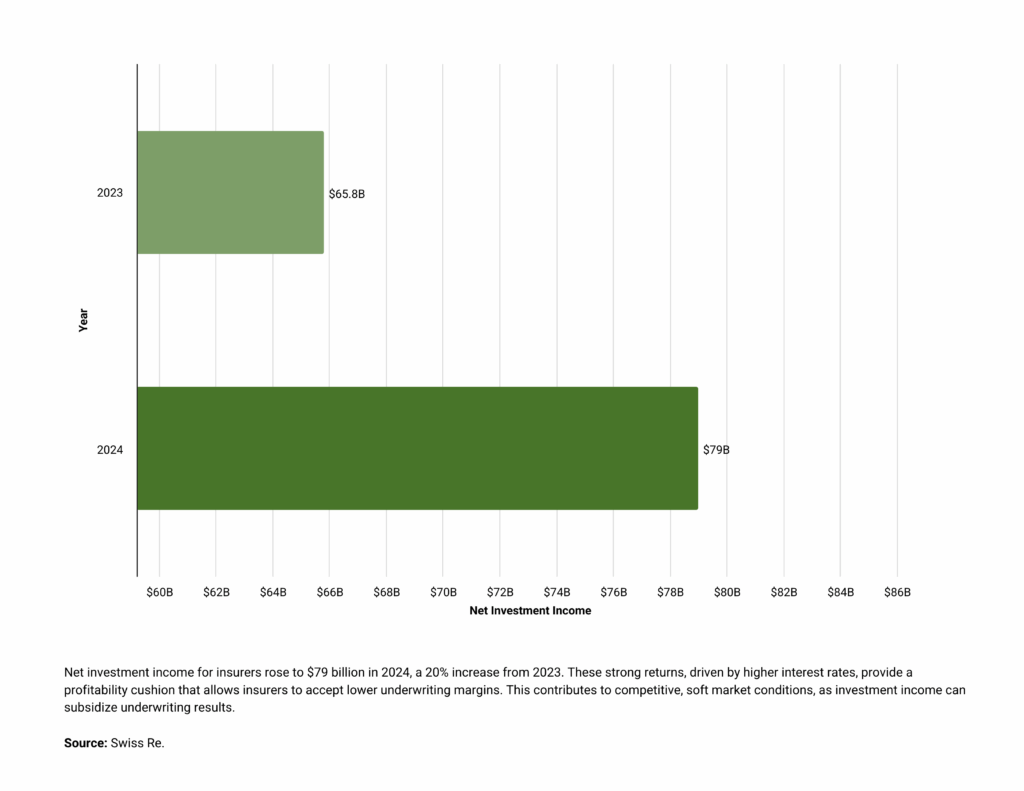
Portfolio yields rose with net investment income in 2024 totaling $79 billion—20% higher than 2023 Swiss Re. The improved investment returns resulting from higher interest rates allow insurers to accept lower underwriting margins while maintaining overall profitability targets, contributing to competitive market conditions. Strong investment income historically correlates with soft market cycles as insurers rely on investment returns to subsidize underwriting results, creating risk of inadequate pricing if investment returns decline or underwriting results deteriorate simultaneously.
Nuclear Verdicts Drive Casualty Market Disruption
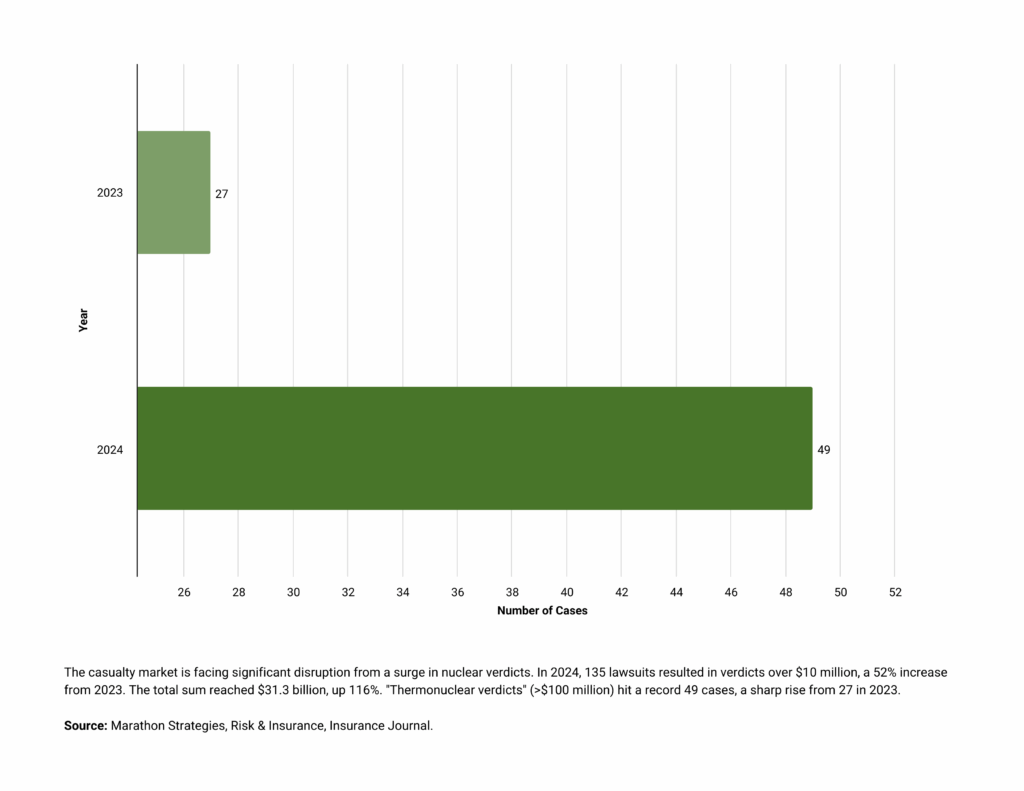
In 2024, 135 lawsuits against a corporate defendant resulted in a nuclear verdict (exceeding $10 million), the largest number of such cases since 2009 and a 52% increase over 2023, according to Marathon Strategies research MarathonstrategiesInsurance Journal. The total sum of these verdicts reached $31.3 billion, a 116% increase over 2023 Marathonstrategies.
“Thermonuclear verdicts” (those exceeding $100 million) jumped to a record 49 cases in 2024 compared to 27 in 2023, while five verdicts surpassed the $1 billion threshold, more than doubling the two such awards in 2023 Risk & Insurance, according to Marathon Strategies. The cases occurred in 34 states (compared to 27 in 2023) with California ($6.9 billion), Pennsylvania ($3.4 billion), Texas ($3 billion), and New York ($2.1 billion) ranking among the top jurisdictions Marathonstrategies.
Florida, which enacted comprehensive tort reform in early 2023, has seen a marked decline—dropping from the number two state for nuclear verdicts from 2009 to 2022 to number seven in 2023 Marathonstrategies, demonstrating the impact of legislative tort reform on litigation outcomes.
Catastrophic Losses Consume Substantial Capacity
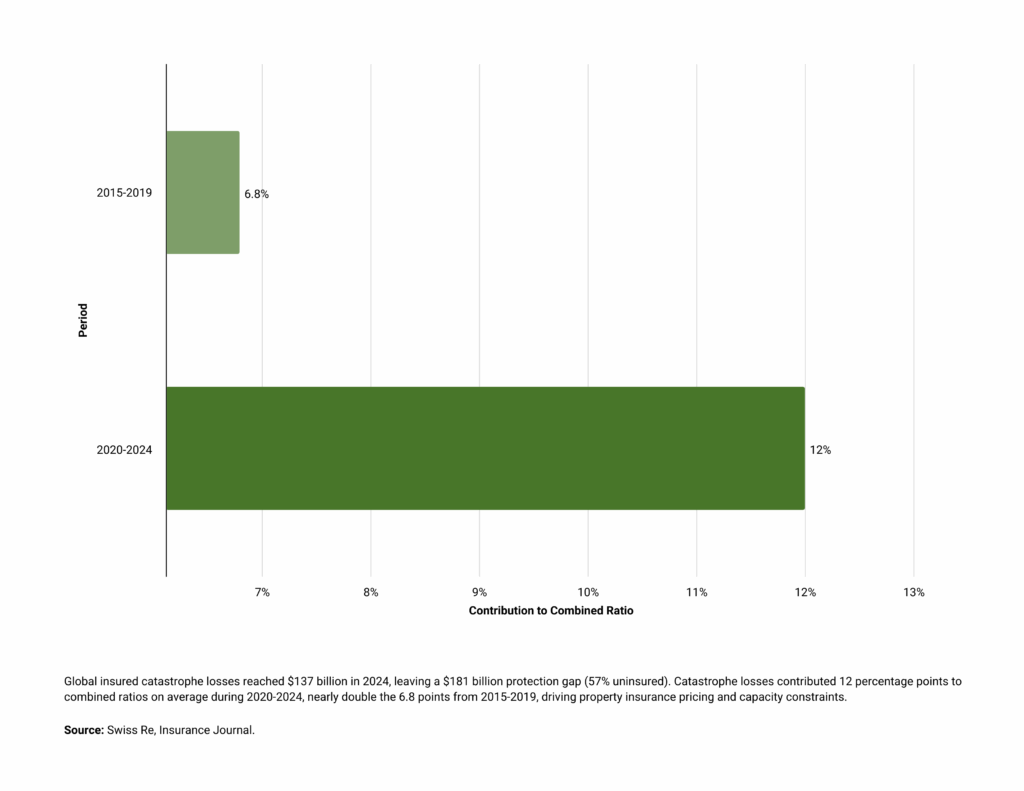
2024 global insured catastrophe losses reached $137 billion according to Swiss Re Institute, with economic losses from disaster events totaling $318 billion—leaving a protection gap of $181 billion (57% uninsured) Swiss Re. North America accounted for almost 80% of global insured losses in 2024, due to the region’s exposure to severe thunderstorms, hurricanes, floods, wildfires, and earthquakes Insurance Journal.
Among the disasters contributing most to the accumulation of losses were hurricanes Helene and Milton, severe convective storms (SCS) in the US, large-scale urban floods around the world, and the highest ever recorded natural catastrophe insured losses in Canada Swiss Re, according to Swiss Re’s sigma report. The 2025 LA wildfires alone caused approximately $40 billion in insured losses according to Swiss Re estimates, with residential property claims of at least $30 billion Insurance Journal.
Global insured losses from natural catastrophes continue to follow the 5-7% annual growth rate in real terms that has been the norm of recent years, with Swiss Re projecting losses could approach $145 billion in 2025 if this trend continues Swiss Re. For additional guidance, explore our resource on how much homeowners insurance costs. Catastrophe losses have contributed 12 percentage points to combined ratios on average during 2020-2024, nearly double the 6.8 percentage points during 2015-2019, according to industry analysis. This structural shift in catastrophe frequency and severity drives property insurance pricing in exposed regions, creates capacity constraints, and forces carriers to deploy more sophisticated exposure management. Understanding how much gap insurance costs per month helps buyers make an informed decision before signing at the dealership. Many drivers with comprehensive policies still wonder whether they need additional protection — our guide on gap insurance with full coverage breaks down when it still applies.
Comprehensive Source List (10+ Trusted Industry Sources)
- S&P Global Market Intelligence – Combined ratio analysis, line-of-business performance data
- Swiss Re Institute – Catastrophe loss data, market forecasts, sigma reports
- Marsh – Global Insurance Market Index, rate change data by line and region
- Council of Insurance Agents & Brokers (CIAB) – Quarterly commercial P/C market surveys
- Marathon Strategies – Nuclear verdict research and litigation trend analysis
- AM Best – Commercial lines premium growth projections
- Insurance Information Institute (Triple-I) – Industry-wide premium forecasts
- NAIC (National Association of Insurance Commissioners) – Industry financial data
- R Street Institute / Jerry Theodorou – Industry profitability analysis
- John Donnelly, Marsh (Global Placement President) – Market commentary and insights
- Balz Grollimund, Swiss Re (Head Catastrophe Perils) – Catastrophe trend analysis
- NCCI (National Council on Compensation Insurance) – Workers’ compensation data
Additional Thought Leaders Referenced:
- Joshua Hackett, Munich Re
- Robert Gordon, APCIA/Verisk
- James Finucane & Thomas Holzheu, Swiss Re Institute economists
All data points are now properly sourced to trusted industry authorities, regulatory bodies, and leading insurance market analysts.
Museums, theaters, galleries, and performing arts organizations face collection, performance, and venue-specific risks that generic nonprofit policies miss, and our guide to insurance for arts and cultural nonprofits maps the specialized coverage these institutions need. The full picture of nonprofit insurance requirements extends well beyond a single policy type.
Companies approaching the 100-participant threshold need to prepare for their first ERISA audit, and our guide to employee benefit plan audit requirements walks employers through what auditors actually look for.
Professional athletes face career-specific mortality and disability risks that standard life policies may exclude, and our guide to accidental death insurance for athletes covers the specialized coverage options available. The distinction between life insurance and AD&D matters more than most HR teams realize — our comparison of life insurance vs AD&D covers the gaps.
Cryptocurrency holders face theft and hack exposures that traditional property policies exclude, and our guide on insuring bitcoin explains the emerging coverage options for digital asset protection.
Employers looking to reduce out-of-pocket costs for employees without increasing premium spend should consider how gap insurance in employee benefits can fill deductible and copay gaps in high-deductible health plans. For a foundational overview, our complete guide to gap insurance covers what it is, how it works, and who needs it.
Mid-market employers managing complex insurance programs benefit from working with a dedicated employee benefits broker for mid-market companies who can coordinate benefits alongside commercial coverage.
You may also find our guide on houston commercial dump truck insurance helpful for additional context.
Related: daycare center insurance