


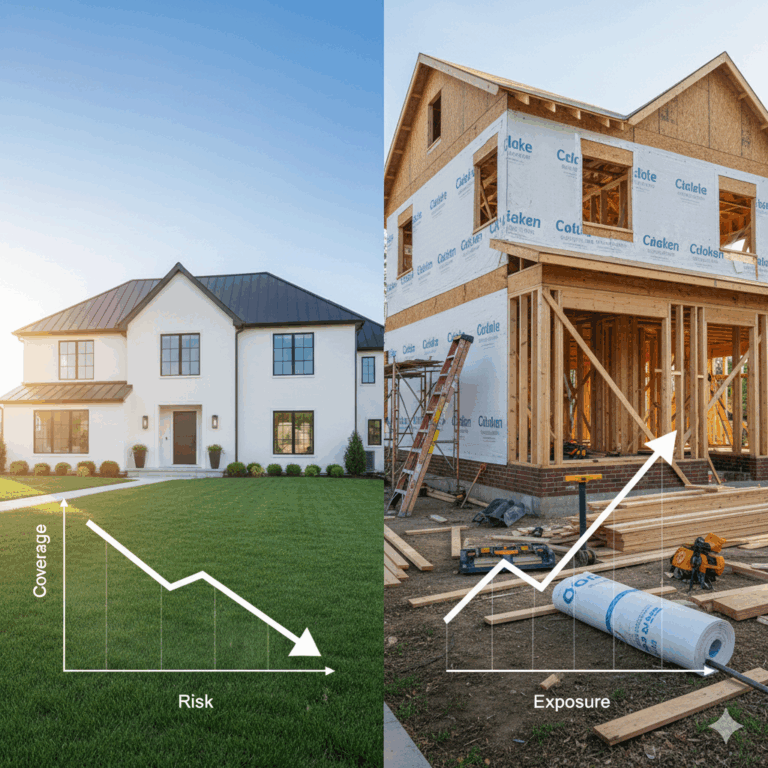
Builders risk insurance for commercial real estate development covers physical damage to a building under construction — fire, weather, theft, vandalism, and certain equipment failures — from groundbreaking through completion. Policies are written for the construction period (typically 6–12 months, renewable) and cover the structure, materials on site, and materials in transit.
For commercial developers, the policy is not optional — lenders require it before funding, and general contractors require it before breaking ground. Here’s what builders risk covers on a commercial project, what it costs, and how to structure it alongside your other project insurance.
Beyond builders risk, CRE investors face ongoing insurance requirements from lenders and tenants — insurance requirements for commercial real estate transactions maps the coverage obligations across the property lifecycle.
Key Takeaways
- What it covers: Fire, weather, theft, vandalism, and certain equipment damage during construction
- Cost: 1–4% of total construction value, paid upfront for the policy term
- Who buys it: Usually the property owner or developer; sometimes the GC depending on the contract
- Lender requirement: Required for commercial construction loans, including SBA 504 loans
- What it excludes: Faulty workmanship, design errors, earthquake (unless endorsed), flood (separate policy)
What Does Builders Risk Cover on a Commercial Project?
| Covered | Not Covered |
|---|---|
| Fire, lightning, explosion | Faulty workmanship or design errors |
| Wind, hail, storm damage | Employee theft (covered by crime policy) |
| Theft of materials and equipment on site | Earthquake (unless endorsed) |
| Vandalism | Flood (separate NFIP or private policy) |
| Materials in transit to the site | Normal wear and tear, rust, mold |
Builders risk is one piece of a multi-layer construction insurance program — our comprehensive guide to types of construction insurance including builders risk covers how all the coverage types work together.
Development projects require builders risk coverage from ground-breaking through certificate of occupancy — our guide to builders risk insurance cost for development projects breaks down what developers actually pay.
Dental expenses illustrate the out-of-pocket gap — our breakdown of dental cleaning costs without insurance shows what patients pay when preventive coverage is missing. For context on what employees pay out of pocket, see our guides on MRI costs without insurance and chiropractor costs without insurance.
Watercraft need coverage beyond homeowners — our watercraft insurance guide details boat and jet ski policies. For more details, see our guide on homeowners coverage basics.
Frequently Asked Questions
How much does builders risk insurance cost for commercial projects?
Typically 1–4% of total construction value. A $5M commercial build would cost roughly $50,000–$200,000 for the builders risk policy, depending on location, construction type, and whether earthquake or flood endorsements are added.
Does builders risk cover subcontractor work?
Builders risk covers the completed work product regardless of who did it. However, damage caused by faulty workmanship itself is excluded — the resulting damage may be covered but not the cost to redo the defective work.
Disclaimer: This article is for informational purposes only. Coverage terms vary by carrier and project. Consult our licensed advisors for project-specific guidance.
Commercial Construction Insurance
Hotaling Insurance Services structures builders risk, GL, and umbrella programs for commercial real estate developers across Texas, New York, and Florida.
Request a QuoteAbout the cost figures and examples in this article: Any premium ranges, cost figures, or pricing factors discussed here are general market estimates drawn from publicly available industry data and are provided for educational context only. They are not quotes, offers, or guarantees of cost, and they do not reflect the price Hotaling Insurance Services will or can offer for any specific policy. Actual premiums are determined solely by the insurance carrier based on your individual risk profile, coverage selections, claims history, location, and other underwriting factors, and they vary widely from the general ranges described above. Any client scenarios are anonymized, illustrative composites created for educational purposes; they do not depict actual named clients and should not be relied upon as a prediction of results. Nothing in this article constitutes financial, legal, tax, or insurance advice. For pricing and coverage specific to your organization, please request a consultation with our licensed advisors.