


Key Takeaways
- $60,000 exemption vs $13.61M: U.S. citizens and residents get a $13.61M estate tax exemption (2024). Non-resident aliens get $60,000. A foreign national with $5M in U.S. assets faces $2.1M in estate tax that a citizen would pay $0 on
- U.S. situs assets include almost everything: Real estate, U.S. stocks, tangible personal property, business interests, and bank deposits above $250K are all U.S. situs assets subject to estate tax at rates up to 40%
- ILIT is the primary planning vehicle: An irrevocable life insurance trust removes the death benefit from the taxable estate while providing liquidity to pay the estate tax bill — dollar-for-dollar tax mitigation
- Treaty benefits vary enormously: Some countries (UK, Germany, Japan) have estate tax treaties with the U.S. that increase the exemption or provide credits. Others (China, Brazil, India) have no treaty — the full $60,000 limit applies
- Cost: $0.015-$0.025 per dollar of tax liability: A $2M ILIT policy to cover $2M in projected estate tax costs roughly $30,000-$50,000 annually in premiums — a 1.5-2.5% annual cost to eliminate a 40% tax bill
Estate Tax Exposure for Non-Resident Aliens by U.S. Asset Level
| U.S. Situs Assets | Est. Federal Estate Tax | ILIT Premium (Annual) | Premium as % of Tax |
|---|---|---|---|
| $1,000,000 | $345,800 | $5,200-$8,700 | 1.5-2.5% |
| $3,000,000 | $1,145,800 | $17,200-$28,600 | 1.5-2.5% |
| $5,000,000 | $1,945,800 | $29,200-$48,600 | 1.5-2.5% |
| $10,000,000 | $3,945,800 | $59,200-$98,600 | 1.5-2.5% |
Tax calculated at 2024 federal rates. State estate taxes (applicable in NY, CT, MA, WA, and others) are additional. ILIT premiums assume healthy 55-year-old, guaranteed UL policy. The Connelly ruling reshaped how entity-redemption agreements are taxed — our guide on buy-sell insurance after Connelly covers what business owners must restructure.
Case Study: Brazilian Real Estate Investor Eliminates $1.4M Estate Tax Exposure for $22,000/Year
A Brazilian national with no U.S. estate tax treaty protection owned $4.2M in U.S. real estate (two Miami condos and a Houston commercial property) and $800K in U.S. equities. Projected federal estate tax: $1.4M at the 40% marginal rate on assets above the $60,000 exemption. With no treaty credits available, the full amount would be due within 9 months of death — forcing a fire sale of properties to generate liquidity. Our advisors structured a $1.5M guaranteed universal life policy inside a Cayman Islands ILIT (properly structured to remain outside the U.S. estate) at $22,000 annually. The trust receives the death benefit tax-free and uses it to pay the estate tax, preserving the real estate portfolio intact for the heirs. The annual premium represents 1.57% of the tax liability it eliminates — a 66:1 return over a 25-year life expectancy.
Frequently Asked Questions
Why is the estate tax exemption so low for non-resident aliens?+
Congress set the non-resident alien exemption at $60,000 in 1988 and has never increased it, even as the citizen exemption rose from $600,000 to $13.61M. There’s no indexing for inflation and no scheduled increase. For non-resident aliens from countries without a U.S. estate tax treaty, the $60,000 exemption means virtually all U.S. assets above that threshold are taxed at rates starting at 26% and reaching 40% above $1M. This creates a massive planning gap that most foreign investors don’t discover until they consult a U.S. tax advisor.
What U.S. assets are subject to estate tax for non-resident aliens?+
U.S. situs assets include: real property located in the U.S. (including co-op and condo interests), tangible personal property physically located in the U.S., stock in U.S. corporations (regardless of where the certificates are held), certain debt obligations issued by U.S. persons, and partnership interests in U.S. partnerships. Bank deposits are generally exempt if they’re not effectively connected with a U.S. trade or business. Life insurance proceeds are also exempt from U.S. estate tax for non-resident aliens — which is precisely why ILIT planning is so effective.
How does an irrevocable life insurance trust reduce estate tax?+
The ILIT owns the life insurance policy, not the insured person. Because the policy is owned by the trust, the death benefit is not included in the insured’s estate for tax purposes. When the insured dies, the trust receives the death benefit tax-free and either pays the estate tax directly or lends the funds to the estate to cover the tax bill. The key requirements: the trust must be properly structured (typically offshore for non-resident aliens), the insured must not retain any incidents of ownership over the policy, and the trust must be funded for at least 3 years before death (the IRC Section 2035 lookback period).
Which countries have estate tax treaties with the United States?+
The U.S. has estate tax treaties with approximately 16 countries, including the United Kingdom, Germany, France, Japan, Australia, Canada, and the Netherlands. Treaty benefits vary — some increase the exemption to the full citizen amount ($13.61M), others provide proportional credits. Notably, China, India, Brazil, Mexico, and most of Latin America have NO estate tax treaty with the U.S. Nationals of non-treaty countries face the full $60,000 exemption and should prioritize ILIT planning if they hold significant U.S. situs assets.
Can a non-resident alien avoid U.S. estate tax by holding assets through an LLC or corporation?+
Holding U.S. real estate through a foreign corporation can remove it from the U.S. estate (because the foreign national owns foreign corporate stock, not U.S. real property directly). However, this creates other tax complications: FIRPTA withholding on sale, branch profits tax, and loss of the IRC Section 121 primary residence exclusion. An LLC taxed as a disregarded entity provides NO estate tax protection — it’s transparent for estate tax purposes. The optimal structure depends on the specific facts and requires coordination between a U.S. tax attorney, CPA, and insurance advisor. We work with estate planning attorneys who specialize in cross-border structures. LLCs need structured coverage from day one — our business insurance guide for LLCs covers what the entity structure does and does not protect.
Protect Your U.S. Assets From the $60,000 Exemption Trap
We structure ILIT-based estate tax solutions for foreign nationals with U.S. real estate, securities, and business interests. Our advisors coordinate with your tax attorney and CPA to implement the most cost-effective approach.
Request Estate Tax ConsultationDisclaimer: This article is for informational purposes only and does not constitute insurance advice. Consult with our licensed advisors for guidance tailored to your needs.
Estate Tax Loophole for Foreign Nationals
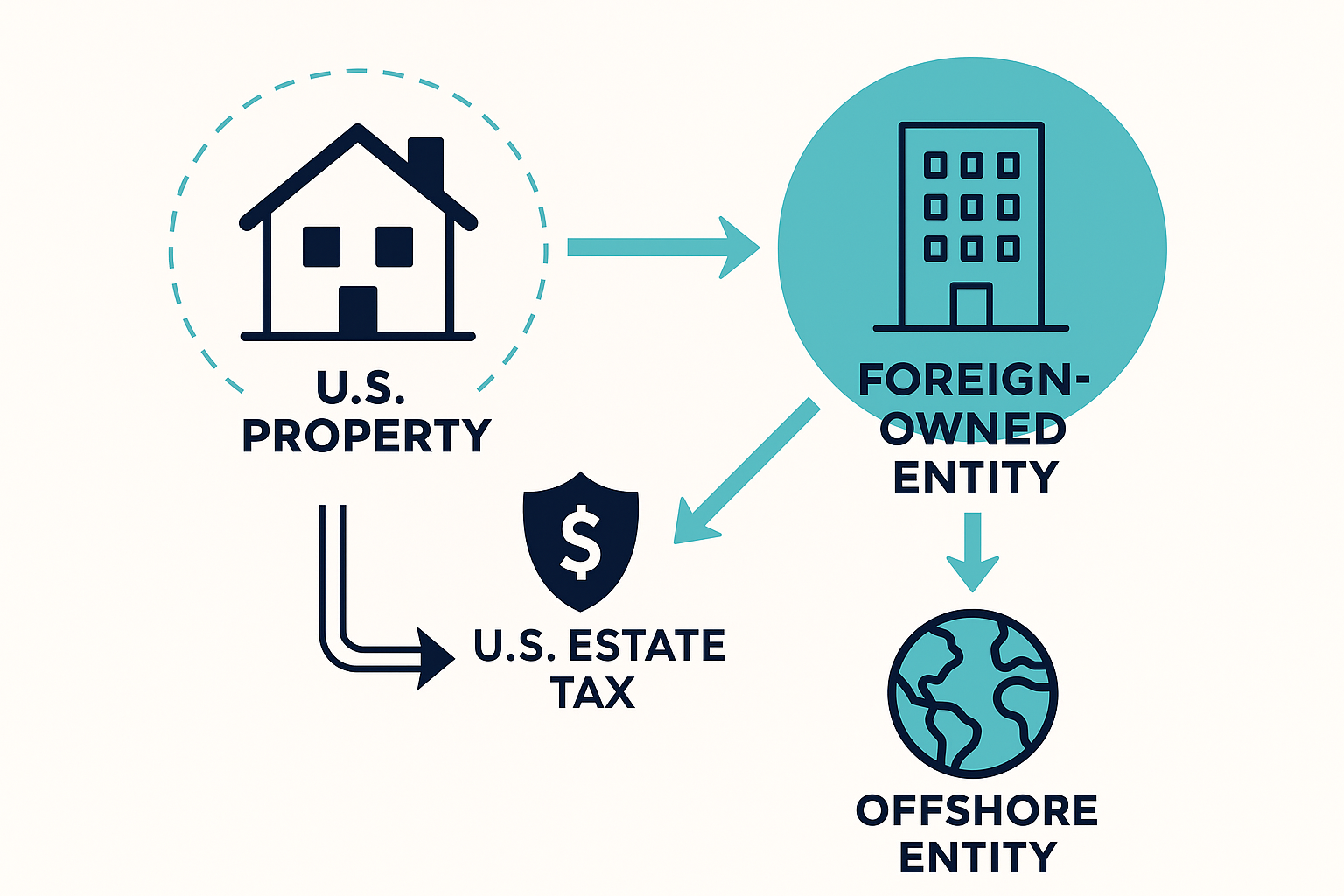
Estate Tax Loophole planning for nonresident aliens begins with one crucial fact: foreign nationals owe U.S. estate tax only on their U.S.–situs assets—real estate, tangible personal property, and U.S. corporate shares. With just a $60,000 exemption for non-U.S. citizens versus a $13.99 million exemption for U.S. citizens in 2025, even modest holdings can trigger significant liabilities. This comprehensive two-thousand-word guide delivers a blueprint of advanced cross-border tax planning tactics—from entity structuring and lifetime gifting to digital-asset management, PFIC elections, QDOT implementation, state-level coordination, and treaty elections—to preserve wealth, optimize nonresident exemptions, and exploit every lawful strategy to minimize U.S. estate tax exposure.Entity Structuring: The Core Estate Tax Strategy
A. Foreign-Owned Entities
Holding U.S. real estate or personal property through a foreign corporation or partnership transforms direct ownership into an intangible equity interest. That interest generally escapes U.S. estate tax. Key steps:- Transfer into an offshore entity (e.g., LLC or partnership)
- Issue shares or partnership units to the nonresident owner
- Obtain professional appraisals of the entity’s equity
- Draft robust operating agreements to avoid U.S. “look-through” rules or inadvertent grantor-trust status
B. Gifting Intangibles to Shrink the Taxable Estate
Gifting non-U.S. situs intangibles—foreign-registered securities, private equity interests, or trust shares—during life can remove millions from the taxable estate without U.S. gift or estate tax:- Annual exclusion gifts: $17,000 per recipient (2024 rate)
- Lifetime gifts under treaties: Leverage country-specific exemptions
- Documentation: Formal gift agreements and independent valuations
- Charitable strategies: Combine gifts with charitable remainder trusts for immediate income-tax deductions
C. Treaty Elections to Amplify Exemptions
The U.S. has estate-tax treaties with 17 countries (Canada, France, Germany, Japan, etc.) that allow residents of those nations to claim a pro rata share of the full unified credit. By filing Form 706-NA and a Transfer Certificate Request, nonresidents can boost their exemption from $60,000 to several million dollars—often matching the U.S. citizen level. Critical steps include:- Document residency: Local tax returns, utility bills
- Obtain legal opinions: Confirm treaty applicability
- File timely IRS forms: Include all required schedules
Digital Assets & Cryptocurrency
A. Inventory & Access Under RUFADAA
Digital holdings—cryptocurrencies, NFTs, domain names, and cloud accounts—are easily overlooked yet often substantial. Under the Revised Uniform Fiduciary Access to Digital Assets Act, fiduciaries can access digital property if the decedent provided written authorization. Best practices:- Compile a secure inventory: Wallet addresses, exchange logins, private keys
- Use multi-signature wallets: Protect assets and streamline transfer
- Include hardware-wallet recovery instructions: Ensure access
B. Updating Estate Documents & Online Tools
Ensure wills, trusts, and digital-asset riders explicitly grant fiduciaries authority over electronic property. Leverage platform-level tools:- Google Inactive Account Manager
- Facebook Legacy Contact
C. Valuation & Tax Reporting Requirements
Executors must:- Include digital assets in the gross estate at fair market value on date of death
- Report post-death income on Form 1041 if the estate generates revenue
- File Form 8937 for PFIC-structured tokens, if applicable
- Engage qualified appraisers for illiquid NFTs or private tokens to preserve step-up basis benefits
State-Level Estate & Inheritance Taxes
A. Overview of State Regimes & Exemptions
Twelve states plus D.C. impose estate taxes (exemptions $1 million–$13.99 million) and some levy inheritance taxes on beneficiaries receiving property. Coordinating federal and state filings is essential to prevent double taxation and late-filing penalties—core components of an effective estate tax loophole plan provided by Hotaling Insurance Services.B. Nexus & Situs Triggers for Nonresidents
Direct ownership of in-state real property or personal property (art, vehicles, equipment) creates state nexus. State domicile tests vary:- New York: Last declared residence
- California: Primary home
C. Federal Credit Coordination
State estate taxes paid may offset federal liability when properly reported on Form 706. Techniques include:- Entity layering: Single-member LLCs or statutory trusts
- Centralized filings: Simplify multi-state compliance
Generation-Skipping Transfer (GST) Tax
A. GST Tax Fundamentals
The GST tax imposes a 40% levy on transfers to “skip” beneficiaries (grandchildren, unrelated heirs) above a $13.99 million lifetime exemption. Unallocated exemption triggers punitive flat rates, undermining the estate tax loophole.B. Exemption Allocation Techniques
Preserve exemption capacity by timely Form 709 elections:- Allocate to dynasty trusts or specific bequests
- Make annual nominal allocations
C. Dynasty Trusts for Long-Term Planning
Multi-generational dynasty trusts shelter appreciation from estate and GST taxes. Include decanting powers and flexible distribution provisions to adapt to future law changes—preserving your core estate tax strategy over decades.Qualified Domestic Trusts (QDOTs) & Spousal Strategies
A. QDOT Requirements & Mechanics
A QDOT allows a non-U.S. spouse to claim the unlimited marital deduction. Key elements:- U.S. trustee with bond and withholding authority
- Qualifying security to cover estate tax
- Timely election on Form 706-NA
B. Alternative Spousal Techniques
For modest assets, consider:- Joint tenancy with right of survivorship
- Tenancy-in-common
Fiduciary Withholding & Income Tax Filings
A. Form 1041 vs. Form 1040-NR
Nonresident estates with over $600 of U.S. source income must file Form 1041. Distributions to foreign beneficiaries often require withholding at 30% unless reduced by treaty and may trigger Form 1040-NR filings by beneficiaries.B. Withholding Optimization Strategies
Use advanced structures to centralize obligations:- Section 1444 notice partners
- U.S. grantor trusts
Gift-Tax Treaty Strategies
A. Treaty Coverage & Filing Requirements
U.S. gift-tax treaties with nine countries parallel estate-tax treaties. Nonresidents file Form 709 with treaty-position statements to claim exemptions on non-U.S. situs gifts.B. Sequencing Gifts for Maximum Impact
Maximize benefits by:- Sequencing annual exclusion gifts of shares
- Leveraging lifetime exemption under treaties
- Employing foreign grantor trusts
PFIC & Offshore Investment Mitigation
A. PFIC Regime Overview
Passive Foreign Investment Companies trigger an “excess distribution” regime with punitive interest charges unless a Qualified Electing Fund (QEF) or mark-to-market election is made. Built-in gains above 125% of prior-year basis can dramatically inflate tax.B. Mitigation Techniques
Key tactics include:- Migrating holdings to non-PFIC vehicles
- Making catch-up QEF elections
- Transferring shares into grantor trusts
Private Placement Life Insurance (PPLI) Structures
A. PPLI Overview
PPLI combines diversified investments with a life insurance wrapper, offering tax-deferred growth and estate exclusion. The death benefit passes to heirs tax-free and policy loans provide pre-death liquidity.B. Suitability & Integration
Typically requires $5 million+ net worth and sufficient liquidity. Pairing PPLI with foreign trust structures achieves multi-jurisdictional deferral and enhances overall planning flexibility.Concrete Case Studies
- $1 Million U.S. Real Estate
- Direct Ownership: $940K net equity × 40% = $376K estate tax
- Foreign Entity: Lower corporate rates → $200K+ savings
- QDOT: Deferral until spouse’s death; bond equals liability
- $500K Life Settlement
- Cash Surrender: $50K (10% face)
- Life Settlement: $60K net $55K after fees
- PPLI Option: Defer tax, retain death benefit
- $3 Million Dynasty Trust
- GST Exemption Use: Avoids 40% on $6 million growth = $2.4 million saved
Who Can Use This Loophole and Why
A. Eligible Individuals
- Nonresident Aliens
- Foreign nationals holding any U.S.-situs assets—real estate, vacation homes, rental properties, tangible personal property, or shares in U.S. corporations.
- Cross-Border Business Owners & Investors
- Entrepreneurs or investors with U.S. holdings who want to minimize U.S. estate tax exposure on business interests or securities.
- High-Net-Worth Families
- Individuals with multi-jurisdictional portfolios seeking to preserve family wealth and streamline multi-generational transfers.
- Digital-Asset Holders
- Those with significant cryptocurrency or NFT positions who need clear fiduciary access and valuation plans under RUFADAA.
B. Key Motivations & Benefits
- Maximize Exemptions
- Leverage entity structuring, gifting, and treaty elections to boost effective exemption from $60,000 to millions.
- Preserve Wealth
- Reduce or eliminate estate tax on U.S.-situs assets, allowing heirs to inherit more of your legacy.
- Simplify Administration
- Centralize ownership via offshore entities and clear digital-asset protocols to avoid probate delays and compliance headaches.
- Cross-Generational Planning
- Use GST strategies and dynasty trusts to protect appreciation from estate and GST taxes over multiple generations.
- Spousal Protection
- Ensure non-U.S. spouses can claim marital deductions via QDOTs, avoiding unintended tax burdens on surviving partners.
Hotaling Insurance Services specializes in guiding nonresident aliens through each of these strategies—helping you decide which combination of entity structures, gifting techniques, and trust vehicles best fits your unique circumstances.
Conclusion & Next Steps
By integrating foreign-entity structuring, lifetime gifting, treaty elections, digital-asset management, PFIC mitigation, QDOT implementation, state coordination, gift-tax treaties, and PPLI strategies, you now have a complete blueprint for an effective Estate Tax Loophole. Next steps:- Engage a qualified cross-border tax advisor
- Inventory and legalize digital assets under RUFADAA
- Secure digital-asset consents
- File Forms 706-NA, 709, and QEF elections timely
- Implement QDOT or alternative spousal arrangements
- Leverage PPLI where appropriate
For ongoing insights on nonresident estate tax planning, visit Hotaling Insurance Services’ News & Blog.
Sources
- Unlocking the Benefits of PPLI Insurance in Miami https://hotalinginsurance.com/news/unlocking-the-benefits-of-ppli-insurance-in-miami hotalinginsurance.com
- What Happens to Debt After You Die? Unknown Facts https://hotalinginsurance.com/news/what-happens-to-debt-after-you-die-unknown-facts hotalinginsurance.com
- How to Determine the Worth of Your Life Insurance Policy https://hotalinginsurance.com/news/how-to-determine-the-worth-of-your-life-insurance-policy hotalinginsurance.com
- Is Life Insurance a Waste of Money? Depends on Your Risk https://hotalinginsurance.com/news/is-life-insurance-is-a-waste-of-money-depends-on-your-risk hotalinginsurance.com
- Connelly Case Life Insurance: Policy Change Summary https://hotalinginsurance.com/news/connelly-case-life-insurance-policy-change-summary hotalinginsurance.com