


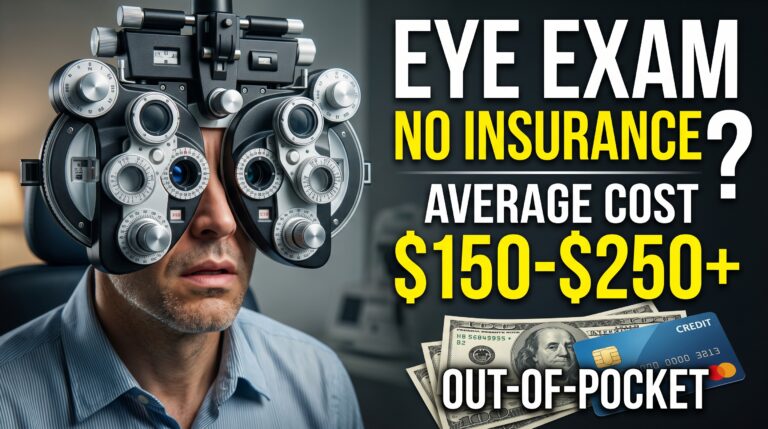
An eye exam without insurance costs about $50 to $250 in 2026, and most adults pay around $100 at a retail optical counter. GoodRx puts the national average near $136. The cheapest routine exams are at warehouse and big-box stores (Walmart, Costco, Sam’s Club, America’s Best), while a private optometrist runs $120 to $200 and an ophthalmologist $150 to $300 or more.
Where you go matters more than anything else on the bill. The same 30-minute exam can cost twice as much two miles away, and contact lens wearers pay a separate fitting fee on top of it. Here’s what each option actually charges, and how to keep the total under $100.
What an Eye Exam Costs Without Insurance
- Typical range: $50 to $250 for a routine exam; about $100 at most retail chains
- National average: about $136 per GoodRx; VSP lists a higher average near $194
- Cheapest options: America’s Best ($50 to $80 standalone, or free with two pairs of glasses), Sam’s Club ($50 to $100), Walmart ($75 to $100)
- Contact lenses cost extra: a fitting adds roughly $50 to $150 on top of the exam
- Medical eye problems cost more: a dilated medical exam with an eye doctor runs $150 to $300
How Much Is an Eye Exam Without Insurance?
A routine eye exam without insurance costs $50 to $250, with most people paying close to $100. When Clark.com called optometrists in Kentucky, Georgia, and Colorado in January 2026, the average came in right around $100. Warby Parker reports that VSP, one of the largest vision plans, lists a national average closer to $194, because that figure leans on private practices.
So which number is right? Both. The gap comes down to who’s doing the exam. Retail optical counters rent space to independent optometrists who keep prices low to sell glasses. Private practices and ophthalmology offices charge more because they bill like medical offices, with more equipment, more staff, and longer appointments.
Location matters too. VisionTestCost found the average exam runs about $196 in Hawaii and $113 in Alabama. Big cities sit toward the top of the range. Rural areas and states with lots of warehouse stores sit toward the bottom.
Eye Exam Prices at Costco, Walmart, Target and Other Retailers
Retail chains are where most uninsured patients go, and for good reason. The table below shows reported 2026 cash prices for a standard exam at each major chain, without a contact lens fitting.
| Where You Go | Exam Price Without Insurance | Source |
|---|---|---|
| America’s Best | $50 to $80 standalone; free with two pairs of glasses | BetterCare, VisionTestCost |
| Sam’s Club Optical | $50 to $100 | VisionTestCost |
| EyeMart Express | $60 to $85 | VisionTestCost |
| Walmart Vision Center | $75 to $100 (Clark.com average: about $98) | VisionTestCost, Clark.com |
| Costco Optical | $79 to $110 | VisionTestCost |
| Visionworks | $89 at one Phoenix location (set locally) | VisionCenter.org |
| LensCrafters | $73 to $150 | VisionTestCost |
| Target Optical | about $113 | Clark.com |
| Private optometrist | $120 to $200 | VisionTestCost |
| Ophthalmologist | $150 to $300 or more | VisionTestCost |
One catch applies to almost every row. At Walmart, Costco, Sam’s Club and Target, the exam is done by an independent doctor who sets the fee locally, so none of these chains publishes a single national price. Call the store you plan to visit and ask for the self-pay price before you book. It takes two minutes and it’s the only number that counts.
You also don’t need a Costco membership to get your eyes checked there. You’ll need one to buy glasses at Costco, though, so the exam is only a bargain if you’re willing to take your prescription somewhere else or join.
Is an Eye Exam Cheaper at Costco or Walmart?
Walmart is usually a little cheaper for the exam itself, at $75 to $100 versus $79 to $110 at Costco, according to VisionTestCost. The difference is small enough that the glasses usually decide it. Costco tends to win on frames and lenses, and Walmart tends to win on convenience and store hours.
If you only need a prescription and plan to buy glasses online, go wherever the exam is cheapest near you. If you want to buy glasses in the same visit, compare the total for exam plus glasses. A $15 cheaper exam doesn’t help much if the lenses cost $80 more.
How Much Is a Contact Lens Exam Without Insurance?
A contact lens exam costs the regular exam fee plus a separate fitting, which usually adds $50 to $150. VisionCenter.org found one Phoenix Visionworks charging $70 for a standard spherical fitting and $90 for toric, multifocal, or gas permeable lenses. At Walmart, a contact fitting typically adds $50 to $75.
| Contact Lens Fitting Type | Typical Added Cost | Who Needs It |
|---|---|---|
| Standard (spherical) soft lenses | $50 to $95 | Nearsighted or farsighted, no astigmatism |
| Toric lenses | $90 to $140 | Astigmatism |
| Multifocal lenses | $90 to $140 | Readers over 40 who want one lens for near and far |
| Gas permeable (hard) lenses | $90 to $140 | Irregular corneas or very specific vision needs |
Ranges combine the Phoenix Visionworks fee schedule from VisionCenter.org, Walmart figures from BetterCare, and the $95 to $140 typical fitting fee reported by VisionTestCost. Your store may charge less, so ask.
Why the extra charge? A glasses prescription and a contact lens prescription aren’t the same thing. Contacts sit on your eye, so the doctor has to measure the curve of your cornea, check the fit, and often send you home with trial lenses. That’s real extra work, and it’s billed separately almost everywhere.
How Much Is an Eye Exam at an Ophthalmologist Without Insurance?
An ophthalmologist visit without insurance usually runs $150 to $300 or more. A full medical eye exam with dilation falls in the same $150 to $300 range. Ophthalmologists are medical doctors, so you’re paying for a different level of care than a routine vision check.
You don’t need an ophthalmologist to update a glasses prescription. You do need one, or at least a medical eye exam, when something is wrong with the eye itself. That includes glaucoma monitoring, diabetic eye checks, cataracts, flashes and floaters, or an eye injury.
Here’s a detail many people miss. A medical eye problem is often billed to your health insurance, not your vision plan. If you have a sudden eye infection, a scratch, or a chemical splash, an eye doctor or urgent care clinic may be the right call. Sudden vision loss, severe eye pain, or a serious injury belongs in the emergency room.
What Does a Routine Eye Exam Include?
A routine exam usually takes 20 to 45 minutes. Knowing what’s in it helps you spot add-ons you didn’t ask for.
- A visual acuity test (reading the letter chart)
- A refraction test to find your exact glasses prescription
- An eye pressure check, often the puff-of-air test, which screens for glaucoma
- A look at the front and back of the eye with a slit lamp
- Sometimes dilation drops, so the doctor can see the retina and optic nerve
Some offices offer retinal imaging instead of dilation for an extra fee. It’s often optional. Ask whether it’s included or added before the tech starts the scan, not after.
Vision Benefits Are Cheap for Employers and Valuable to Employees
Group vision coverage is one of the lowest-cost benefits an employer can add, and it turns a $136 exam into a $10 to $40 copay. Our licensed advisors build group health, dental, and vision programs for companies with 100+ employees.
Employer Benefits ConsultationAre Online Eye Exams Worth It?
Online vision tests are cheap, and for the right person they’re fine. Clark.com notes that 1-800 Contacts offers an online test for about $20. These tests can renew a stable glasses or contact prescription for an adult with healthy eyes.
They are not a real eye health exam, though. An online test can’t measure eye pressure, look at your retina, or catch early glaucoma or diabetic eye disease. If it’s been more than two years since an in-person exam, or you’re over 40, or you have diabetes, pay for the in-person visit.
Is Vision Insurance Worth It for One Exam a Year?
For one exam and nothing else, usually not. A standalone vision plan costs about $10 to $25 a month, or $120 to $300 a year. With a plan, your exam copay typically drops to $10 to $40. If you only need the exam, paying about $100 cash at a retail chain is often cheaper than a full year of premiums.
The math flips when you buy glasses or contacts every year. Most vision plans add a frame allowance and lens coverage on top of the exam. If you’d spend $200 or more on eyewear anyway, the plan often pays for itself.
| Your Situation | Better Choice | Why |
|---|---|---|
| Healthy eyes, exam every 2 years, no glasses | Pay cash | About $100 every other year beats $120 to $300 in yearly premiums |
| Wear glasses, replace them yearly | Vision plan | Frame and lens allowance usually covers more than the premium |
| Wear contacts | Vision plan | Fitting fee plus lens allowance adds up fast |
| Employer offers group vision | Enroll | Group rates are lower than individual plans |
You can also use FSA or HSA money for eye exams, glasses, and contacts at most retailers, including Pearle Vision. That’s pre-tax money, so it cuts the real cost by your tax rate.
How to Get a Free or Low-Cost Eye Exam
If $100 is a stretch right now, you have options. Some are free, and most people don’t know they exist.
- Bundle the exam with glasses. America’s Best includes a free exam when you buy two pairs of glasses, per BetterCare.
- EyeCare America offers free medical eye exams for many adults 65 and older through the American Academy of Ophthalmology.
- InfantSEE provides a free eye assessment for babies between 6 and 12 months old.
- VISION USA offers free exams to qualifying low-income workers and families through the American Optometric Association.
- Ask about programs. Warby Parker points readers to a National Eye Institute list of programs that cut or cover the cost of exams and glasses.
Buying glasses online after the exam is another way to save. Once you have your prescription, you can shop anywhere. Our guide to whether Zenni takes insurance covers how that works with vision plans.
How Often Should You Get an Eye Exam?
Most healthy adults under 40 can go every two years. After 40, many eye doctors suggest every one to two years, because that’s when reading vision starts to change and glaucoma risk climbs. People with diabetes, a family history of glaucoma, or contact lenses usually need a yearly exam.
Kids are a separate case. Children often get vision screenings at school or at the pediatrician’s office, and orthodontic work like braces is a far bigger cash expense for most families than an annual eye check.
Frequently Asked Questions
How much is an eye exam without insurance?+
An eye exam without insurance costs $50 to $250 in 2026, and most people pay about $100 at a retail chain like Walmart, Costco, or Target. GoodRx puts the national average near $136. Private optometrists charge $120 to $200, and ophthalmologists charge $150 to $300 or more.
How much is an eye exam at Walmart without insurance?+
A standard eye exam at Walmart Vision Center costs about $75 to $100 without insurance. Clark.com’s January 2026 survey put the average near $98. The exam is done by an independent doctor who sets the fee, so call your local store to confirm.
How much is an eye exam at Costco without insurance?+
Costco Optical exams cost about $79 to $110 without insurance. You don’t need a membership for the exam itself, but you do need one to buy glasses at Costco. Fees are set by the independent optometrist at each warehouse.
Why does a contact lens exam cost more?+
A contact lens exam adds a fitting that measures the curve of your eye and checks how the lens sits. That fitting usually adds $50 to $150 on top of the regular exam fee. Toric and multifocal lenses cost the most to fit.
Does health insurance cover eye exams?+
Most medical plans don’t cover routine vision exams for adults. They often do cover medical eye problems like infections, injuries, glaucoma, or diabetic eye disease. Routine exams and glasses are usually covered by a separate vision plan.
Disclaimer: The prices in this article are published benchmark ranges from the named sources, shown for informational purposes only. They are not quotes, estimates, or guarantees, and they do not reflect pricing from Hotaling Insurance Services. Actual eye exam costs vary by provider, location, and clinical need. Nothing here is medical, financial, or insurance advice. Always confirm the price with the provider before your appointment.
A $136 Exam Becomes a $10 Copay With Vision Coverage
Paying cash for one exam is manageable. Paying cash every year for exams, glasses, and contacts is where vision coverage earns its keep, especially through an employer plan.
Hotaling Insurance Services works with employers on group health and employee benefits programs. For individual or personal coverage, we recommend starting with State Farm, GEICO, or Progressive.
Employer Benefits ConsultationGroup health and benefits programs for companies with 100+ employees.