


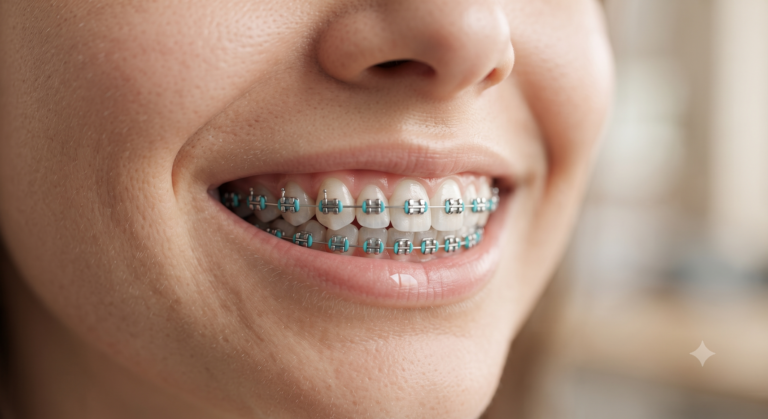
Braces cost between $3,000 and $10,000 without insurance in 2026, depending on the type you choose and how complex your case is. Invisalign runs $3,000 to $8,000 for most patients, with the national average sitting around $5,100. Metal braces remain the cheapest option. Lingual braces — the kind bonded behind your teeth — are the most expensive, sometimes exceeding $13,000 for difficult cases.
Those numbers feel big when you see them on paper, and they should. Orthodontic treatment is one of the largest dental expenses most people face in their lifetime. But the sticker price and the price you actually pay are rarely the same number. Dental schools, community health centers, in-house payment plans, and HSA or FSA accounts can cut real costs by 30 to 50 percent — and none of those options require traditional dental insurance.
Key Takeaways
- Metal braces: $3,000-$7,000 — cheapest option, most effective for complex cases
- Ceramic braces: $4,000-$8,500 — less visible but slightly more expensive than metal
- Invisalign: $3,000-$8,000 — nearly invisible, removable, best for mild to moderate cases
- Lingual braces: $8,000-$13,000 — hidden behind teeth, highest cost, longest adjustment period
- Dental schools charge 30-50% less than private orthodontists for the same treatment
- Insurance typically covers $1,000-$3,000 toward orthodontics — once per lifetime, not annually
What Braces and Invisalign Actually Cost by Type
The price you pay depends heavily on which type of appliance your orthodontist recommends. Here is what each option costs on average across the U.S. in 2026, based on data from CareCredit, the American Association of Orthodontists, and provider surveys.
| Type | Cost Without Insurance | Typical Treatment Time | Best For |
|---|---|---|---|
| Traditional Metal Braces | $3,000-$7,000 | 18-36 months | Complex cases, bite correction, budget-conscious patients |
| Ceramic (Clear) Braces | $4,000-$8,500 | 18-36 months | Adults wanting less visible brackets with full correction power |
| Invisalign (Comprehensive) | $5,000-$8,000 | 12-18 months | Moderate crowding/spacing, adults who need discretion |
| Invisalign Lite / Express | $1,200-$4,500 | 3-12 months | Minor spacing or crowding, touch-ups from relapse |
| Lingual Braces | $8,000-$13,000 | 18-36 months | Patients who need full correction with zero visibility |
A few things worth noting about these numbers. The ranges are wide because orthodontic pricing is not standardized — it varies by region, provider experience, and case complexity. A straightforward spacing case in a midwestern city will cost significantly less than a full bite correction at a Manhattan practice. Adults generally pay $500 to $1,500 more than children for the same treatment because adult bone is denser and teeth move more slowly, extending treatment time.
What Those Prices Actually Include
Most orthodontists quote an all-inclusive fee that bundles everything together: the initial consultation, diagnostic records (X-rays, 3D scans, impressions), the appliance itself, all adjustment visits over the course of treatment, and a set of retainers when the braces come off. Make sure to ask whether the quote you receive is all-inclusive before comparing prices across providers. Some offices break these out separately, and a lower base price can end up costing more once adjustment visits and retainers are added.
The costs that catch people off guard tend to be the ones outside the treatment bundle. Retainer replacements run $150 to $600 depending on the type. Emergency visits for a broken bracket or poking wire may or may not be included. And if you need pre-treatment dental work — fillings, extractions, or gum treatment before braces can go on — those are always billed separately.
Best Places to Get Affordable Braces Without Insurance
The gap between what braces cost at a private orthodontist and what you can actually pay is not as fixed as it looks. Several legitimate options reduce the real price by 30 to 50 percent without cutting corners on care quality.
Dental Schools
University-affiliated dental schools offer orthodontic treatment performed by dental residents under direct faculty supervision. The quality of care is equivalent to a private practice — in many cases the supervising faculty are among the best orthodontists in the region — but fees run 30 to 50 percent lower. Treatment takes longer because appointments include teaching time, so plan for extra visits. The American Dental Association maintains a searchable directory of accredited dental schools by state. Some of the largest programs include NYU College of Dentistry, University of the Pacific in San Francisco, and the University of Texas Health Science Center in Houston.
Federally Qualified Health Centers (FQHCs)
Community health centers that receive federal funding are required to offer services on a sliding-fee scale based on income. Not all FQHCs provide orthodontics, but those that do charge substantially less than private practices. The HRSA Health Center Finder lets you search by ZIP code to find locations near you. Call ahead and ask specifically whether they offer orthodontic services — many locations provide general dentistry but refer out for braces.
In-House Payment Plans
Most private orthodontists offer zero-interest monthly payment plans, typically $89 to $250 per month spread over the length of treatment. This is the most common way uninsured patients pay for braces. The practice collects a down payment (usually $500 to $1,500) and divides the remaining balance into equal monthly installments with no interest. Always ask if the practice offers a pay-in-full discount — many will reduce the total fee by 5 to 10 percent if you pay the entire amount upfront.
HSA and FSA Accounts
If your employer offers a Health Savings Account (HSA) or Flexible Spending Account (FSA), orthodontic treatment is an eligible expense. This effectively gives you a tax deduction on the cost. A family in the 24% federal tax bracket saving $5,000 in an HSA for braces reduces the real cost by $1,200 in taxes alone — before accounting for any state tax savings. FSAs have annual contribution limits ($3,200 in 2026 for healthcare), so plan ahead if treatment costs exceed one year’s limit.
Dental Discount Plans
Dental savings plans — not insurance, but membership-based discount programs — can reduce orthodontic fees by 10 to 60 percent at participating providers. Companies like DentalPlans.com, Careington, and Cigna Dental Savings offer annual memberships ranging from $80 to $200 that unlock negotiated rates at network providers. The savings on braces alone can make the membership cost worthwhile several times over. Just verify that the specific orthodontist you want to use participates in the plan’s network before signing up.
CareCredit and Healthcare Financing
CareCredit offers promotional financing for dental work, including 0% APR plans for 6 to 24 months depending on the provider. If you can pay off the balance within the promotional period, this is effectively free financing. The catch: if you miss the payoff deadline, deferred interest at 26.99% APR applies retroactively to the entire original balance. Only use this option if you are confident you can pay it off within the promotional window. CareCredit also covers other healthcare expenses — if you are budgeting for multiple procedures, check what chiropractor visits cost without insurance to see how the same financing strategies apply.
What Dental Insurance Actually Covers for Braces
Dental insurance covers orthodontics differently than it covers fillings or cleanings. Most plans that include orthodontic benefits apply a lifetime maximum — typically $1,000 to $3,000 — rather than the annual percentage-based coverage used for routine dental work. That means insurance might cover $1,500 of a $6,000 treatment, leaving you responsible for the remaining $4,500.
Coverage is also far more common for children than adults. Many plans cover orthodontics for dependents under 19 but exclude adult orthodontic treatment entirely. If your plan does cover adult braces, check whether it requires pre-authorization and whether it limits you to in-network providers. Some plans also impose waiting periods of 12 to 24 months before orthodontic benefits kick in.
The practical takeaway: dental insurance helps but rarely covers more than a third of the total cost. If you are buying dental insurance specifically to offset braces costs, run the math carefully. Two years of premiums plus the plan’s orthodontic lifetime maximum may or may not beat paying out of pocket with the other strategies listed above. For a deeper look at what dental plans cover for routine care, see our guide on how much a dental cleaning costs without insurance. You can also compare what a dental filling costs without insurance for a sense of routine restorative pricing.
Braces vs Invisalign — How to Choose When You Are Paying Out of Pocket
When you are covering the full cost yourself, the decision between braces and Invisalign is not just cosmetic — it is financial. Here is how to think through it.
Choose metal braces if your case involves significant bite correction (overbite, underbite, crossbite), severe crowding, or if you want the lowest possible price. Metal braces are the workhorse of orthodontics. They handle the widest range of cases, they do not depend on patient compliance (you cannot forget to put them back in), and they tend to be $1,000 to $2,000 cheaper than Invisalign for comparable cases.
Choose Invisalign if your case is mild to moderate, you need discretion for professional or personal reasons, and you are disciplined enough to wear the aligners 20 to 22 hours per day. Invisalign’s biggest advantage is aesthetics and convenience — you can remove them to eat and brush. Its biggest disadvantage is that it requires consistent wear. Patients who remove their aligners too often extend treatment time and may need additional refinement trays at extra cost.
For severe cases, traditional braces are still the gold standard. Invisalign has improved significantly, but complex tooth movements — especially root torque and vertical repositioning — are still more predictable with fixed brackets and wires. If an orthodontist recommends braces over Invisalign for your specific case, that recommendation is usually clinical, not financial.
If you are comparing costs across providers and need to understand how dental restorations factor into the equation, our guide on how much a dental crown costs without insurance covers the pricing mechanics for related dental work.
Do Adults Pay More Than Children?
Yes — by $500 to $1,500 on average. Adult orthodontic treatment costs more for three reasons. First, adult bone is denser than adolescent bone, so teeth move more slowly and treatment takes longer. Second, adults are more likely to have prior dental work (crowns, bridges, implants) that complicates treatment planning. Third, adults more frequently choose the less visible (and more expensive) options like ceramic braces, lingual braces, or Invisalign.
Adult insurance coverage for orthodontics is also less common. Many employer-sponsored dental plans limit orthodontic benefits to dependents under 19. If you are an adult considering braces, confirm your coverage before assuming your plan will help — and factor the full out-of-pocket cost into your decision. The same principle applies to other medical costs that catch adults off guard — see our breakdown of how much an MRI costs without insurance for another common example of price variation by facility.
Frequently Asked Questions
How much is Invisalign without insurance in 2026? +
Invisalign costs $3,000 to $8,000 without insurance for most patients, with the national average around $5,100 according to CareCredit research. Minor cases using Invisalign Express or Lite can cost as little as $1,200 to $3,000. Comprehensive treatment for moderate to complex cases runs $5,000 to $8,000. The final price depends on how many aligner trays your case requires, how long treatment lasts, and your provider’s fee structure.
What is the cheapest way to get braces without insurance? +
Dental schools are consistently the cheapest option, offering braces at 30 to 50 percent below private practice rates — supervised by faculty orthodontists. Combining a dental school with HSA or FSA tax savings can reduce the effective cost by 50 percent or more. If a dental school is not accessible, in-house payment plans at private orthodontists (typically $89 to $250 per month at 0% interest) are the most common way uninsured patients afford treatment.
Does dental insurance cover braces for adults? +
Some dental plans cover adult orthodontics, but coverage is far less common than for children. Plans that do include adult braces typically apply a lifetime maximum of $1,000 to $3,000 — not an annual benefit. Many employer-sponsored plans limit orthodontic coverage to dependents under 19. If your plan covers adult orthodontics, expect to pay $2,500 to $5,500 out of pocket after benefits, depending on the treatment type and your plan’s lifetime cap.
Is Invisalign cheaper than braces? +
For comparable cases, Invisalign and traditional braces cost roughly the same — both fall in the $3,000 to $7,000 range for standard treatment. Invisalign can be cheaper for very minor cases using Express or Lite trays ($1,200 to $3,000), where full braces would be over-treatment. For complex cases, traditional braces are typically $1,000 to $2,000 less expensive than Invisalign and may deliver better clinical results.
Can I use my HSA or FSA to pay for braces? +
Yes. Both HSA and FSA funds can be used for orthodontic treatment, including braces and Invisalign. This allows you to pay with pre-tax dollars, effectively reducing the cost by your marginal tax rate. A family in the 24% federal bracket saves $1,200 on a $5,000 treatment just from the tax benefit. FSAs have annual contribution limits ($3,200 for healthcare in 2026), so you may need to spread contributions across two plan years to cover the full cost. HSAs have no spending deadline, making them more flexible for multi-year treatments.
Disclaimer: This article is for informational purposes only and does not constitute dental, medical, or insurance advice. Treatment costs vary by provider, location, and case complexity. Consult directly with an orthodontist for a personalized treatment plan and cost estimate.