


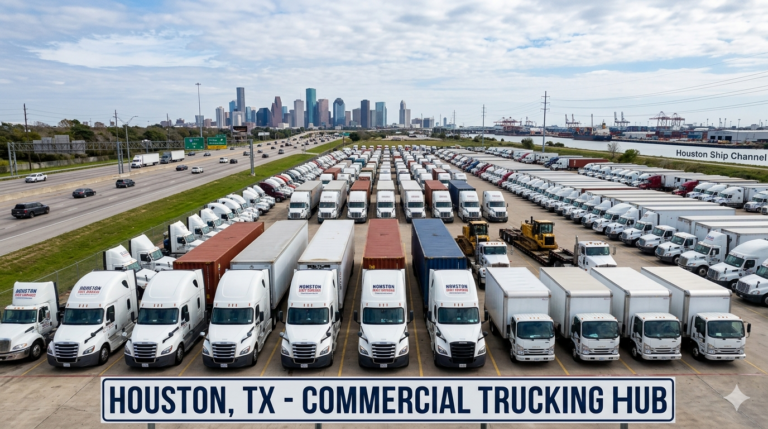
Commercial truck insurance is not a single policy — it’s a coordinated program of coverage lines that together protect a trucking operation’s equipment, cargo, liability exposure, and workforce. A single-truck owner-operator managing local deliveries has meaningfully different insurance needs than a 50-truck fleet running interstate freight under a motor carrier authority. Getting the program wrong in either direction costs money: underinsured fleets face catastrophic uninsured losses, while overinsured operators pay for coverage they cannot trigger. Houston-based logistics companies should review our freight broker insurance guide for Texas-specific licensing and coverage requirements. For companies with business vehicles, our commercial auto insurance guide covers policy structures and pricing for mid-market fleets. Our business liability checklist identifies the coverage gaps mid-market companies miss most often.
Contractors and developers need a coordinated insurance program that layers multiple coverage types — our comprehensive guide to types of construction insurance covers every component.
Contractors operating on construction sites need coverage beyond commercial auto — our guide to construction project insurance costs covers the project-specific coverage layer that protects structures during build-out. For a comparison of digital insurance platforms, see our Otto Insurance review. Our breakdown of monthly gap insurance costs shows what drivers actually pay across different providers.
This guide covers every coverage line a commercial trucking operation needs, what each costs in 2026, and how to structure a program that matches your actual exposure rather than a generic quote.
Key Takeaways for Fleet Operators and Owner-Operators
- Primary liability is mandatory: FMCSA requires minimum $750,000 in primary liability for general freight carriers; $1M for household goods; $5M for hazmat. Most shippers require $1M regardless of regulatory minimum.
- Cargo coverage is separate: Primary liability covers third-party bodily injury and property damage — it does not cover the freight you’re hauling. Motor truck cargo insurance is a distinct line.
- Physical damage is optional but operationally essential: FMCSA doesn’t require it, but any lender financing your equipment does. Losing a $180,000 semi to an at-fault accident without physical damage coverage ends a small carrier.
- Non-trucking liability fills the off-dispatch gap: Primary commercial auto covers drivers under dispatch. When drivers use equipment for personal use, non-trucking liability provides the coverage their personal auto policy excludes.
- Fleet size drives program structure: Small fleets (1–5 trucks) typically use named-driver policies; larger fleets use scheduled vehicle programs with blanket coverage options.
- Houston operators face unique exposures: Gulf Coast weather, ERCOT grid vulnerability for refrigerated cargo, and Texas’s high commercial vehicle accident rate all affect program design and cost.
The Core Coverage Lines Every Trucking Operation Needs
A complete commercial truck insurance program consists of six primary lines. Most trucking operations need all six — the question is limits, deductibles, and whether each line is placed with the same carrier or split across specialists.
Primary Liability Insurance
Primary auto liability is the foundation of every trucking program. It covers bodily injury and property damage you cause to third parties — other drivers, pedestrians, and property — when your truck is at fault in an accident. FMCSA’s minimum limits by cargo type:.
- General freight (non-hazmat): $750,000 per occurrence
- Household goods: $1,000,000 per occurrence
- Hazardous materials (Oil, explosives): $5,000,000 per occurrence
- Hazardous materials (Other): $1,000,000 per occurrence
Regulatory minimums are floors, not recommendations. For additional guidance, explore our resource on umbrella insurance protection. Most major shippers and freight brokers require carriers to carry $1 million per occurrence regardless of cargo type. A single catastrophic accident — a fully loaded semi striking multiple vehicles on a Houston freeway — can generate claims well exceeding $1 million. Our licensed advisors consistently recommend $1M minimum for any carrier regardless of regulatory requirement, and excess liability above that for fleets operating in high-traffic corridors. Real estate investors with multiple properties should evaluate umbrella insurance for real estate portfolios to close gaps between individual property policies.
Physical Damage Insurance
Physical damage covers your own equipment — tractors, trailers, and specialized bodies — against collision damage, comprehensive losses (fire, theft, weather), and specified perils. It has two components:
- Collision: Damage from impact with another vehicle or object regardless of fault
- Comprehensive: Non-collision losses including theft, fire, hail, flooding, and vandalism
Physical damage is not required by FMCSA, but any lender financing equipment requires it as a loan condition. For owned equipment, the decision is risk management: a 5-year-old semi worth $120,000 with a $15,000/year physical damage premium may or may not pencil out depending on your cash reserves and risk tolerance. For newer equipment worth $150,000+, skipping physical damage is rarely advisable.
Houston operators should pay particular attention to comprehensive coverage terms for hail — DFW and Gulf Coast corridor hail events regularly total tractors and damage refrigerated trailers. Confirm your policy covers hail without a separate sub-limit.
Motor Truck Cargo Insurance
Cargo insurance covers the freight you’re hauling against loss or damage during transit. Primary auto liability does not cover cargo — it covers your liability to third parties, not your customers’ goods. If your load of electronics is destroyed in a fire or stolen from your trailer overnight, cargo insurance pays the shipper’s claim.
Cargo limits should match your maximum load value. For additional guidance, explore our resource on insuring collectibles. A flatbed carrying $80,000 in steel needs different limits than a refrigerated trailer carrying $400,000 in pharmaceutical products. Key exclusions to review: most cargo policies exclude refrigeration mechanical breakdown (the cargo spoils because the reefer unit failed, not because of an accident), high-value commodities like electronics or jewelry, and certain hazmat classifications. These exclusions can often be bought back with endorsements.
Non-Trucking Liability
Primary commercial auto covers drivers while operating under dispatch — when hauling freight for your motor carrier authority. When drivers use equipment for personal purposes (driving home, running errands in the cab, deadheading for personal reasons), that use falls outside primary commercial auto coverage. Personal auto policies exclude commercial vehicles entirely. Non-trucking liability fills this gap, providing liability coverage for those off-dispatch personal uses.
For owner-operators leased to a carrier, the carrier’s primary policy typically covers them while under dispatch. Non-trucking liability (sometimes called bobtail insurance) covers them when they’re operating the truck outside of that leased arrangement. Owner-operators who don’t carry it are uninsured for personal use of their equipment.
Trucking General Liability
Commercial auto liability covers accidents involving your vehicles while in operation. Trucking general liability covers everything else — slip-and-fall claims at your terminal, damage caused while loading or unloading freight, products liability if you handle third-party goods, and advertising injury. For carriers with a physical terminal or warehouse, GL is essential. For owner-operators who operate from home without a terminal, GL need is lower but still relevant for loading/unloading operations.
Workers Compensation
Workers compensation is mandatory in Texas for most employers (Texas allows opt-out, but carriers who opt out face unlimited common law liability). Trucking workers comp premiums are driven by payroll and classification codes — over-the-road trucking carries higher rates than local delivery due to higher injury severity. Large fleets often benefit from experience modification factors that reduce premiums when safety programs keep claims below industry averages.
Coverage Costs: What Commercial Truck Operators Actually Pay in 2026
Commercial truck insurance costs vary dramatically based on fleet size, cargo type, operating radius, driver history, and equipment age. These ranges reflect 2026 market rates for Texas operators:
- Primary liability (per truck, annual): $8,000–$18,000 for general freight; $15,000–$35,000+ for hazmat
- Physical damage (per truck): 2–4% of equipment value annually; a $150,000 semi runs $3,000–$6,000/year
- Motor truck cargo (per truck): $1,500–$5,000 depending on commodity and limit
- Non-trucking liability (per truck): $400–$800/year
- Trucking GL: $3,000–$8,000/year for a small fleet
- Workers comp: $8–$15 per $100 of payroll for over-the-road drivers
- Total program (5-truck general freight fleet, Texas): $85,000–$160,000 annually
The largest cost driver is loss history. A carrier with multiple at-fault accidents, cargo claims, or driver violations pays substantially more than a clean operation — often 2–3× base rates. Investing in safety programs, dashcams, and driver monitoring directly translates to lower insurance costs over a 3–5 year horizon. Understanding your claims track record is critical — our loss history report guide covers how CLUE reports affect your premiums.
Tenants often underestimate what they stand to lose — our guide to the benefits of renters insurance covers what the policy protects. For more details, see our guide on renters insurance coverage details.
Liability extends beyond business operations — our guide to personal liability insurance explains individual coverage options.
For related coverage, explore our resources on providers does geico offer gap insurance and coverage exclusions when does gap insurance not. Many drivers with comprehensive policies still wonder whether they need additional protection — our guide on gap insurance with full coverage breaks down when it still applies. For a foundational overview, our complete guide to gap insurance covers what it is, how it works, and who needs it.
Commercial Fleet Insurance Program Review
Our licensed advisors structure commercial truck insurance programs for fleets from single owner-operators to 100+ truck operations across Texas, Florida, and the Northeast. We work with specialized trucking carriers including Progressive Commercial, National Interstate, and Canal Insurance to build programs that match your actual exposure.
Request a Fleet Insurance ReviewServing fleets with $100K+ in annual insurance premiums. Houston office: 713.324.7680 For more details, see our guide on homeowners insurance costs. For more details, see our guide on homeowners dock coverage. Homeowners facing rising premiums should review our breakdown of 2026 homeowners insurance rate increases and the strategies to manage costs. Homeowners considering a switch should follow our step-by-step guide to changing homeowners insurance providers to avoid coverage gaps.
How Fleet Size Changes Program Structure
Insurance program structure changes meaningfully as fleet size grows. A single truck operation and a 50-truck operation have fundamentally different underwriting profiles, carrier options, and cost structures.
1–3 trucks: Named-driver policies, limited carrier options, highest per-unit cost. New ventures with no loss history face admitted market challenges and often need non-standard carriers. Premiums are highest per truck at this size.
4–10 trucks: Fleet rating begins to apply, opening more carrier options. Safety programs and dashcam documentation meaningfully reduce costs. This is the range where bundling all lines with one carrier (vs. split placement) typically produces the best pricing.
10–50 trucks: Experience modification factors apply significantly. Fleets with clean 3-year loss histories can qualify for substantial discounts. Programs often split primary liability, physical damage, and cargo across specialized carriers for optimal pricing. Safety coordinators and driver monitoring programs have direct measurable impact on insurance costs.
50+ trucks: Large-fleet programs can include retrospective rating (pay-as-you-go based on actual losses), captive arrangements, or self-insured retention layers for physical damage. At this size, risk management and claims management become as important as carrier selection.
Texas and Houston-Specific Considerations
Texas presents a specific insurance environment for commercial trucking that differs from other major trucking markets:
High accident severity: Texas consistently ranks among the top states for commercial vehicle fatality rates. Houston’s freeway network — particularly I-10, I-45, and the Beltway — sees high-speed commercial vehicle accidents that generate outsized liability claims. Carriers operating in Houston should carry limits well above FMCSA minimums.
Houston-based commercial operators share overlapping facility insurance requirements with specialty trade contractors — see our guide to Houston commercial contractor insurance for the full compliance landscape.
Weather exposure: Gulf Coast hurricanes affect cargo in transit, refrigerated trailers, and physical damage on parked equipment. ERCOT grid vulnerability creates additional exposure for refrigerated cargo operations — a multi-day power outage during extreme weather can spoil loads even when trucks are stationary. Confirm your cargo policy covers reefer breakdown from grid failures, not just mechanical failures. South Florida homeowners face some of the highest rates in the country — our Fort Lauderdale homeowners insurance guide covers what drives costs.
Texas workers comp opt-out: Texas allows employers to opt out of the workers comp system. Most trucking operations should not opt out — the unlimited common law liability exposure for an injured over-the-road driver far exceeds workers comp premiums. Major shippers increasingly require Texas carriers to carry workers comp regardless of the legal opt-out option.
UIIA and intermodal requirements: Houston’s port and rail intermodal operations have specific insurance requirements under the Uniform Intermodal Interchange and Facilities Access Agreement. Carriers pulling port containers need to verify their programs meet UIIA requirements, which differ from standard FMCSA minimums.
Core Trucking Coverages Compared
Operators routinely buy one line and assume it answers a loss it was never built for. Here’s how the core lines divide the risk:
| Coverage | Protects | Cost driver |
|---|---|---|
| Auto liability | Third-party injury/damage you cause | Driving records; radius; limits (social inflation pressure) |
| Physical damage | Your own tractor/trailer | Unit value; deductible |
| Motor truck cargo | Freight you’re hauling | Commodity type; limit per load |
| Non-trucking / bobtail | Use outside dispatch | Owner-operator status |
| General liability | Premises/operations off the road | Operations scope |
The 2026 cost-driver to watch: commercial auto is the hardest line in the entire P&C market — premiums rose ~5.8% in Q1 2026, the 59th consecutive quarter of increases (CIAB), driven by claims inflation and litigated claims. Trucking sits at the center of that pressure, which is why limit adequacy — not just price — is the real 2026 decision.
Directional, peer-relative positioning — not a quote. Actual cost depends on your operation, loss history, and market at renewal.
Frequently Asked Questions: Commercial Truck Insurance
How much does commercial truck insurance cost per year? +
A single-truck owner-operator running general freight in Texas typically pays $12,000–$22,000 annually for a complete program including primary liability, physical damage, cargo, and non-trucking liability. A 5-truck general freight fleet runs $85,000–$160,000 per year. Hazmat carriers pay substantially more — $25,000–$50,000 per truck for primary liability alone.
The largest cost variables are loss history, driver MVR records, operating radius, and cargo type. Clean operations with experienced drivers and documented safety programs can pay 40–60% less than comparable fleets with poor loss history. Annual rate increases in the commercial trucking market have run 5–12% in recent years due to rising accident severity and nuclear nuclear verdicts and excess liability exposure. For current benchmarking data, our commercial insurance market performance report tracks rate movements across all major lines.
What is the FMCSA minimum insurance requirement for trucking? +
FMCSA requires carriers to file proof of insurance (Form MCS-90) as a condition of operating authority. Minimums are $750,000 for general freight, $1,000,000 for household goods and most hazmat, and $5,000,000 for the most hazardous materials including explosives and certain toxic inhalation hazards. These are statutory minimums — not recommendations. Need interim proof of coverage? Our guide to insurance binders explains how temporary coverage works and when you need one.
Most shippers, brokers, and load boards require $1,000,000 regardless of cargo type, effectively making $1M the market minimum. Beyond that, excess liability — $1M or $2M excess over primary — is increasingly required by larger shippers and is strongly recommended given today’s commercial trucking verdicts, which regularly exceed $10 million.
Does commercial truck insurance cover the cargo inside the trailer? +
No — primary liability does not cover cargo. It covers bodily injury and property damage you cause to third parties. Motor truck cargo insurance is a separate line that covers loss or damage to the freight you’re hauling. This is one of the most common gaps in trucking programs: carriers assume their liability policy covers cargo claims and discover the gap only after a significant load loss.
Cargo limits should reflect your maximum load value. Review exclusions carefully — refrigeration breakdown, high-value electronics, and certain commodities are commonly excluded from standard cargo policies. If you regularly haul high-value freight, confirm your policy limits and exclusions match your actual exposure before accepting loads.
What is bobtail insurance and do I need it? +
Bobtail insurance (also called non-trucking liability) covers a truck tractor operating without a trailer or operating outside the scope of your commercial authority — essentially, personal use of your commercial equipment. Primary commercial auto coverage applies while you’re under dispatch hauling freight. It doesn’t apply when you’re driving the truck home, making personal trips, or deadheading outside your dispatch.
Personal auto policies exclude commercial trucks. Without bobtail insurance, you’re uninsured for personal use of your rig. For owner-operators leased to a carrier, the carrier’s primary policy covers them under dispatch — bobtail fills the gap outside that arrangement. It’s relatively inexpensive ($400–$800/year per unit) relative to the exposure it covers.
How do I reduce my commercial truck insurance premiums? +
The highest-impact cost reduction levers: clean driver MVR records (violations and accidents drive premium increases that persist 3–5 years), dashcam systems with forward-facing and driver-facing cameras (many carriers offer 5–15% discounts and they provide critical defense documentation), electronic logging devices and telematics (speed, braking, and hours-of-service compliance all factor into underwriting), and a documented safety program with regular driver evaluations.
On the program structure side: higher deductibles on physical damage (going from $1,000 to $5,000 deductible on a 10-truck fleet can save $8,000–$15,000 annually), annual policy review with multiple carrier quotes rather than auto-renewal, and working with a specialized trucking broker rather than a generalist. Trucking insurance requires specialist underwriting — generalists often don’t have access to the best trucking market carriers.
Disclaimer: This article is for informational purposes only and does not constitute legal or insurance advice. Commercial trucking insurance requirements, FMCSA regulations, and carrier-specific terms vary. Consult with licensed insurance advisors for guidance specific to your operation, cargo type, and fleet size.
Commercial Truck Insurance Resource Library
Complete coverage guides for every trucking insurance line:
- Commercial Dump Truck Insurance: What It Costs in 2026
- Box Truck Insurance: What Owner-Operators and Small Fleets Pay
- Semi Truck Insurance: What Large Fleet Operators Pay
- Motor Truck Cargo Insurance: Coverage for Freight Carriers
- Trucking General Liability Insurance
- Physical Damage Coverage for Commercial Trucks
- Non-Trucking Liability: Bobtail Coverage for Owner-Operators
- Houston Commercial Truck Insurance: Port and Freeway Risk
- Commercial Auto vs. Personal Auto Insurance
- Cargo Insurance: What Freight Brokers and Carriers Need
Hotaling Insurance Services — Commercial Trucking Practice
We structure commercial truck insurance programs for fleets of all sizes — from single owner-operators to 100+ truck fleets. Our licensed advisors work with specialized trucking carriers to build programs that cover your actual exposure without paying for coverage you can’t trigger.
- ✓ Houston office: 24 Greenway Plaza, Suite 800 | 713.324.7680
- ✓ Nationally licensed in 50 states
- ✓ Specialized trucking carrier access: Progressive Commercial, National Interstate, Canal, and more
- ✓ $368M in managed premium volume