


Reading Time: 12 minutes
What Is a Data Center and Why Does It Need Specialized Insurance – Hotaling Insurance Guide
Key Takeaways for Enterprise Risk Managers
- Data Centers Defined: A data center is a physical facility housing computer servers, storage systems, and networking equipment that processes and stores massive volumes of digital data — and the insurance requirements bear zero resemblance to standard commercial property coverage
- Scale Creates Unique Risk: Hyperscale data centers exceed 100MW of power draw, contain billions of dollars in GPU hardware, and operate 24/7 — creating property, liability, and business interruption exposures that most carriers have never underwritten
- $7 Trillion Construction Pipeline: McKinsey estimates up to $7 trillion in global data center construction spending by 2030, generating unprecedented demand for builders risk, workers compensation, and technology equipment coverage
- Insurance Market Transformation: Aon’s Data Center Lifecycle Insurance Program now offers up to $2.5 billion in coverage, signaling that specialized products are replacing generic commercial policies for this asset class
- Enterprise Exposure: Any business relying on cloud computing, AI platforms, or third-party data processing carries downstream risk tied to data center infrastructure — even if you don’t own or operate one
Most executives think of data centers as someone else’s problem — rows of blinking servers in a building they’ll never visit. That assumption worked fine when your company’s data lived on a server closet down the hall. It doesn’t hold up when your entire operation runs on cloud infrastructure housed in a facility consuming more electricity than a small city.
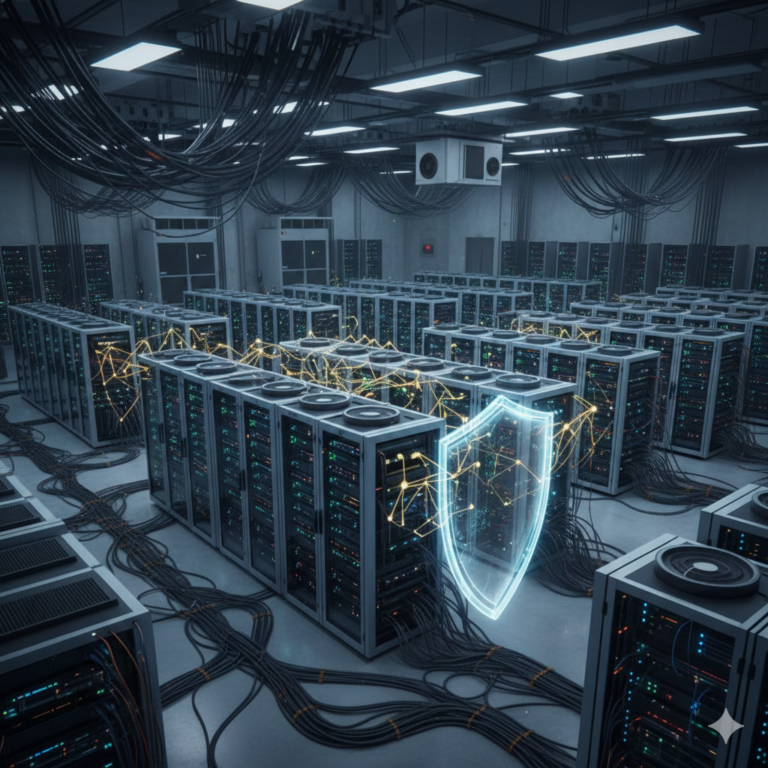
A data center is a purpose-built facility designed to house, power, cool, and protect the computing infrastructure that modern businesses depend on for everything from email to artificial intelligence. According to the Congressional Research Service, U.S. data centers consumed approximately 176 terawatt-hours of electricity in 2023 alone — roughly 4.4% of total national electricity consumption. The insurance implications of operating, building, or even depending on these facilities are staggering.
- Data centers range from single-room server closets in office buildings to hyperscale campuses spanning thousands of acres with power draws exceeding 1 gigawatt
- The core components — servers, storage arrays, networking equipment, cooling systems, and backup power — each carry distinct insurance exposures that standard commercial policies don’t address
- Cooling alone can account for 30-40% of a data center’s total energy consumption, introducing water damage, chemical handling, and mechanical breakdown risks that require specialized coverage endorsements
- Uninterruptible power supply systems and backup generators create fire, fuel storage, and environmental liability exposures on top of the primary electrical infrastructure
- Our licensed advisors structure insurance programs that address the full spectrum of data center risk — from construction through operations — for developers, contractors, and the enterprise businesses that depend on this infrastructure
How Data Centers Actually Work — And Where Insurance Gaps Hide
The Physical Infrastructure Layer
Walk into a hyperscale data center and you’re looking at a facility engineered to tolerances that make most commercial construction look casual. The building itself is just a shell for layers of interconnected systems — power distribution, cooling, fire suppression, physical security, and network connectivity — each creating its own risk profile. When one system fails, the cascade can destroy hundreds of millions of dollars in equipment within minutes.
The International Energy Agency reports that roughly half of a data center’s electrical demand powers IT equipment directly, with cooling and infrastructure consuming the rest. This split matters for insurance because property policies must cover both the technology assets and the mechanical systems keeping them operational.
- Server racks in AI-optimized facilities now draw 40-100+ kilowatts each, compared to 5-15 kilowatts for traditional racks — concentrating enormous property values in tight physical footprints
- Liquid cooling systems replacing traditional air conditioning introduce water damage risks directly adjacent to millions of dollars in electronic equipment
- Redundant power feeds, automatic transfer switches, and battery backup systems create electrical fire exposures that standard property policies often exclude or sub-limit
- Physical security infrastructure including biometric access, mantrap entries, and 24/7 monitoring creates premises liability exposure distinct from typical commercial buildings
- We’ve helped Houston-area technology companies audit their existing property policies and discovered coverage gaps averaging $15-25 million in uninsured data center equipment values
Understanding Tiered Reliability Standards
The data center industry classifies facilities into tiers based on redundancy and uptime guarantees. A Tier I facility offers basic capacity with no redundancy, while a Tier IV facility provides fault-tolerant infrastructure with 99.995% uptime. The tier classification directly impacts insurance underwriting because higher tiers mean more complex mechanical systems, higher construction costs, and greater business interruption values when something goes wrong. For more details, see our guide on key person insurance costs.
Insurance carriers pricing data center coverage need to understand the difference between a Tier II colocation facility and a Tier IV hyperscale campus. The property values, business interruption exposure, and mechanical breakdown risks differ by orders of magnitude — and policies written without this understanding leave gaps that surface only during claims.
Organizations looking to understand how rapid data center expansion is reshaping coverage requirements will find our detailed breakdown of data center growth and insurance implications a useful companion resource.
- Tier I facilities support a single distribution path with no redundancy, creating total-loss exposure from any single point of failure in power or cooling
- Tier III and IV facilities require concurrent maintainability and fault tolerance, meaning parallel mechanical and electrical systems that double construction costs but reduce downtime risk
- Business interruption values scale exponentially with tier classification — a Tier IV facility serving enterprise cloud customers may generate $50-100 million in monthly revenue that stops entirely during an outage
- Insurers increasingly require independent risk engineering assessments of tier classification claims before binding coverage, as many operators overstate their redundancy capabilities
- Our team works with carriers who specialize in technology infrastructure underwriting and understand how tier classification affects premium pricing, deductible structures, and coverage terms
Related Resources: nonprofit directors officers insurance • does zenni take insurance
Related: Otto Insurance rates
Data Center Insurance Program Assessment
Whether you’re building, operating, or critically dependent on data center infrastructure, your insurance program needs to reflect the specialized risk profile of these facilities. Our licensed advisors work with enterprise clients managing complex technology infrastructure across Houston, Miami, and NYC.
Request Data Center Insurance ReviewServing businesses with $1M+ annual insurance premiums across technology and construction sectors.
Why Standard Commercial Insurance Fails Data Centers
Property Coverage Gaps
Here’s what catches most CFOs off guard: the standard commercial property policy sitting in your desk drawer was designed for office buildings, retail spaces, and light manufacturing. It was never engineered to cover a facility where a single floor contains more asset value than most commercial real estate portfolios. Data center equipment — GPU racks, custom cooling systems, fiber optic interconnects — falls into coverage gray zones that standard policies handle poorly or exclude entirely.
Morgan Lewis attorneys analyzing data center insurance risks emphasize that policyholders must ensure property policies cover the entirety of the data center operation — structures, infrastructure, equipment, computer systems, and business personal property. Most don’t, at least not adequately.
- Electronic equipment exclusions in standard property policies can void coverage for servers, GPUs, and networking hardware that represent 60-70% of a data center’s total insurable value
- Water damage exclusions become critical when liquid cooling systems — now the industry standard for AI workloads — operate inches away from equipment worth hundreds of millions
- Business interruption sub-limits designed for office buildings cap at values that a hyperscale data center can exceed in a single day of downtime
- Equipment breakdown coverage must extend beyond standard boiler and machinery policies to address the specialized power distribution, cooling, and UPS systems unique to data centers
- We structure technology property programs using specialty markets and London syndicates that understand data center valuations and provide limits adequate for hyperscale operations
Liability Exposures Most Operators Miss
Data center operators face liability exposures from three directions simultaneously: the physical premises, the technology services they deliver, and the regulatory environment governing data handling. A visitor injury on-site triggers standard GL coverage. A service outage affecting enterprise customers triggers professional liability. A data breach affecting stored information triggers cyber liability. Most operators carry all three policies — but the coordination between them creates gaps that plaintiff attorneys exploit.
Organizations looking to understand how power infrastructure creates insurance exposure for data center operators will find our detailed breakdown of power infrastructure insurance exposure a useful companion resource.
The contractual environment makes this worse. Enterprise service level agreements (SLAs) create financial penalties for downtime that can reach millions of dollars per hour. These contractual obligations need to align with insurance coverage, and we regularly find that they don’t.
- General liability policies must address premises exposure for construction workers, maintenance technicians, vendors, and authorized visitors accessing secured facilities
- Professional liability (E&O) coverage should respond to claims arising from service interruptions, data loss, and failure to meet contractual uptime guarantees
- Cyber liability has become the fastest-growing coverage need as data centers store and process sensitive information subject to HIPAA, PCI-DSS, SOX, and state privacy regulations
- Environmental liability addresses diesel fuel storage for backup generators, cooling chemical handling, and battery disposal from UPS systems
- Our licensed advisors coordinate GL, professional liability, cyber, and environmental coverage into integrated programs that eliminate the gaps between individual policies
Case Study: How Meridian Infrastructure Partners Discovered $40 Million in Coverage Gaps
Meridian Infrastructure Partners (name changed for confidentiality) operates three colocation data centers in the Houston metropolitan area, serving mid-market enterprise clients across energy, healthcare, and financial services. Their CEO brought us in after a minor cooling system failure exposed a much bigger problem — their insurance program had been built piecemeal over five years by three different brokers, and nobody had audited it as a unified risk profile.
What we found wasn’t unusual for data center operators who’ve grown quickly. It was typical — and that’s what made it alarming.
- Their commercial property policy excluded “electronic data processing equipment” above $2 million — leaving $38 million in server and networking hardware uninsured against fire, flood, or mechanical failure
- Business interruption coverage capped at $5 million annually, despite SLA obligations that would generate $12 million in contractual penalties from a 72-hour facility-wide outage
- Workers compensation covered their 45 full-time employees but excluded the 120+ contract technicians who performed 60% of on-site maintenance work
- No environmental liability policy existed despite storing 15,000 gallons of diesel fuel for backup generators across three sites
- We restructured their program with a specialty technology property policy, increased BI limits to match contractual exposure, added a contractor-inclusive workers comp endorsement, and placed environmental coverage — reducing their total premium by 8% while closing every identified gap
Don’t Wait for a Claim to Find Your Coverage Gaps
Data center insurance programs require specialized expertise that most commercial brokers don’t possess. Our licensed advisors have structured coverage for technology infrastructure operators across Texas, Florida, and the Northeast.
Schedule Coverage AuditMinimum $1M annual premium. Enterprise clients only.
The Construction Insurance Dimension
Why Building Data Centers Is Different from Everything Else
Data center construction sits at the intersection of commercial building, heavy industrial, and technology installation — creating a risk profile that doesn’t fit neatly into any standard construction insurance category. The buildings themselves are relatively straightforward concrete and steel shells. But the power infrastructure, cooling systems, and technology equipment installed inside those shells represent values that dwarf the structure itself, often by a factor of 5:1 or more.
Organizations looking to understand how enterprise CEOs are structuring data center risk management programs will find our detailed breakdown of how CEOs are managing data center risk a useful companion resource.
We’ve written extensively about builders risk insurance for data center construction and the unique challenges these projects present. Builders risk values for hyperscale data center buildings typically range from $200 million to $2 billion per building, pushing well past the capacity of most standard construction insurance markets. For a deeper look at how this affects Texas contractors specifically, our Texas Data Center Boom Insurance Guide covers the Stargate, Tract, and Vantage corridors in detail.
- Builders risk policies must cover not just the building shell but the GPU racks, liquid cooling systems, and power distribution equipment being installed — which standard forms often exclude
- Delayed completion coverage is critical when lenders have structured billions in financing around specific delivery dates and missing milestones triggers loan covenant violations
- Workers compensation for data center construction spans trade classifications from heavy civil to precision electrical, with 5,000-7,000 workers on a single campus generating massive exposure
- Owner Controlled Insurance Programs (OCIPs) consolidate coverage for all contractors on campus-scale projects, eliminating gaps between individual subcontractor policies
- Our advisors structure construction insurance programs for data center projects with capacity sourced from excess and surplus lines markets and London syndicates experienced in technology infrastructure values
Who Needs Data Center Insurance — Even If You Don’t Own One
Enterprise Cloud Dependency Risk
Here’s the part most CEOs don’t think about: if your business runs on AWS, Azure, Google Cloud, or any third-party data center provider, you carry downstream risk tied to that provider’s physical infrastructure. A tornado destroying a hyperscale campus in Texas doesn’t just affect the facility owner — it affects every enterprise customer whose applications, data, and operations lived in that facility.
Your standard business interruption policy probably covers income loss from damage to your own premises. But does it cover income loss when your cloud provider’s data center goes offline? For most enterprise policies, the answer is no — or the sub-limits are laughably inadequate relative to actual exposure.
- Contingent business interruption coverage extends protection to losses caused by damage to a key supplier’s or customer’s property — including data center providers
- Service interruption coverage specifically addresses losses from utility and service provider failures, though exclusions for cyber-induced outages require careful policy negotiation
- Technology E&O policies should include coverage for downstream losses when your SaaS product or digital service fails because your infrastructure provider experienced a physical loss
- Contract review is essential — most cloud service agreements limit the provider’s liability to credits against future service fees, not actual business losses
- We help enterprise clients in the Houston energy sector and other industries evaluate their cloud dependency exposure and structure coverage programs that address third-party infrastructure risk
Case Study: When Atlas Logistics Group Lost $3.2 Million in 47 Hours
Atlas Logistics Group (name changed for confidentiality) is a Houston-based freight management company with $95 million in annual revenue and 340 employees. Their entire dispatch, routing, and customer communication platform ran on a single colocation provider’s infrastructure in Dallas. When that provider experienced an HVAC failure that cascaded into a facility-wide shutdown, Atlas went dark for 47 hours.
The financial damage was immediate and severe — and their insurance program covered almost none of it.
Organizations looking to understand what developers and contractors should expect from construction insurance costs will find our detailed breakdown of data center construction insurance costs a useful companion resource.
- Direct revenue loss from 47 hours of dispatch downtime totaled $1.8 million in missed shipments, rerouted freight, and penalty charges from enterprise customers
- An additional $900,000 in emergency costs covered manual dispatch operations, overtime for terminal workers handling paper-based processes, and expedited freight to fulfill time-sensitive contracts
- Customer relationship damage resulted in two enterprise accounts ($14 million combined annual revenue) issuing RFPs to competing carriers within 30 days of the outage
- Their existing business interruption policy required physical damage to Atlas’s own premises — the colocation provider’s HVAC failure didn’t trigger coverage
- After engaging our team, we placed a contingent business interruption policy with service interruption extensions, technology E&O with downstream coverage, and negotiated improved SLA terms with their replacement colocation provider — total additional premium was $47,000 annually against $3.2 million in demonstrated exposure
Enterprise Cloud Risk Assessment
If your business depends on third-party data center infrastructure, your insurance program should reflect that dependency. Our licensed advisors evaluate cloud concentration risk and structure coverage that responds when your provider’s facility fails — not just your own.
Request Cloud Risk AssessmentServing mid-market and enterprise businesses with $1M+ annual insurance premiums.
The Insurance Market Is Evolving — Rapidly
The data center insurance market is transforming faster than any segment we’ve seen in commercial insurance. Aon launched its Data Center Lifecycle Insurance Program with up to $2.5 billion in coverage spanning construction, operations, and cyber. Munich Re offers up to $250 million in net construction capacity for individual data center projects. These aren’t incremental changes — they represent a fundamental restructuring of how carriers approach technology infrastructure risk.
For enterprise businesses navigating this market, the opportunity is clear: specialized products now exist that didn’t two years ago. But accessing them requires working with a broker who understands both the data center industry and the specialty insurance markets serving it. The gap between what’s available and what most businesses actually carry is enormous.
- Lifecycle products binding construction and operational coverage under a single policy eliminate transition gaps that historically created uninsured exposure during commissioning phases
- Parametric insurance products tied to grid outages or uptime thresholds deliver liquidity when traditional claims triggers are contested
- Residual value insurance protects data center investors and lenders against tenant cancellations or stranded asset risk as the market evolves
- The June 2025 federal designation of hyperscale data centers as “Critical Digital Infrastructure” unlocked expedited permitting and eligibility for federal risk-sharing programs
- We’re actively placing these next-generation data center insurance products for developers, operators, and enterprise tenants across our Houston, Miami, and NYC markets
Frequently Asked Questions
What is a data center and why does it need specialized insurance? +
A data center is a physical facility that houses computer servers, storage systems, networking equipment, and supporting infrastructure like cooling and backup power systems. These facilities process and store the data that modern businesses rely on for cloud computing, artificial intelligence, and digital operations.
Organizations looking to understand the full coverage structure for data center construction projects will find our detailed breakdown of data center construction insurance coverage a useful companion resource.
Data centers need specialized insurance because standard commercial property and liability policies weren’t designed for facilities containing billions of dollars in electronic equipment, consuming megawatts of electricity, and generating revenue that stops entirely during any interruption. Specialty coverage addresses electronic equipment values, technology-specific business interruption, environmental liability from cooling and fuel systems, and the complex contractual obligations of service level agreements.
How much does data center insurance cost for enterprise operations? +
Data center insurance costs vary dramatically based on facility size, tier classification, geographic location, and the specific coverage structure. For a mid-market colocation facility with $50-100 million in total insurable values, annual premiums typically range from $150,000 to $500,000 for a comprehensive program including property, liability, cyber, and business interruption coverage.
Hyperscale facilities with insurable values exceeding $1 billion can see annual premiums in the $2-10 million range. Construction-phase insurance for new data center builds adds builders risk premiums of $0.15-$0.50 per $100 of project value. Our licensed advisors can provide specific premium indications based on your facility’s risk profile and coverage requirements.
Does my business need data center insurance if we only use cloud services? +
Yes. If your business operations depend on cloud infrastructure — AWS, Azure, Google Cloud, or any third-party data center provider — you carry downstream risk that most standard business insurance policies don’t adequately address. When your cloud provider’s physical facility experiences damage or downtime, your business suffers revenue loss and operational disruption that standard business interruption policies typically exclude.
Contingent business interruption coverage and service interruption extensions can fill this gap. These endorsements respond to losses caused by damage to your key service provider’s infrastructure, not just your own premises. For enterprise businesses generating $20M+ in annual revenue with significant cloud dependency, this coverage is essential.
Organizations looking to understand exactly what builders risk policies cover on data center projects will find our detailed breakdown of what builders risk insurance covers for data centers a useful companion resource.
What types of insurance do data center construction projects require? +
Data center construction requires builders risk insurance covering the building shell and all installed technology equipment, workers compensation for construction trades, commercial general liability for contractors, commercial auto, umbrella/excess liability (typically $10M-$25M), and often professional liability and pollution liability. Contract specifications from developers typically dictate minimum coverage requirements.
Large campus projects may use Owner Controlled Insurance Programs (OCIPs) or Contractor Controlled Insurance Programs (CCIPs) that consolidate coverage for all participants. Inland marine coverage for technology equipment in transit and during installation is also essential. Our advisors help contractors navigate these requirements and build programs that qualify them for data center construction contracts.
How is AI changing data center insurance requirements? +
AI workloads have fundamentally changed data center insurance requirements by dramatically increasing power density, equipment values, and cooling complexity. AI-optimized server racks draw 40-100+ kilowatts compared to 5-15 kilowatts for traditional racks, concentrating enormous property values in smaller physical footprints. A single advanced GPU rack can cost hundreds of thousands of dollars, and a single data center building may house billions in AI hardware.
The shift to liquid cooling for AI workloads introduces water damage risks adjacent to high-value electronic equipment. Business interruption values have increased exponentially as AI services generate revenue measured in millions per day. These changes require higher property limits, specialized equipment coverage, enhanced BI valuations, and updated risk engineering assessments that account for AI-specific infrastructure demands.
Related Data Center Insurance Resources
You may also find our guides on vendor liability insurance and daycare liability insurance helpful.
Disclaimer: This article is for informational purposes only and does not constitute financial, legal, or insurance advice. Data center insurance programs require individualized analysis based on specific facility operations, technology infrastructure, and risk exposures. Consult with our licensed insurance advisors for guidance tailored to your organization’s needs.
Complete Data Center Insurance Resource Library
Deep-dive guides for every coverage line and risk category:
- AI Data Center Insurance: Hyperscale Risk and Coverage Gaps 2026
- Data Center Cyber Insurance: Coverage and Costs 2026
- Data Center Business Interruption Insurance
- Colocation Data Center Insurance: Operators and Tenants
- Data Center Insurance Cost Guide 2026
- Texas Data Center Insurance: ERCOT and Hurricane Risk
- Data Center Environmental Liability Insurance
Work With Licensed Enterprise Insurance Advisors
Hotaling Insurance Services specializes in comprehensive insurance programs for data center operators, developers, contractors, and enterprise businesses dependent on digital infrastructure. Our licensed advisors bring decades of experience structuring coverage for complex technology operations across multiple states and jurisdictions.
Credentials & Expertise:
- ✓ Nationally licensed in 50 states
- ✓ $368M in managed premium volume
- ✓ 99.7% client retention rate
- ✓ Partnerships with top-tier carriers (Hartford, Travelers, AIG, Chubb, etc.)
- ✓ Specialized expertise in technology infrastructure, construction, and enterprise risk management
Serving Houston, Miami, and NYC markets. Minimum $1M annual premium.