


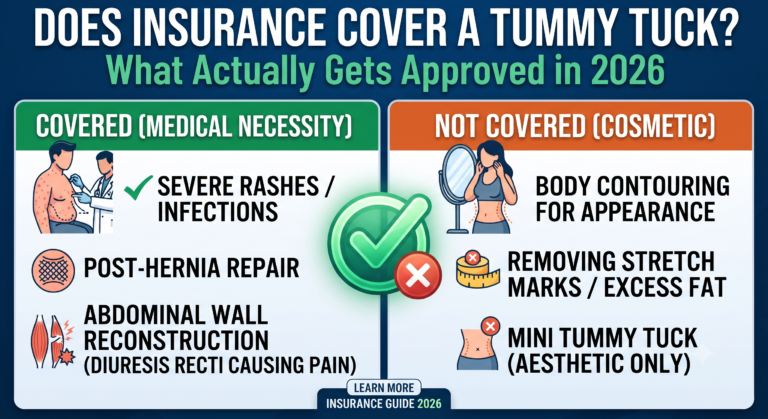
No — health insurance does not cover a cosmetic tummy tuck. Insurers classify abdominoplasty as an elective cosmetic procedure and exclude it from coverage regardless of the reason. Pregnancy, aging, weight fluctuation, and dissatisfaction with abdominal appearance are all considered cosmetic motivations that do not meet the medical necessity standard insurers require.
There is, however, a related procedure that insurance does cover under specific conditions: a panniculectomy. A panniculectomy removes the hanging apron of excess skin (called a pannus) from the lower abdomen when it causes documented medical problems — chronic skin infections, rashes that do not respond to treatment, back pain, or functional limitations. If your surgeon can demonstrate medical necessity and your documentation meets the insurer’s criteria, a panniculectomy may be covered. Understanding the difference between these two procedures is the key to knowing what your insurance will and will not pay for.
Key Takeaways
- Cosmetic tummy tuck (abdominoplasty): NOT covered by insurance — $6,000-$20,000 out of pocket
- Panniculectomy (medical skin removal): MAY be covered if medical necessity criteria are met
- The difference: A tummy tuck tightens muscles and contours the waist. A panniculectomy only removes hanging skin causing medical problems
- To qualify for coverage: You typically need 6+ months of documented failed conservative treatment (dermatology, physical therapy, skin care regimens)
- After bariatric surgery: Coverage is more likely if you have maintained stable weight for 12-18 months and have documented complications from excess skin
- Financing options: CareCredit, Alphaeon Credit, PatientFi, and surgeon payment plans make self-pay manageable at $150-$400/month
Tummy Tuck vs. Panniculectomy — Why It Matters for Insurance
These two procedures are frequently confused, and the confusion costs patients money. Surgeons perform both, but insurance treats them completely differently.
| Tummy Tuck (Abdominoplasty) | Panniculectomy | |
|---|---|---|
| Purpose | Cosmetic: flatten abdomen, tighten muscles, contour waistline | Medical: remove hanging skin causing infections, rashes, mobility issues |
| Muscle repair | Yes — repairs diastasis recti (separated muscles) | No — only removes excess skin and fat |
| Belly button | Repositioned for cosmetic result | Not repositioned |
| Insurance | NOT covered (cosmetic) | MAY be covered (medical necessity) |
| Cost without insurance | $6,000-$20,000 | $4,000-$15,000 |
| Recovery | 4-6 weeks (more extensive) | 3-5 weeks |
Many patients want a tummy tuck but qualify only for a panniculectomy. Some surgeons will perform both simultaneously — the panniculectomy portion billed to insurance, the cosmetic tummy tuck portion billed to the patient. This hybrid approach can reduce the out-of-pocket cost significantly, but not every insurer allows it and not every surgeon offers it. Ask your surgeon specifically whether they can bill the medical and cosmetic portions separately.
What Insurance Actually Requires for Panniculectomy Approval
Getting a panniculectomy covered requires clearing a documentation hurdle that most patients underestimate. Insurers do not approve based on a single doctor’s note. They require a trail of evidence showing that conservative treatment failed over a sustained period. Here is what most major insurers (UnitedHealthcare, Aetna, Blue Cross, Cigna) require before approving coverage.
First, you need a documented BMI history. Most insurers require your BMI to be at or below 30 at the time of surgery — or at minimum, you must have maintained a stable weight for 12 to 18 months after significant weight loss. If your BMI is above 30, the insurer will argue that further weight loss could reduce the excess skin without surgery.
Second, you need 3 to 6 months of documented conservative treatment for the skin-related medical conditions. That means dermatology visits for recurring rashes or infections under the skin fold, prescriptions for antifungal or antibiotic treatments, documentation that the treatments did not resolve the problem, and photos of the affected areas taken at medical appointments. Insurers want to see that you tried non-surgical options and they failed.
Third, you need a letter of medical necessity from your surgeon. The letter must connect the excess skin to specific medical conditions — not discomfort, not appearance, not inconvenience. The language matters enormously. “Patient has chronic intertrigo under the pannus that has not responded to six months of topical antifungal treatment” gets approved. “Patient is unhappy with excess abdominal skin” gets denied immediately.
Fourth, most insurers require prior authorization before the surgery is scheduled. Submitting the surgery and billing after the fact almost always results in denial. The prior authorization process takes 2 to 6 weeks and may involve a peer-to-peer review where your surgeon speaks directly with the insurer’s medical director.
How Much a Tummy Tuck Costs Without Insurance
The national average for a cosmetic tummy tuck is $8,174 according to the American Society of Plastic Surgeons, but the total out-of-pocket cost — including surgeon’s fee, anesthesia, facility fee, and post-operative garments — runs $6,000 to $20,000 depending on the type of procedure and where you live.
| Procedure Type | Total Cost | What It Includes |
|---|---|---|
| Mini Tummy Tuck | $4,000-$8,000 | Lower abdomen only, small incision, minimal muscle repair |
| Full Tummy Tuck | $6,000-$15,000 | Hip-to-hip incision, full muscle repair, belly button repositioning |
| Extended Tummy Tuck | $8,000-$18,000 | Full tummy tuck plus flanks/love handles |
| Fleur-de-Lis | $10,000-$20,000 | Vertical + horizontal incision for massive weight loss patients |
| Panniculectomy Only | $4,000-$15,000 | Skin removal only, no muscle repair or contouring |
Geography drives a significant portion of the price difference. Surgeons in New York City, Los Angeles, and Miami charge 30 to 50 percent more than equally qualified surgeons in Houston, Dallas, Atlanta, or the Midwest. The surgeon’s experience and board certification matter far more than location when evaluating quality — but if budget flexibility exists, traveling to a lower-cost market for surgery can save $3,000 to $5,000.
How to Pay for a Tummy Tuck Without Insurance Coverage
Medical Financing (CareCredit, Alphaeon, PatientFi)
Medical credit cards offer promotional 0% APR financing for 12 to 60 months depending on the provider and the amount financed. CareCredit and Alphaeon Credit are accepted by most plastic surgery practices. PatientFi specializes in cosmetic surgery financing with longer repayment terms. Monthly payments on a $10,000 tummy tuck financed over 36 months at 0% APR run roughly $278 per month. The critical rule: pay off the balance before the promotional period ends. Deferred interest at 26-29% APR applies retroactively to the full balance if you miss the deadline.
Surgeon Payment Plans
Many plastic surgeons offer in-house payment plans that split the surgical fee into monthly installments. Terms vary by practice — some require full payment before surgery, others accept a 50% deposit with the balance paid over 6 to 12 months post-surgery. Ask during your consultation whether the practice offers direct payment plans, as these often have no interest charges and avoid the credit inquiry that medical credit cards require.
HSA and FSA Funds
If your procedure includes a medically necessary component — such as hernia repair or panniculectomy performed alongside the cosmetic tummy tuck — the medical portion may be eligible for HSA or FSA reimbursement. The cosmetic portion is not eligible. HSA and FSA accounts are also useful for managing other out-of-pocket healthcare costs — see how they apply to dental fillings without insurance and braces and Invisalign without insurance. Your surgeon’s office should provide an itemized bill separating the medical and cosmetic charges if applicable.
Medical Tourism
Tummy tucks performed in Mexico, Colombia, the Dominican Republic, and Turkey cost 40 to 70 percent less than in the United States — typically $2,500 to $5,000 all-inclusive. The trade-off is regulatory oversight, complication management, and follow-up care. Board certification standards, facility accreditation, and malpractice accountability differ significantly by country. If you pursue this route, verify that the surgeon is certified by the country’s recognized plastic surgery board (not a self-certification body), the facility is accredited by Joint Commission International (JCI), and you have a plan for post-operative complications that may require treatment at home.
After Bariatric Surgery — When Coverage Is Most Likely
Patients who have undergone bariatric surgery (gastric bypass, sleeve gastrectomy, duodenal switch) and lost 100+ pounds are the group most likely to get panniculectomy coverage approved. Insurers recognize that massive weight loss creates excess skin that causes genuine medical complications — and these patients have documented surgical history proving the weight loss is real and sustained.
Even in these cases, approval is not automatic. Most insurers require 12 to 18 months of stable weight post-bariatric surgery before considering skin removal. They want evidence that you have reached your final weight and that the excess skin is a permanent condition, not something that further weight loss might address. Your bariatric surgeon and plastic surgeon should coordinate documentation to present a unified case to the insurer.
Frequently Asked Questions
Does insurance cover a tummy tuck?+
No. Health insurance does not cover cosmetic tummy tuck surgery (abdominoplasty). Insurance may cover a panniculectomy — a related procedure that removes medically problematic hanging skin — if your surgeon documents medical necessity and the insurer approves prior authorization. The cosmetic components of a tummy tuck (muscle tightening, waist contouring, belly button repositioning) are excluded from coverage in all cases.
How much does a tummy tuck cost without insurance?+
A tummy tuck costs $6,000 to $20,000 without insurance, with the national average around $8,174 for the surgeon’s fee alone (ASPS data). Total cost including anesthesia, facility fees, and post-operative care runs higher. Mini tummy tucks start around $4,000. Extended and fleur-de-lis procedures for massive weight loss patients can exceed $18,000.
What is the difference between a tummy tuck and a panniculectomy?+
A tummy tuck (abdominoplasty) is a cosmetic procedure that removes excess skin, tightens abdominal muscles, and reshapes the waistline. A panniculectomy is a medical procedure that only removes the hanging apron of skin (pannus) causing health problems like infections, rashes, or mobility issues. Panniculectomy does not include muscle repair, waist contouring, or belly button repositioning. Insurance may cover a panniculectomy but will not cover a tummy tuck.
How do I get a panniculectomy covered by insurance?+
You need four things: a BMI at or below 30 (or stable weight for 12-18 months after weight loss), 3-6 months of documented conservative treatment for skin conditions under the pannus (dermatology visits, prescriptions, photos), a letter of medical necessity from your surgeon linking the excess skin to specific medical conditions, and prior authorization from your insurer before scheduling surgery. The process takes 2-6 weeks from submission to decision.
Does Medicare cover a tummy tuck or panniculectomy?+
Medicare does not cover cosmetic tummy tucks. Medicare may cover a panniculectomy if it meets medical necessity criteria — specifically if the hanging skin causes documented, recurring medical problems that conservative treatment has not resolved. Medicare requires prior authorization and follows similar documentation requirements to commercial insurers. Coverage applies under Medicare Part B as an outpatient surgical procedure with standard 20% coinsurance after the deductible.
Disclaimer: This article is for informational purposes only and does not constitute medical or insurance advice. Insurance coverage, surgical costs, and medical necessity criteria vary by plan, provider, and state. Consult a board-certified plastic surgeon and your insurance company for personalized guidance.