


Key Takeaways
- What it is: The amount employees pay out of pocket for covered medical services before the plan starts paying its share
- 2026 averages: Individual deductibles average $1,787 for PPO plans and $2,825 for HDHPs. Family deductibles run $3,500–$7,500 depending on plan type
- Employer cost lever: Raising the deductible by $500 typically reduces premium costs 8–12% — but only works if paired with employee education on how to use the plan
- HDHP + HSA strategy: High-deductible health plans paired with employer HSA contributions are the fastest-growing plan design for mid-market employers — now used by 55% of covered workers
- Out-of-pocket maximum: The 2026 ACA maximum is $9,450 for individual coverage and $18,900 for family — this caps total employee exposure regardless of deductible level
What Is a Health Insurance Deductible and How Does It Work?
A health insurance deductible is the dollar amount an employee pays for covered medical services before the insurance plan begins paying its share. If an employee’s deductible is $2,000, they pay the first $2,000 of covered medical costs out of pocket — expenses like MRI scans or dental fillings that can range from hundreds to thousands of dollars. After meeting the deductible, the plan kicks in with coinsurance — typically covering 70–80% of costs while the employee pays the remaining 20–30%.
For HR directors and CFOs designing group health plans, understanding how deductibles interact with premiums, coinsurance, copays, and out-of-pocket maximums is essential. The deductible level is one of the biggest levers for controlling total plan cost — but setting it too high pushes employees to delay care, which increases downstream costs from untreated conditions. For a comparison of digital insurance platforms, see our Otto Insurance review. Buyers exploring no-exam options should review our guide to direct term life insurance for a breakdown of how these policies compare.
- Premium relationship: Higher deductibles = lower monthly premiums. A plan with a $3,000 deductible costs roughly 15–20% less in employer premium than the same plan with a $1,000 deductible
- Coinsurance phase: After the deductible is met, the plan and employee split costs (usually 80/20 or 70/30) until the out-of-pocket maximum is reached
- Copay vs. deductible: Some plans charge flat copays ($25 for primary care, $50 for specialists) before the deductible is met. Others apply the full deductible to all services except preventive care
- Preventive care exception: Under the ACA, all plans must cover preventive services (annual physicals, immunizations, screenings) at 100% with no deductible — even on HDHPs
- Family deductible structure: Embedded deductibles let individual family members meet their own deductible threshold. Aggregate deductibles require the entire family amount to be met before the plan pays for anyone. This distinction matters enormously for families with one high-utilization member
What Are the Average Health Insurance Deductibles in 2026?
Deductible levels vary dramatically by plan type, employer size, and geography. The Kaiser Family Foundation’s annual employer health benefits survey provides the benchmarks that HR teams use for plan design decisions. Our guide to supplemental life insurance for employers covers plan design, participation, and carrier benchmarks.
Here’s what mid-market employers (100–500 employees) are typically offering in 2026:
- PPO plans: Average individual deductible of $1,787. Family deductibles range from $3,200–$5,000. This is the most common plan type for mid-market employers who want to balance cost control with employee access
- HDHP plans: Average individual deductible of $2,825. The IRS minimum deductible for HSA-eligible HDHPs in 2026 is $1,650 for individual and $3,300 for family coverage. Maximum out-of-pocket limits are $8,300 individual and $16,600 family
- HMO plans: Average individual deductible of $1,475. Lower deductibles but narrower networks. Most common in markets with strong regional health systems (Kaiser in CA, Geisinger in PA)
- EPO plans: Similar deductibles to PPO ($1,500–$2,200) but no out-of-network coverage. Growing in popularity as employers seek PPO-level access at lower premium costs
- Small group vs. mid-market: Employers with 50–99 employees average 15–20% higher deductibles than employers with 200+ employees. Scale gives larger employers negotiating leverage with carriers that directly reduces employee cost-sharing
How Do Employers Choose the Right Deductible Level?
The deductible decision isn’t just a premium calculation — it’s a workforce strategy question. The right deductible depends on your employee demographics, compensation levels, industry, and retention priorities. Setting a $5,000 deductible for a warehouse workforce earning $45,000/year creates a plan nobody uses, which drives up long-term costs from deferred care.
Here’s the framework we use with mid-market employee benefits clients:
- Match deductible to compensation: A common guideline is the deductible should not exceed 5% of the employee’s annual salary. For a $60,000 employee, that’s a $3,000 maximum individual deductible. Beyond that threshold, utilization drops and ER visits for preventable conditions rise
- Offer a choice architecture: Give employees 2–3 plan options at different deductible/premium levels. A typical mid-market setup: a low-deductible PPO ($1,000/$2,000), a mid-range PPO ($2,500/$5,000), and an HDHP with HSA ($3,000/$6,000). Let employees self-select based on their expected utilization
- Fund the HSA gap: If offering an HDHP, contribute $500–$1,500/year to each employee’s HSA to offset the higher deductible. This costs less than the premium savings from the HDHP and dramatically improves employee satisfaction with the plan. Benefits cost benchmarking shows this is now standard practice at 60%+ of mid-market employers
- Model total cost of care, not just premium: A $500 lower deductible might cost $800 more in premium annually — but if it prevents $3,000 in ER visits from deferred care, the net savings favors the lower deductible. Your broker should run claims-based utilization models, not just premium comparisons
- Review annually at renewal: Don’t set-and-forget. Employee demographics change, claims patterns shift, and carrier pricing evolves. Open enrollment is the opportunity to recalibrate deductible levels based on the prior year’s utilization data
What Is an HDHP and How Does It Pair With an HSA?
High-deductible health plans are now the most common plan type in employer-sponsored coverage. The IRS defines an HDHP by its minimum deductible — $1,650 for individual and $3,300 for family in 2026 — and its maximum out-of-pocket limit of $8,300/$16,600.
The real value of an HDHP isn’t the high deductible itself — it’s HSA eligibility. Health Savings Accounts offer a triple tax advantage that no other savings vehicle provides:
- Contributions are pre-tax: Reduces the employee’s taxable income. 2026 contribution limits are $4,300 for individual and $8,550 for family coverage
- Growth is tax-free: HSA funds can be invested and grow without capital gains tax
- Withdrawals for medical expenses are tax-free: No tax at contribution, growth, or qualified withdrawal — the only triple-tax-advantaged account in the tax code
- No use-it-or-lose-it: Unlike FSAs, HSA balances roll over indefinitely. Employees who contribute young and invest aggressively can accumulate $100,000+ for retirement healthcare costs
- Employer contributions: Employers can contribute directly to employee HSAs. Average employer HSA contributions for mid-market companies: $750 for individual coverage, $1,400 for family
Employee Benefits Plan Design Review
Choosing the right deductible structure is one decision in a broader plan design strategy. Hotaling’s licensed advisors model deductible scenarios against your workforce demographics, claims history, and budget to find the configuration that controls costs without driving employees to defer necessary care.
What’s the Difference Between a Deductible, Copay, Coinsurance, and Out-of-Pocket Maximum?
These four terms get confused constantly — even by HR professionals who manage benefits programs. Here’s how they actually work together in a typical mid-market plan:
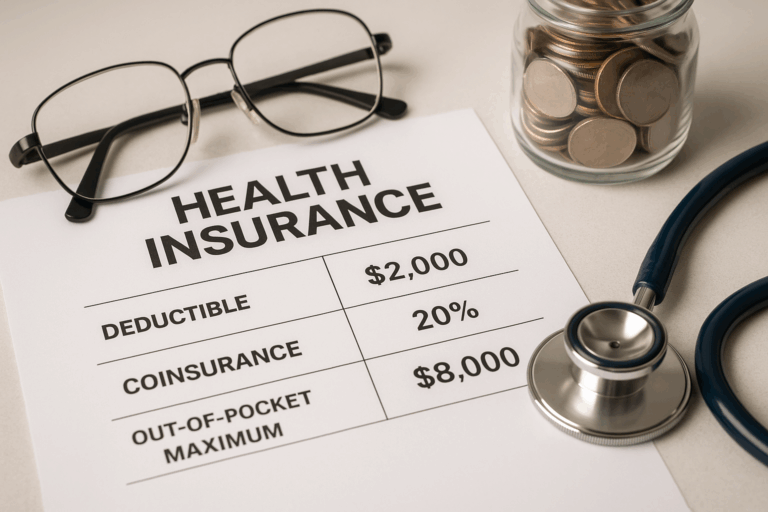
- Deductible ($2,000): Employee pays the first $2,000 of covered costs. Preventive care is exempt. Some plans exempt primary care copays from the deductible as well
- Copay ($25/$50): A flat fee paid per visit — $25 for primary care, $50 for specialists. On some plans, copays apply before the deductible is met. On others, the full deductible applies to all services
- Coinsurance (80/20): After the deductible is met, the plan pays 80% and the employee pays 20% of covered costs. On a $10,000 surgery after a $2,000 deductible: the employee pays $2,000 (deductible) + $1,600 (20% of remaining $8,000) = $3,600 total
- Out-of-pocket maximum ($9,450): The absolute cap on what the employee pays in a plan year. Once reached, the plan covers 100% of covered costs for the rest of the year. The 2026 ACA maximum is $9,450 for individual coverage
- How they stack: Deductible → coinsurance → out-of-pocket max. Employee pays the deductible first, then shares costs through coinsurance, until total out-of-pocket spending hits the maximum. After that, the plan pays everything
Frequently Asked Questions
What is a good deductible for employer-sponsored health insurance?+
For mid-market employers, a “good” deductible balances premium savings with employee accessibility. Most land between $1,500–$3,000 for individual coverage. The key metric is the deductible-to-salary ratio — employees earning under $50,000/year generally need deductibles under $2,000 to maintain plan utilization, while higher-compensated employees can absorb $3,000–$5,000 deductibles when paired with HSA contributions.
Does a higher deductible always mean lower premiums?+
Generally yes — raising the deductible by $500 typically reduces premiums 8–12%. But the relationship isn’t linear. Going from a $1,000 to $2,000 deductible produces a larger premium reduction than going from $4,000 to $5,000. At higher deductible levels, the marginal premium savings flatten out while the employee cost exposure continues to grow. Run the math before assuming a higher deductible saves money on a total-cost-of-care basis.
What is the IRS minimum deductible for an HSA-eligible HDHP in 2026?+
For 2026, the IRS minimum deductible for HSA-eligible high-deductible health plans is $1,650 for individual coverage and $3,300 for family coverage. Maximum out-of-pocket limits are $8,300 for individual and $16,600 for family. HSA contribution limits are $4,300 for individual and $8,550 for family coverage, with a $1,000 catch-up contribution allowed for employees age 55 and older.
Should our company offer an HDHP with HSA or a traditional PPO?+
Offer both and let employees choose. Companies that offer only an HDHP risk low satisfaction among employees with chronic conditions or families with high expected utilization. Companies that offer only a PPO miss the premium savings and HSA tax advantages. The most effective mid-market strategy is a dual-option plan: a PPO for employees who value lower out-of-pocket costs and an HDHP with employer HSA contributions for employees who want lower premiums and long-term savings.
How do deductibles work for families on employer health plans?+
Family deductibles come in two structures: embedded and aggregate. With an embedded deductible, each family member has an individual deductible threshold (say $2,000) within the larger family deductible ($5,000). Once one member hits $2,000, the plan starts paying for that member — even if the family total hasn’t been reached. With an aggregate deductible, the entire $5,000 family deductible must be met before the plan pays for anyone. Embedded is better for families with one high-utilization member. Aggregate is cheaper but riskier.
Disclaimer: This article is for informational purposes only and does not constitute financial, legal, or insurance advice. Health plan design requires individualized analysis based on workforce demographics, claims history, and regulatory requirements. Consult with a licensed insurance advisor or employee benefits consultant for guidance tailored to your organization.