


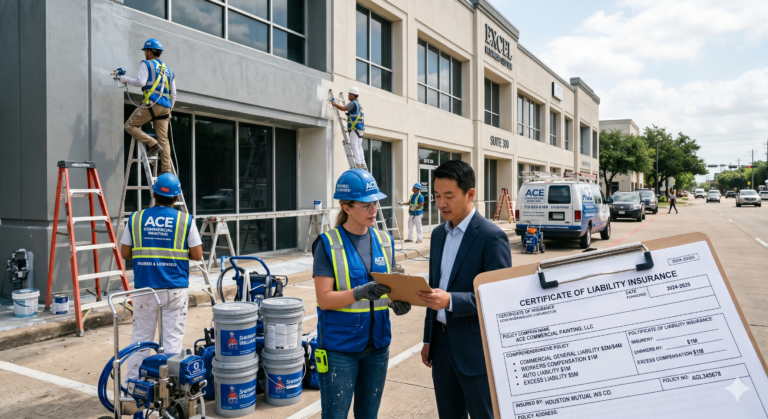
Commercial Painting Insurance Cost: 2026 Pricing by Revenue Tier
For a commercial or industrial painting contractor, total insurance program cost runs from roughly $38,000 to well into six figures, depending on crew size, project scope, and the type of work performed. That is a fundamentally different cost structure from the $42-to-$80-per-month quotes that dominate search results aimed at solo residential painters.
At the higher revenue tiers, workers compensation, commercial auto, and excess liability drive most of the premium. For additional guidance, explore our resource on personal umbrella coverage. General liability is a relatively small portion of the total cost for large painting operations, but it is the coverage most contracts require first. We cover this topic in depth in our commercial umbrella coverage resource. Our analysis of vendor insurance requirements
Key Takeaways
- Small operators: Solo painters and 2-3 person crews pay $2,000 to $6,000 per year for GL plus basic coverage
- Mid-size contractors: 10-50 employees typically pay $15,000 to $60,000 annually across GL, WC, auto, and umbrella
- Large commercial contractors: 50+ employees with industrial projects pay $60,000 to $200,000+ depending on payroll and project types
- Workers comp: The largest single premium item for painting contractors, driven by payroll and trade classification
- Lead paint and abatement: Contractors performing lead abatement face significantly higher GL and pollution liability premiums
What Drives Painting Contractor Insurance Costs
Painting contractor insurance is priced on a combination of trade classification, payroll, revenue, claims history, and the specific types of work performed. For additional guidance, explore our resource on PEO insurance. The difference between residential interior painting and industrial coating application is enormous in underwriting terms.
Five factors determine where a painting contractor’s premium lands.
- Trade classification code: Interior painting, exterior painting, industrial coating, bridge painting, and lead abatement each carry different ISO classification codes with different base rates per $1,000 of payroll
- Payroll size: Workers compensation premium is calculated directly from payroll. A 20-person crew at $50,000 average salary generates $1M in payroll exposure, driving WC premiums significantly higher than a 5-person operation
- Height and hazard exposure: Exterior work requiring scaffolding, lifts, or rope access carries higher rates than ground-level interior work. Industrial painting on elevated structures, tanks, and bridges is in the highest-risk classification tier
- Lead paint and hazardous materials: Contractors certified for lead abatement under EPA RRP rules face additional pollution liability requirements and higher GL rates due to the health exposure risks
- Claims history and experience modification rate: A three-to-five-year clean loss run earns the best pricing. Workers comp experience modification rates above 1.0 increase premiums proportionally, and rates below 1.0 create savings
Cost Breakdown by Revenue Tier
Painting
These are typical annual insurance program costs by tier.
- Solo operator ($50K-$150K revenue): $1,500 to $4,000 per year. GL is the primary cost. Workers comp may not be required if the operator has no employees, depending on state law. Commercial auto for one vehicle adds $1,200 to $2,500
- Small crew (3-10 employees, $250K-$750K revenue): $6,000 to $20,000 per year. Workers comp becomes the largest line item at this tier. GL, auto, and inland marine for equipment round out the program
- Mid-size contractor (10-50 employees, $1M-$5M revenue): $15,000 to $60,000 per year. Umbrella or excess liability is needed to meet contract requirements at this scale. Fleet auto costs increase with vehicle count
- Large commercial/industrial (50+ employees, $5M+ revenue): $60,000 to $200,000+ per year. Workers comp dominates at this scale. Industrial coating and bridge painting classifications carry the highest rates. Pollution liability is often required
- Enterprise contractors ($20M+ revenue): Six-figure to seven-figure annual programs. Wrap-up (OCIP/CCIP) participation on large projects, dedicated risk management, and self-insured retention programs become relevant at this tier
Workers Compensation for Painting Contractors
Workers compensation is typically the largest single insurance expense for painting contractors with employees. The premium is calculated by multiplying payroll by the classification rate, then adjusting for the contractor’s experience modification factor.
Key factors that shape painting contractor WC costs.
- Classification rates: Interior painting rates run $3 to $8 per $100 of payroll in most states. Exterior painting with height exposure runs $8 to $15. Industrial coating and bridge painting can exceed $20 per $100 of payroll
- Experience modification rate: A mod below 1.0 reduces the premium proportionally. A contractor with a 0.80 mod pays 20% less than the base rate. A mod above 1.0 from prior claims increases costs, and mods above 1.25 make it difficult to find competitive coverage
- State-by-state variation: Workers comp rates vary significantly by state. Texas does not require WC for most employers but most commercial contracts mandate it. California, New York, and Florida have among the highest painting classification rates
- Safety programs: Documented safety programs, regular toolbox talks, and OSHA compliance records help with carrier pricing and can reduce the experience mod over time by preventing claims
- Subcontractor management: Uninsured subcontractors’ payroll gets added to your workers comp audit, increasing your premium. Certificate verification and written sub agreements prevent this
For a deeper look at WC requirements specific to painting trades, see our painting contractor workers compensation guide.
Tenants often underestimate what they stand to lose — our guide to the benefits of renters insurance covers what the policy protects. For more details, see our guide on renters insurance and vehicle theft.
Liability extends beyond business operations — our guide to personal liability insurance explains individual coverage options.
General Liability and Additional Coverages
General liability is the coverage most GCs and property owners require first, but for painting contractors it is usually a smaller portion of the total insurance spend than workers compensation.
GL and supporting coverages that painting contractors need.
- General liability: Covers third-party bodily injury and property damage from painting operations. Overspray damage to vehicles, neighboring properties, or building components is the most common GL claim for painters. Our painting contractor GL guide covers coverage details and endorsements
- Commercial auto: Covers work trucks, vans, and trailers used to transport crews and equipment. Fleet size directly drives the premium. See our commercial auto guide for painting contractors
- Inland marine: Covers spray equipment, lifts, scaffolding, and other mobile equipment. Standard property policies do not cover tools and equipment at job sites
- Umbrella or excess liability: Extends GL, auto, and employers liability limits above the primary policies. Most commercial painting contracts require $2M to $5M in total limits, which typically requires an umbrella. Our umbrella cost guide covers pricing
- Pollution liability: Required for lead abatement, industrial coating removal, and work involving hazardous materials. Standard GL excludes pollution claims
How to Reduce Painting Insurance Costs
Painting contractors cannot control classification rates or state-mandated workers comp minimums, but they can manage the variables that insurers use to price within those classifications.
Five strategies that reduce painting contractor insurance costs.
- Maintain a clean loss run: Three to five years of claims-free history earns the best rates from every carrier. Small claims under $5,000 that could be paid out of pocket should be weighed against the long-term premium impact of filing
- Verify subcontractor insurance: Every uninsured sub’s payroll flows to your workers comp audit. Require certificates of insurance before any sub starts work and verify them
- Bundle coverages: Packaging GL, auto, and property with one carrier typically produces 8% to 15% savings over placing each separately
- Invest in safety: OSHA 10 or 30-hour training for crew leaders, documented safety meetings, and fall protection programs reduce claims frequency and improve the experience mod over time
- Market the program annually: The current insurance market rewards competitive shopping. Carriers that declined your class two years ago may be writing it aggressively now. An independent broker markets to multiple carriers simultaneously
For a complete overview of all coverages painting contractors need, see our commercial painting contractor insurance pillar guide.
Frequently Asked Questions
How much does painting contractor insurance cost per year?
Total annual cost ranges from $2,000 to $6,000 for solo operators, $15,000 to $60,000 for mid-size contractors with 10-50 employees, and $60,000 to $200,000+ for large commercial and industrial painting operations. Workers compensation is the largest single cost component for any contractor with employees.
Why is painting contractor insurance more expensive than other trades?
Does a painting contractor need pollution liability insurance?
If you perform lead paint removal, abatement, or work with industrial coatings that contain hazardous materials, yes. Standard general liability excludes pollution claims. Even contractors who encounter lead paint incidentally during prep work should consider pollution liability coverage, particularly on pre-1978 structures. The financial mechanics of this coverage are explored further in our dental cleaning costs without insurance guide.
What is an experience modification rate and how does it affect painting insurance cost?
The experience modification rate compares your actual workers comp claims history to the expected claims for your classification. A mod of 1.0 is average. Below 1.0 reduces your premium proportionally, and above 1.0 increases it. A contractor with a 0.80 mod pays 20% less than the base rate, while a 1.30 mod pays 30% more. It is the single most controllable factor in workers comp pricing.
Disclaimer: This article is for informational purposes only and does not constitute insurance, legal, or financial advice. Premium ranges are general market estimates and not quotes. Actual premiums are determined by the carrier based on your specific risk profile. Consult our licensed advisors for guidance specific to your painting operation.
Painting Contractor Insurance Programs
Hotaling structures complete insurance programs for commercial and industrial painting contractors including GL, workers comp, auto, and umbrella coverage.
Request a ConsultationKey Takeaways
- Total program cost: $38,000-$250,000+: A commercial painting contractor’s full insurance program (GL, WC, auto, umbrella, inland marine) scales with crew size, revenue, and project scope
- Workers comp is the largest line item: At $4.85-$7.20 per $100 of payroll for painting classification codes, WC typically runs 40-55% of total premium for labor-intensive operations
- Subcontractor certificates matter: Using uninsured subs transfers their exposure to your GL policy — carriers audit for this and can retroactively charge premium or deny claims
- Loss runs drive renewals: Three years of clean loss runs can reduce total program cost by 15-25% at renewal versus a contractor with frequency claims
- Annual carrier marketing saves 10-18%: Painting contractor insurance has wide carrier-to-carrier pricing variance — we routinely see $30,000+ spreads between highest and lowest quotes on the same risk
Case Study: Industrial Coatings Contractor Saves $47,000 by Restructuring Program
A 45-employee industrial painting and coatings contractor operating across Texas and Louisiana was paying $186,000 annually for their insurance program — all with a single carrier they’d used for 6 years. Our advisors submitted the risk to 9 carriers, identified that their workers comp classification was incorrect (they were rated as structural steel painters instead of building painters, a $2.10 per $100 difference), and restructured the deductible on their commercial auto from $1,000 to $5,000 per occurrence. New program: $139,000 annually — a $47,000 savings (25.3%) with identical liability limits and improved inland marine coverage for their spray equipment.
Frequently Asked Questions
How much does general liability insurance cost for a painting contractor?+
GL premiums for painting contractors range from $2,500-$8,000 annually for a small residential crew to $15,000-$45,000 for a commercial or industrial operation. The primary rating factors are annual revenue, number of employees, project types (residential vs commercial vs industrial), and claims history. Industrial painting and coating operations pay more because of the exposure to property damage from overspray, chemical hazards, and work-at-height liability.
Do painting contractors need pollution liability insurance?+
Commercial and industrial painting contractors should carry pollution liability. Standard GL policies exclude pollution-related claims, and paint products — particularly industrial coatings, epoxies, and lead-containing materials — create environmental exposure. A standalone pollution policy or a pollution buyback endorsement on GL typically costs $1,500-$5,000 annually. If you’re working on government contracts, schools, or healthcare facilities, pollution coverage is usually contractually required.
What workers comp classification codes apply to painting contractors?+
The primary NCCI codes are 5474 (painting — interior or exterior, residential or commercial) and 5482 (painting — structural steel, bridges, and tanks). Code 5474 rates range from $4.85-$6.50 per $100 of payroll. Code 5482 rates range from $7.20-$12.40 per $100 because of the height and chemical exposure. Getting classified under the correct code is critical — a misclassification can cost $15,000-$40,000 in excess premium on a $1M payroll.
Can a painting contractor reduce insurance costs without cutting coverage?+
Yes. The most effective levers are maintaining 3+ years of clean loss runs (15-25% savings at renewal), implementing a formal safety program with documentation (5-10% credit from most carriers), using certificates of insurance to verify all subcontractors carry their own coverage (prevents your GL from picking up their exposure), and marketing the program to multiple carriers annually through an independent broker. We also recommend adjusting physical damage deductibles on commercial auto — most contractors carry $1,000 deductibles when their cash position can easily absorb $2,500-$5,000.
Does a painting contractor need commercial auto insurance?+
If you use any vehicle for business purposes — transporting crews, hauling equipment, driving to job sites — you need commercial auto, not personal auto. Personal auto policies exclude business use, and a claim denial during a job-related accident can be financially catastrophic. Commercial auto for a painting contractor with 3-5 vehicles typically runs $4,000-$12,000 annually depending on vehicle values, driver records, and radius of operations. For full coverage details, see our painting contractor commercial auto guide.
Get Competitive Painting Contractor Insurance Quotes
We shop Hartford, Travelers, Zurich, CNA, and specialty construction carriers to build programs for commercial and industrial painting operations. From small crews to 100+ employee operations.
Request Contractor Insurance QuoteDisclaimer: This article is for informational purposes only and does not constitute financial, legal, or insurance advice. Consult with our licensed insurance advisors for guidance tailored to your organization.